Appendix A: The development of the 15th century Milan decks: an hypothesis.
My hypothesis links the Michelino deck of c. 1424 more closely with the Cary-Yale than has hitherto been done. It does this by considering the way that the Beinecke Library has catalogued the Cary-Yale. They group the triumphs by suits, as follows.
SWORDS: "Empress of Swords"; "Emperor of Swords"; "Love (Swords)".
BATONS: "Fortitude (Batons)"; "Faith (Batons)"; "Hope (Batons)".
CUPS: "Charity (Cups)"; "Chariot (Cups)"; "Death (Cups)".
COINS: "World (Coins)"; "Judgment (Coins)".
I emailed the Beinecke as to where this grouping came from, and what librarian said was that they had been catalogued that way by whoever did it for Cary. So we don’t know where it comes from. Let us suppose it reflects an original grouping.
One consequence of grouping the cards this way is that the deck would have only 4 suits, not 5. There is a precedent for this in the Michelino triumph deck, done for Philippo Visconti in 1424 or so. As can be seen in Trionfi’s chart on their “analysis” page for this deck, these cards can be grouped into 4 suits of 15 cards each, 4 gods and demi-gods plus 11 suit cards associated with particular birds.
Both the gods and the bird-suits are organized on the 4 themes of Virtues, Riches, Virginities, and Pleasures. One suit is Eagles, the bird of Jupiter and so of Virtues. The next is Phoenices, golden birds that burn up in a fire, like Riches. The chief god of this suit is Juno, whose bird is the Peacock. It is possible that Peacocks are somehow connected with Phoenices. They are both used in alchemy, to signify different stages of the Work. Turtledoves are the bird of pure, spiritual love, i.e. Virginities, led by Athena. (Recall here Shakespeare’s poem “The Turtle and the Phoenix.”) Doves are the bird of Venus, i.e. Pleasures.
This assignment of god-cards to suits does not mean that they are played any differently than they would be if they did not attach to suits. In the Michelino deck, Martiano’s manuscript says, “Each of the gods is higher than all the orders of birds and also higher than the kings of the orders.” So they probably acted like trumps. The division into 4 groups might be to help one remember their order in the hierarchy.
If we see the Cary-Yale in this 4-suited way, then the Cary classification into four groups, one for each of its suits, might help us reconstruct what cards are missing. The total number of triumph cards would have to be a multiple of 4. I think it is most natural to assume that each suit would have had 4, giving the deck as a whole a 4x20 structure. 3 is too few, as with one virtue present one would expect the other two, and there isn’t room for both; 5 is a lot.
If so, what is missing in Swords? To start with, let us proceed empirically. Let us look at the other extant early decks and see what they had in the cards before “Love” that isn’t here, and then do a kind of popularity contest, i.e. see which cards appear most frequently. When we do that, the Pope gets 3 votes (PMB, d’Este, Charles VI), the Bagatella 2 votes (PMB, d’Este), and the Popess 1 vote (PMB). So, tentatively we go with the Pope.
With the Pope, moreover, the four cards fit a grouping connected with the idea of swords, namely one of combat. The Empress and the Emperor are leaders in temporal combat, the Pope in spiritual warfare, and Love is the combat of the knights for the Lady’s favor.
We also have here the first of Petrarch’s triumphs, that of Love (for Petrarch see (http://petrarch.petersadlon.com/trionfi.html).
Next, Batons. In these middle sections, there are many possibilities: Justice, Hunchback, Wheel, Hanged Man, Temperance, Devil, Arrow (i.e. Tower), Star, Moon, Sun. My view is that we can eliminate Star, Moon, and Sun because iconographically in the PMB they are similar to Hope, Faith, and Charity. That is, Star, Moon, and Sun later on are just a redoing of Hope, Faith, and Charity here. (I can elaborate on this point if needed.) My pick in Batons would be Temperance, because Justice usually appears near the end in the early decks. And Temperance is a popular card: it appears in the PMB, the d’Este, and the Charles VI.
Another reason for picking Temperance is that it fits the Triumphs of Petrarch, as a tarot version of Chastity. Here it is self-control, i.e. Temperance, that triumphs over Cupid’s frequently unwise and disastrous passions.
Batons are Bastoni, sticks. They are the common man’s implement and weapon. The grouping is the common man’s virtues: temperance, fortitude, hope, and faith.
Next, Cups. The possibilities are Hunchback, Wheel, Hanged Man, Devil, and Arrow. Hunchback gets 2 votes (PMB, Charles VI), and so do Wheel (PMB, Brera-Brambilla), and Hanged Man (PMB, Charles VI). Either the Hunchback or the Wheel would do as a suitable representative of Petrarch’s Time. I would pick Wheel for two reasons. First, Trionfi has a good argument that Philippo Maria Visconti, as a user of crutches, would not have liked the image of the Hunchback. Second, the Brera-Brambilla was likely painted by the same artist as the Cary-Yale, as indicated by the similarity of the two Emperor cards. Since Brera-Brambilla has a Wheel, it is reasonable to assume that Cary-Yale does, too.
We now have four of Petrarch’s five triumphs: Love, chastity (as Temperance), Death, fame (as Chariot), and time (as Wheel). In the cards, Death appears after Chariot and Wheel in all the lists, unlike in Petrarch. Petrarch is being adapted to a different context.
Cups are the symbol of Religion. A suitable name for this grouping would be Mercies. Charity is God’s mercy, and humanity’s. The chariot represents fame, for which thanks are owed to God. The Wheel of Fortune giveth and taketh away, like God; each is a mercy. Death is a mercy for those bound for Heaven.
Finally, Coins. Here is where Justice goes. But we still need one more. My inclination would be the Fool. First, it frequently was listed at the end, even though it technically had no number. But at this point the cards didn’t have their customary numbers. And second, it is a very common card, appearing in PMB, d’Este, and Charles VI.
Perhaps World, as the New Jerusalem, represents Petrarch’s last triumph, Eternity.
The grouping here would be Rewards, only not monetary ones. Justice for all at the Last Judgment. And the New Jerusalem for the faithful, Hell for Fools.
So my proposal for the Cary-Yale is as follows. For our purposes, the order within suits does not matter: I am just trying to identify what the cards are.
SWORDS: Empress, Emperor, Pope, Love.
BATONS: Temperance, Fortitude; Faith, Hope.
CUPS: Charity, Chariot, Wheel, Death.
COINS: Justice, World, Judgment, Fool.
For our purposes, the order within suits does not matter: I am just trying to identify what the cards are. For mnemonic purposes there is a symbolic relationship between suit names and their associated triumphs, as in the Michelino: swords for Combats, batons for Virtues, cups for Mercies, coins for Rewards. Or some such thing.
Now for the PMB. My hypothesis accepts Trionfi’s idea of two stages for this deck, based on the two different artists for the deck. It could even be that the first stage only had 14 triumphs, as a fifth suit matching the 14-card regular suits. However the 4-suit principle suggests another approach.
It is possible that the first stage was merely a redoing of the four-suited Cary-Yale, only now with 14 cards per suit (no female pages or knights). In this scenario, in place of the 3 theological virtues, which are removed, there are put the 4 other cards that are in the PMB but not in the Cary-Yale: Bagatella, Popess, Hunchback, and Hanged Man. Here is what it might have looked like:
SWORDS: Bagatella, Empress, Emperor, Popess.
BATONS: Pope, Love, Temperance, Fortitude.
CUPS: Chariot, Wheel, Hunchback, Hanged Man.
COINS: Death, Justice, World, Judgment.
WILD CARD: Fool.
Again, the order within suits is not important for our purposes. But now the grouping idea doesn’t fit all the cards. While it still holds in a general way, people have to supplement the groupings with a different mnemonic device, such as an allegorical narrative going through all the triumphs.
Three of these cards--Temperance, Fortitude and World--do not currently exist in the hand of the first artist. Trionfi theorizes that they were not part of the deck at stage one at all. But two of these, Fortitude and World, did exist in the Cary-Yale. Moreover, Fortitude as Strength has a verbal association with the deck’s patron, a Sforza. Why would these cards be dropped? The only reason I can think of would be to fit a 5x14 layout.
The usual other explanation for the second artist is that these three cards were made (as well as the other three), but then were damaged and had to be redone. I can think of other explanations as well: Perhaps the patron wanted these 3 cards changed. Perhaps the first-stage World card was similar to the Cary-Yale card, which looks to me like something out of a Grail legend, fashionable in the 1440’s but not later. As for Fortitude, Galeazzo Sforza and his son owned a tame lion (my source is Gregory Lubkin, A Renaissance Court: Milan under Galeazzo Maria Sforza); perhaps he wanted to imply that he was the Hercules on this card that he called “Sforza.” As Lubkin documents, triumphs were an important part of Galeazzo’s court, with betting encouraged. As for Temperance, perhaps Galeazzo or some other Sforza wanted to put a particular woman on the card—or remove a particular woman that had been on the card.
The four-suit hypothesis has the virtue of accounting for the Fool’s unnumbered status as a natural part of the game. An unnumbered status for one of the cards would have been absolutely essential in a four-suited deck, as a 17th triumph put into one of the four suits would give it more cards than the others. The Fool, for symbolic reasons, is the natural choice. Admittedly the Fool could have gotten this status in others ways—as a novelty, perhaps, or solely in virtue of its symbolism. But it is by being the odd man out in a deck built on multiples of four that is the most natural, in a set of cards used primarily for gaming.
Then the second artist comes in and expands the deck. He and his patron agree on how to redo the three objectionable cards and how to make the Star, Moon, and Sun cards, which combine Ferrara’s themes with the iconography of the old Hope, Faith, and Charity. The deck now has the 20 triumphs we associate with the PMB, detached from the 4 suits.
Meanwhile, people do play cards in Ferrara. Trionfi documents 70-card decks in 1457, at the time of Galeazzo Sforza’s visit. But were they made on Milan’s specifications or Ferrara’s? On 2 August Galeazzo Sforza writes home to his father that he played cards and tennis with Francesco Pico della Mirandola when it rained” (Lubkin p. 309). Francesco Pico is the father of two boys Galeazzo's age. The game would have been triumphs, and the players probably included the two older Pico brothers, and possibly the Picos’ cousin Matteo Boiardo. If the year given by Tarotpedia for Boiardo's birth is correct, he was the same age as the elder Pico boy. From the order for 70-card decks, we may infer that the deck they used probably had a 5x14 structure. Such a structure is also compatible with the Cary collection's cataloguing of the 8 d'Este triumph cards--it not identify the 8 surviving d’Este triumphs with particular suits at all, and there appear to have been 14 cards per suit. Perhaps Galeazzo took a deck home with him. But it is still a Ferrara deck, not necessarily the same as a Milan deck.
Appendix B: The 22 trumps in terms of Pico della Mirandola's Christian Kabbalah.
Here I will explore possible correlations between Pico's presentation of Christian Kabbalah, of which he is the first known exponent, and the tarot of that time, 1486 and the years closely following. Even if Pico had no direct influence on the cards, he might have influenced how informed esotericists in the 16th and 17th centuries interpreted them. According to scholars today, his work was highly influential well into the 18th century.
In the years around 1486, when Pico published his “Cabalistic Conclusions” as part of his 900 Theses, it is not clear how many triumphs there were or what their precise order was. The “Steele Sermon,” from the latter half of the 15th century, lists 22, in an order that departs from the familiar one in several instances (http://www.tarotpedia.com/wiki/Sermones_de_Ludo_Cum_Aliis). Early 16th century orderings offer other alternatives (http://l-pollett.tripod.com/cards26.htm).
Another possible number of triumphs then is 21, based on the numbers that were written after they were made on some cards in some decks (http://www.tarotforum.net/showthread.php?t=28920&page=1&pp=10). As we saw in the previous Appendix. in the Charles VI or "Gringonneur" deck, the Sun is numbered 18 and the World 19, leaving the Angel as the last numbered triumph, 20. However the decks could have expanded to 22 shortly after these numbers were added. I will apply Pico’s work in a spirit of flexibility, seeking the order and cards that fit his work rather than any preconceived arrangement of the cards.
For interpreting Pico, we are fortunate since 1998 in having S.A. Farmer's Syncretism in the West: Pico's 900 Theses (1486), a translation accompanied by concise and helpful notes. It is a welcome addition to the meager comments by E.A. Waite (in his Holy Kabbalah) and Eliphas Levi (cited in Waite).
There are two Kabbalist sections in the 900 Theses. The first set contains 47 conclusions “according to the secret doctrine of the Hebrew Cabalist Wisemen.” The second set has 72, his own opinions, "confirming the Christian religion using the Hebrew Wisemen's own principles."Farmer's notes on these sections benefit from the ground-breaking 1989 study by Chaim Wieszubski, Pico della Mirandola's Encounter with Jewish Mysticism. Wieszubski in turn was following the lead of a 17th century commentary on Pico, by Jacques Gafferel in 1651. He used sources mentioned by Reuchlin in his 1517 Art of Kabbalah. Reuchlin in turn had actual contact with Pico. I will say more about these earlier understandings of Pico at the end of this essay.
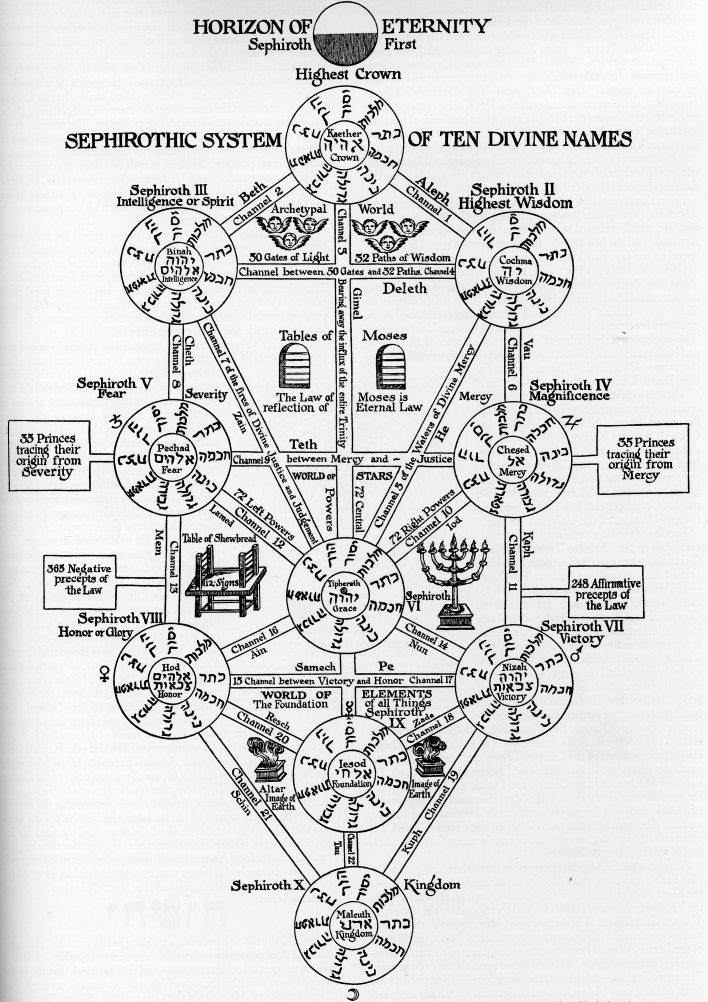
Pico did not express himself specifically in terms of paths between sefiroth. He did mention “32 paths,” 10 for the sefiroth and 22 for the letters (Syncretism 345). Pico nowhere had a systematic account of the letters. When he did mention particular letters, it was in connection with specific Hebrew words; e.g. he associated Beth with Binah, which begins with that letter. He gave no indication of assigning letters to paths between sefiroth. His image of the Tree may not even have had such lines. Moreover, his work shows no direct knowledge of the Sefer Yetzirah or the Zohar, although he would have known of them from other works that cited them.The only picture of the sefirotic Tree I have seen from that period, on the frontispiece to the Portae Lucis, 1516 (http://www.digital-brilliance.com/themes/tol.php), shows 15 paths between sefiroth. That text itself, even in its Hebrew version (the Sha'are Orah, or Gates of Light, trans. Avi Weinstein) speaks of light or energy flowing down from above through the various sefiroth, but implies no more than those in the picture. For example, it says that Yesod unites the two flows from the right and the left, receiving from both sides. Hod and Netzachin n turn receive the flow from the other side by way of Tiferet, and therefore not from each other. That is exactly what is expressed in the Portae Lucis's frontispiece.

It is theoretically possible that Pico and others knew of 22 paths up the Tree of Life (for the soul to ascend, after perhaps 10 down from En Sof). But as far as I can determine, it was in the middle of the 16th century, in Palestine, part of the Turkish Empire, that the doctrine of the 22 paths first appeared in writing, buried in the voluminous writings of Moses Cordovera, c. 1550. . Here is Cordovero's version of the tree, corresponding to his description (Essential Kabbalah p. 42f), as it appears on Jewish websites today:

There are not only 22 paths, but 3 horizontals, 5 verticals, and 12 diagonals, the same groupings as in the Sefer Yetsirah (3 elements, 7 planets, 12 signs of the zodiac). Was the application of these three groupings to the Tree something new or something that was already familiar to Jews in places like Italy? We may never know. Some of Cordovero's works were published in Venice, 1584-1587 (http://en.wikipedia.org/wiki/Moses_ben_Jacob_Cordovero). But until Kircher, 1653, I suspect that most Christians would have known only the Tree of the Portae Lucis, a work that was later reprinted as part of an anthology. By then Cordovera's work was already superseded among Jewish Kabbalists by Isaac Luria's.
Cordovero's Tree, even though it has 22 paths and the same 3-7-12 grouping as the one Kircher published (saying he got it from an Italian Jewish source), is closer to Pico's understanding of Kabbalah and the 15- pathed Tree of the Portae Lucis, than it is to Kircher's. I will start with the Portae Lucis. What is important is that it expressly excludes any paths to Malkhuth except the one through Yesod. Malkuth there is isolated from the rest of the sefiroth. In case one could not recognize this point in the author's dense, mystical prose, it is in Ricci's introduction to his translation:
As long as he inhabited the garden of pleasure, the first Adam knew all these ten sephiroth ...by contemplation of mind, without the dictate of the Law. But when...at the stimulation of the serpent and Eve, he ate of the tree of knowledge of good and evil, he did not cut around its skin; he cut off a twig from its proper root, and he separated Kingdom from Foundation. (Blau, The Christian Interpretation of the Cabala of the Renaissance (1944) p. 53)It is only through circumcision, the power of which is attributed to Yesod, that Kingdom is rejoined to Foundation. Foundation is thus Kingdom's only link to the rest of the tree.
Pico seems familiar with this point when he says of Kingdom that it was "severed from the other shoots by Adam's sin" (900 Theses 28.4), and that Foundation is "eighth day, circumcision" (28.32) and "redeemer" (11>21). For Christians, this point is important, because St. Paul had said that with Christ, circumcision was no longer needed. Christ took the place of circumcision as the believer's sole access to salvation.
Cordovera, too, insists that there is only one path to Malkuth, the one from Yesod.
Malkhut receives solely from Yesod, through whom she received from them all. Without him, she cannot receive from any of them...(Matt, The Essential Kabbalah, p. 43).
Yet Kircher's tree, the one that has become more accepted by tarot theorists, has Malkhut connected to the rest of the tree by three paths, to Hod and Netzach as well as Yesod! (For a somewhat larger version, see (http://www.digital-brilliance.com/themes/Kircher-ToL.jpg.)
For our purposes here, the differences among these Trees does not matter. My only reason for bringing them up is to show how different 15th-17th century Christians' understanding of Kabbalah was than later.
Here is my version of Pico’s Tree. The numbers, Hebrew names, and first word or phrase are from Farmer's commentary, adapting Scholem (Kabbalah, 1974). The other words, after the semi-colon, are from Pico or his sources, which I will document and expand on in what follows and use later for correlations to the tarot cards.
1 Kether (crown; Father, Empyrean)
3 Binah (intelligence; upper woman, mother , Firmament) 2 Hokhmah (wisdom; intellect, upper Christ, PM)
5 Din (judgment; Mars, demons) 4 Hesed (love/piety in Pico; Abraham, Jupiter)
6 Tiferet (beauty; inferior Christ, Sun, combiner of fire and water, “shining mirror,”)
8 Hod (majesty; Venus, inferior conversion ) 7 Nezah (endurance; Saturn, superior conversion)
9 Yesod (foundation; Mercury, generation, redeemer “sold for silver”)
10 Malkhut (kingdom; Moon, “lower woman,” “unshining mirror”)
Whatever other Cabalists say, I say that the ten spheres corresond to the ten numerations like this: so that, starting from the edifice, Jupiter corresponds to the fourth, Mars to the fifth, the sun to the sixth, Saturn to the seventh, Venus to the eighth, Mercury to the ninth, the moon the tenth. Then above the edifice, the firmament to the third, the primum mobile to the second, the empyrean heaven to the tenth [sic]. (Farmer p. 541)Farmer explains that "Whatever other Cabalists say" is a "disclaimer", meaning that he is not reporting what others say, but giving his own view (p. 518). By "numerations" Pico means the sefiroth (p. 540). By "edifice" he means the fourth through tenth sefiroth (p. 540). And "Pico's correlation in 11>48 of the empyrean heaven with the tenth sefirah--rather than with the first, as we would expect--was probably a slip" (p. 540). I would say it is almost certainly a slip.
So now let us go down the tree sefirah by sefirah. The first three of Pico's sefiroth are the "superior" ones. The 1st is Crown, Father, Ehyweh (Syncretism p. 523), Empyrian (p. 541), and the indwelling (p. 545).
The 2nd is Wisdom, Christ, Intellect, Bereshit, procession, and the primum mobile (pp. 349, 356, 536f, 541).
The 3rd is Intelligence, repentance (pp. 355, 533), Reason (549), the firmament (541), the “great north wind” (348f), the “great jubilee” (351), “mother of the world” (351), "green line" (532), and the "upper woman" (353), who unites with 6, Tiferet, and by whom the realms below are created. The “great jubilee” is a reference to the apocalypse, according to Farmer.The 4th is Piety, Love, Abraham, water (all p. 538), the southern water (355), and Jupiter (541). We are now in the “inferior sefiroth,” to which Pico assigns names of planets.
The 5th is Judgment, North Wind, Magical Power, Mars, superior anger, northern fire, and also demons like Satan and Lilith, who come when judgment is too harsh or a Cabalist errs in his work (pp. 354f, 525, 539, 541).
The 6th is the Ineffable Name, clemency, Christ in the inferior world, Beauty, the Sun, the shining mirror, free choice, procession, Heaven, and the combining of water and fire (pp. 347, 541, 542, 545, 539, 549).
The 7th is the North, to whom is addressed petitions to be granted (Syn. 541; for Wirszubski, p. 146f, this echoes Isaiah 43:6). It is also Endurance, Eternity and Saturn; it effects the conversion to superior things (Syncretism pp. 541, 549).
The 8th is the South, to whom petitions are addressed not to prohibit something; it is also Majesty, Venus, and the conversion to inferior things. (pp. 541, 549)
The 10th is Kingdom, the Kingdom of David (p. 357), the Keneset Israel, the Moon, Adonai, the Holy Spirit (523), "universalized bride," (Syn. 358f), night (354), "lower woman" (353), the “daughter of the voice” (362), and the “sea to which all rivers run,” the Shekhinah (357f). It is also the "unshining mirror" (355), cut off from the other sefiroth by Adam’s sin (347), whose goal is mystical unity with the 6th sephiroth, Christ, the “shining mirror” (542f).
Pico also has correspondences between the sefiroth and the 10 commandments (p. 541) and the 9 beatitudes (p. 547), things that later Kabbalists and tarot theorists did not pay much attention to.
Now for correlations to the cards. The most straightforward way of making correlations is simply to assign cards to sefiroth using the Ferrarese tarot order at that time. Fortunately, we know it from the Steele Sermon (http://www.tarotpedia.com/wiki/Sermones_de_Ludo_Cum_Aliis.
1. Crown, Empyrean: Bagatella/Justice
3. Intelligence, Firmament: Emperor/Sun 2. Wisdom,First Moved: Empress/Angel
5. Judgment, Mars: Pope/Star; 4. Love, Jupiter: Emperor/Moon
6. Beauty, Sun: Pope/Arrow
8. Majesty, Venus: Chariot/Death; 7. Endurance, Saturn: Love/Devil
9. Foundation, Mercury: Hunchback/Hanged Man
10. Kingdom, Moon: Wheel/Fortitude
Well, this doesn't work very well. Symbolically, many items don't fit together. For most of 2 through 8, neither the cards nor the planets fit the sefiroth as Pico would have known the symbolism.
But the order of the trumps didn't stay the way they were in Ferrara late 1400s. By at least the time of the Catelin Geoffrey, 1557, they had taken the familiar Marseille order. There were also other names for the sefiroth, from Pico and also Reuchlin, that connect better to the cards. With that order, what we have is this:
1, Crown/Empyrean: Bateleur/Judgment
3. Mother, Firmament: Empress/Moon; 2. Wisdom, First Moved: Popess/Sun
5. Severity, Mars: Pope/Arrow 4. Goodness, Jupiter: Emperor/Star
6. Beauty, Sun: Love/Devil
8. Praise, Venus: Justice/Death 7. Victory, Saturn: Chariot/Temperance
9. Foundation, Mercury: Hunchback/Hanged Man
10, Kingdom, Moon: Wheel/Fortitude
This set of correspondences works much better. The only place I see a problem is with 7 and 8. Saturn goes better with Death than with Temperance. So we switch the positions of Saturn and Venus, as follows
There is the question of whether people in those days would have had the same understanding of Kabbalah as the one I have presented. I think the answer is vaguely affirmative, up to themiddle of the 17th century. In the early 16th century, the main work developing Pico was Reuchlin’s The Art of Kabbalah, 1517. He has something like Pico’s list of the sefiroth. The Jewish works he enumerated were much the same ones that Farmer cites for Pico. He relied heavily on Ricci's Portae Lucae of a year earlier. So using Reuchlin and Ricci as a guide, one could get something very like the interpretation that I have summarized from Pico. In another blog, "The Latin Sefiroth" (http://latinsefiroth.blogspot.com/) I have summarized Pico, Reuchlin, Ricci, the Portae Lucis, and Agrippa for each sefirah.
By the mid-17th century, there was even a commentary on Pico, by J. Gafferel, Richileu's librarian, published in Paris, 1651 (Syncretism, 344). He used the same Hebrew source, in the same Latin translation, that Wieszubski (and hence Farmer, my own basis) used in his interpretation (and which Reuchlin cites, too), namely Recanati’s 14th century Commentary on the Pentateuch, which was Pico’s main source in his “Conclusiones.”
The only change in the planetary attributions that might have been made is in the positions of Saturn and Mars. Kircher's version of the Tree in 1667 (http://www.digital-brilliance.com/themes/Kircher-ToL.jpg) has them switched. That is the case also in several alchemical versions of the Tree as well, showing Mars and Venus opposite each other and Jupiter and Saturn opposite each other. In that case, the 5th sefirah, corresponding to the Pope, would be Saturn, and the 7th, corresponding to the Chariot, would be Mars. Considering that the Charioteer is a young man and the Pope usually old, that would have been a congenial modification.
In the 17th century was also the important work by von Rosenroth, Kabbala Denuta, which inroduced the Latin-speaking world to the Zohar and Isaac Luria. From what I have read (in secondary sources), von Rosenroth used the planetary sequence that starts with the primum mobile and ends with Malkuth as Earth. That one does not fit the tarot as well as Pico's. It was the Kabbalah Denuta and a bowlderized Sefer Yetzirah, of course, that influenced the late 19th century's application of Kabbalah to the tarot.
I suspect that Gafferel, as well as Agrippa, Reuchlin, and Pico himself, were more influential on tarot interpreters before the 18th century than the later influential von Rosenroth. Unfortunately (according to WorldCat). Gafferel currently is accessible only in Latin and only in a few libraries. I cannot see any influence of the tradition started by Pico on the "Kabbalah" of the French occultists of the 19th century. Waite, in his Holy Kabbalah, dismisses Gafferel out of hand, and only deals with Pico’s first 47 Theses. After a very inadequate attempt at translation, he finds them mostly obscure and does not seem even to have noticed the more important second 72.Appendix C: Matteo Boiardo's late 15th century poem, on 11 virtues and 11 vices.
Matteo Boiardo, older cousin of Giovanni Pico della Mirandola, wrote a poem that seems to describe, or perhaps propose, a tarot deck with four suits plus 22 triumph cards. Particularly challenging are Boiardo's 22 verses at the end, each of which describes a person from the Bible or from Greco-Roman myth or history, relating him or her to a particular virtue or vice. Tarot researchers at Trionfi once attempted to link these verses with the 10 sefiroth of Kabbalah, (there used to be a link at http://trionfi.com/0/h/, by clicking on the line "Interpretation of the Boiardo Deck-in a Scheme of Kabbala; but that no longer works). Tarotpedia gives the poem as a whole, both original and translation, at http://www.tarotpedia.com/wiki/Boiardo. Trionfi's mapping of the virtues and evils onto the Kabbalistic Tree of Life and the tarot trumps in their traditional "Marseille" order was at http://www.geocities.com/autorbis/boiardo.html; but that link no longer works. As a whole, it was not well thought out, but it did stimulate my own thinking.
Here I will identify another possible source for Boiardo's pairings of virtues and evils in his poem, developing a suggestion made by Trionfi (on the page now inaccessible). They mentioned a division between 10 "good sefiroth" and 10 "bad kelipoi." The problem is how to get the specific pairings that Boiardo uses: the Jewish descriptions are all pretty general. I think they come from Tractate XIII of the Corpus Hermeticum, of which Marsilio Ficino's Latin translation was published in 1471. That book was widely read at the time and in fact held, on St. Augustine's authority, to date from before Moses. Another possible place Boiardo could have read this list was in Pico della Mirandola's 900 Theses, in particular the 9th and 10th theses on Hermes Trismegistus, which refers to the list in Tractate XIII and attempts to relate it to "10 evil leaders in Cabala." Pico's 900 Theses were published on 8 December 1486. Trionfi estimates that the poem was written shortly before a wedding in Ferrara in January of 1487.
What Pico wrote is as follows:
27.9. Within each thing there exist ten punishers: ignorance, sorrow, inconstancy, greed, injustice, lustfulness, envy, fraud, anger, malice.Pico's reference in Thesis 27.9 is to Corpus Hermeticum XIII.7-8. (http://www.gnosis.org/library/hermes13.html). A dialogue is occurring between a student, Tat, and Hermes Trismegistus:
27.10. A profound contemplator will see that the ten punishers, of which the preceding conclusion spoke according to Mercury, correspond to the evil order of ten in the Cabala and its leaders, of whom I have proposed nothing in my Cabalistic conclusions, because it is secret.(Farmer, Syncretism in the West, p. 343).
"Do I have tormenters within me?”
“More than a few, my child; they are many and frightful.”
“I am ignorant of them, father.”
“This ignorance, my child, is the first torment; the second is grief; the third is incontinence; the fourth, lust; the fifth, injustice; the sixth, greed; the seventh, deceit; the eighth, envy; the ninth, treachery; the tenth, anger; the eleventh, recklessness; the twelfth, malice. These are twelve in number, but under them are many more besides, my child, and they use the prison of the body to torture the inward person with the sufferings of sense."
Here Hermes lists 12 “tormentors." What Pico has done is to reduce the 12 of the Tractate to 10, so as to correspond to the 10 punishers he has read about in Kabbalah. Farmer says this reduction is "forced." Yet there is some textual justification for such a reduction in the Tractate. For Hermes Trismegistus goes on to say:
This tent – from which we also have passed, my child – was constituted from the zodiacal circle, which was in turn constituted of [ ] entities that are twelve in number, omniform in appearance. To mankind’s confusion, there are disjunctions among the twelve, my child, though they are unified when they act. (Recklessness is not separable from anger; they are indistinguishable.) Strictly speaking, then, it is likely that the twelve retreat when the ten powers (the decad, that is) drive them away.So at least some of the powers appear as "disjunctions," meaning "either this or that." So recklessness and anger are two expressions of the same power, which can be driven out by the same good power. No other examples are given. Pico probably assumed that two other of the last four evil powers also make up one disjunction, treachery and malice being inseparable. Thus 12 in one system, considered 12 because of the zodiac, can be considered 10 as well. Another pair of similar powers are Incontinence and Lust; but instead of removing one, Pico interprets Incontinence as Inconstancy.
Now let us compare these powers to Boiardo's. Ignorance corresponds to Boiardo's Error or Doubt; Sorrow corresponds to Secrecy (the verse is about a man's secret love); both Incontinence and Lust correspond to Desire; Pico's Inconstancy corresponds to Error; Greed corresponds to Chance (the Wheel of Fortune mentioned in the poem); Injustice corresponds to Disdain (Herod's unjust killing of Mariamne) or Peril (the assassination of Julius Caesar); Envy doesn't correspond; Fraud or Deceit is the same as Boiardo's Deception; Anger/Recklessness corresponds to Disdain (Herod's anger against the one he loved, resulting in his overhasty murder of her); Treachery/Malice is what was involved in Caesar's assassination, Boiardo's Peril. Two remaining Boiardo evils are Idleness and Time; neither matches any "punishers" in Pico, although they are standard Renaissance motifs. At the same time, we have matched two of Boairdo's tormentors, Peril and Disdain, to four of Pico and Hermes'. But overall the match-up is fairly good, 8 or so out of 10.
Having enumerated the 12 tormentors, Hermes describes how they may be driven out by 10 powers of God, described in a manner similar to Kabbalistic descriptions of the sefiroth. Then the soul will be capable of rebirth:
“To us has come knowledge of god, and when it comes, my child, ignorance has been dispelled. To us has come knowledge of joy, and when it arrives, grief will fly off to those who give way to it. The power than I summon after joy is continence. O sweetest power! Let us receive her too, most gladly, child. As soon as she arrives, how she has repulsed incontinence! Now in fourth place I summon perseverance, the power opposed to lust. This next level, my child, is the seat of justice. See how she has expelled injustice, without a judgment. With injustice gone, my child, we have been made just. The sixth power that I summon to us is the one opposed to greed – liberality. And when greed has departed, I summon another, truth, who puts deceit to flight. And truth arrives. See how the good has been fulfilled, my child, when truth arrives. For envy has withdrawn from us, but the good, together with life and light, has followed after truth, and no torment any longer attacks from the darkness. Vanquished, they have flown away in a flapping of wings.”
The 10 good powers are knowledge of god, joy, continence, perseverance, justice, liberality, truth, the good, life and light.
Now I think we can be more precise about the correspondences. between Corpus Hermeticum XIII and Boiardo's poem, regarding their pairs of virtues and torments.
Two of Hermes' virtues and vices don't correspond: Justice driving out Injustice and Good driving out Envy--although a case could be made that Justice/Injustice corresponds to both 6 and 7, Caesar's and Mariamne's murders, driven out by Psyche's Patience and Rhea's Experience. In Boiardo, the virtues that don't correspond to Hermes are Endurance, driving out Laziness, and Oblivion, driving out Time. So again the match is about 8 out of 10.
Also, in the first of Boiardo's paired stanzas, the tormentor is not always driven out by the virtue. In Boiardo, the torment is always opposed by the virtue, but not always defeated. However it will be easier to follow the parallels if I use the same verbs each time.
Here is the line-up again, this time going stanza by stanza through the Boiardo poem.
(1) Lazyness kept Sardanapalus idle between feathers,
Lustful concubines and banquet,
For so long that he lost the habit of reigning.Hyppolita endured such efforts, that she is the only [one]
Of the amazons who is crowned by merit:
And her name still flies in Scythia and in Greece.
Boiardo's Endurance opposing Laziness does not correspond to anything in Hermes or Pico.
(2) Actheon was inflamed of love for an heavenly
Person, so much that he was transformed in[to a] deer:
So a man should not put his desire too high.Reason made Laura triumph over the perverted
Child Cupidus, because she never moved
Her eye from virtue nor misplaced her foot.
Boiardo's Reason driving out Desire corresponds to Pico's unspecified virtue driving out Lustfulness, or Hermes' Perseverence driving out Lust There is also Hermes' Continence driving out Incontinence.
(3) Antiochus was so secret, that he almost
Died for his love for Stratonica.
But the kind physician helped him effectively.Grace does not go by chance, but with reason,
To the discreet and wise, for in love can be proud
He that hides his strongest passion.
Boiardo's Grace driving out Secrecy corresponds to Hermes' Joy driving out Sorrow. In the poem Secrecy is a source of Sorrow. I think the sense of the last line and a half of the 2nd stanza is, "...for with love can be pride, /With him who hides the strongest passion" ("ché con amore ha il vanto /Colui che asconde le passion piu forte.")
(4) Anger filled king Herod so muchBoiardo's Patience driving out Anger corresponds to Hermes' Light driving out Recklessness/Anger. Psyche, of the lamp with which she viewed Cupid at night, is a symbol of Hermetic Light. The 1st stanza, starting in the 2nd line, would read better as "...That he ordered the killing of Mariamne; then /He calls to her..." (Che fatta occider Marianna, poi /La chiama").
That he ordered to kill Mariamne than
He calls her, and crying suffers with love.
Psyche was patient in what happened to her,
And because of that she found help in her troubles,
And in the end she was made a Goddess, so that she can be an example for us.
(5) An error make Jabob [Jacob] a slave for seven years,Boiardo's Perseverence driving out Error corresponds to an unspecified virtue in Pico, certainly Constancy, driving out Inconstancy, or less well, Hermes' Continence driving out Incontinence (mixed with Perseverence driving out Lust). Penelope's suitors' Error was in thinking Ulysses dead. Jacob and Penelope did not succumb to Error, but overcame it by remaining Constant and Persevering.
Because he did not speak of Rachel to Laban;
But time repaired all his damage.
In Penelopes [Penelope] there was such perseverance,
That, by weaving and undoing her web,
She deserved to rejoin her beloved Ulysses.
(6) Egeus made for himself a cruel doubt,Boiardo's Faith driving out Doubt corresponds to Hermes' Knowledge of God driving out Ignorance. (Boiardo can't talk about Hermetic Gnosis, smacking of heresy, only Christian Faith.)
So that he was quick to seek death in the sea,
As soon as he saw Theseus come back with black sails.
Sophonisba was faithful to Massinissa
Beyond doubt, because she promised to drink poison
If she were forced to follow the triumph.
(7) Nesso deceived when he said to Dianira:Boiardo's Wisdom driving out Deception corresponds to Hermes' Truth driving out Deceit.
Give this cloth with blood to Hercules,
If it ever happens that you have to fight for love.
In Hipermestra, as in a cunning snake,
There was wisdom because wearing the clothes of a woman
She saved her husband who was bloodless with fear.
(8) Chance fell on Pompeyus, that for many yearsBoiardo's Modesty driving out Chance corresponds to Hermes' Generosity driving out Greed. Aemelia meets Scipio's taking of his opportunity, and her own opportunity for vengeance, with a modest, silent Generosity. In the last line, I would prefer "Because, when she found him with a maid, /She did not talk of his sin in order not to make it public" ("..ché, trovato con l'ancilla, /Tacque el peccato per non dargli nota"). That translation fits the classical source and the point of the stanza. See Wikipedia article on Aemilia Tertia. In the translation, "Aemilia" should probably be left with that spelling, as in the original, since references to her in English are spelled that way. "Pompeyus," however, in English is usually spelled "Pompey.")
Had seated at the top of the wheel,
But in the end fortune submerged him with troubles.
Emilia, the faithful wife of Scipio, showed
Modesty; because when she found him with a maid,
He did not talk of his sin not to make it public.
(9) A spark brings danger of a big fire:Boiardo's Experience driving out Peril corresponds, in the context of his examples, to Hermes' Life driving out Treachery/Malice. The person called "Scilla" in the original in English is called either "Scilla" or, more commonly, "Sulla."
See how Caesar was killed in the senate
By only two people; after he survived the anger of Silla [Sulla].
Experience was in Rhea, who after hiding
Jove in mount Ida, ordered to make noise [noise-making]
So that he could not be found because of his crying.
(10) Time, you that hurry men to death,Boiardo's Oblivion driving out Time does not correspond to anything in Hermes.
You saved Nestor, and if in the end he came to an end,
It seems impossible to think of such a life.
Oblivion, you are the end and boundary
Of all, you took to Lethe Elice and Dido,
And among your ruins you have fame and time.
Hermes' Good driving out Envy doesn't correspond to anything in Boiardo. Hermes' Justice driving out Injustice doesn't correspond to anything specifically in Boairdo, although it could apply generally to both 4 and 9.
Then in Boiardo there is an 11th torment and virtue at the beginning and end of the section: Fortitude, Boiardo's last virtue, may or may not drive out the World, his first torment. These don't correspond to anything in Hermes or Pico.
Since Boiardo in every case follows Pico's changes to Hermes, it seems reasonable to conclude that Boiardo's poem, at least in its final form, came after Pico's Theses, which he wrote in 1486 and published in that year on either 7 November (Grofton Black, Pico's Heptaplus and Biblical Hermeneutics 2006, p. 7) or 7 December (Farmer, Syncretism in the West 1998, p. 3).
Thus there is a fairly close match up between the torments in Hermes/Pico and the evils in Boiardo. The general idea of powers of God driving out torments comes from Hermes, and about 8 out 10 of the actual correspondences, allowing for the difference between Hermetic virtues and Christian ones. Boiardo is adapting Hermes to the Christian setting of his particular time and place.
From Pico’s hints, it is possible that Boiardo was also be intending an allusion to Kabbalah. There are 10 sefiroth. Trionfi assigned stanzas to sephiroth at the now inaccessible http://www.geocities.com/autorbis/boiardo.htm. Did Boiardo actually intend such assignments? If we match up the 10 pairings to the names of the 10 sefiroth, which sometimes contain the names of virtues, the results are not promising, as we shall see.
Another possibility, also explored in the table below, is a correlation between the pairings and the planets associated with the sefiroth. Since planets are associated with Greco-Roman gods who have various virtues and vices embedded in their myths, such assignments give us more flexibility. The problem here is that there are many different possible orderings of the planetary spheres of traditional Ptolemaic astronomy.
One is the sequence used by Christian sources such as Dante's Paradiso (c. 1320) and the author of the "tarocchi of Mantegna"(c. 1470). There are 10 "spheres": first, the Empyrean, next the Primum Mobile or "first moved," then the Firmament of fixed stars, and then the 7 planets from Saturn to the Moon.
Another is the sequence found on many Kabbalah websites today. It starts with the Primum Mobile ("First Moved," as opposed to the Primer Mover) followed by the Firmament, then the 7 planets, and ends with the Earth. Roob has a picture which he says dates from c. 1400 Italy and implies, by his side-comments, that it has such a schema. All I see is Hebrew labels for the ten circles around the earth, not the earth itself.
The sequence starting with the Primum Mobile and ending with the earth is often termed the "Lurianic" sequence, because it was popularized by Isaac Luria, who died in 1572. I will call it that, although it probably did not originate with Luria.
As far as I can tell (and as argued by Tishby, in Wisdom of the Zohar, the most extensive and respected study of the Zohar yet made), the Zohar itself never correlated any of the sefiroth specifically with the earth. The Zohar's "supernal palace" section (Wisdom pp. 597-613) does correlate "seven sacred halls" of the "supernal king" (p. 597) with the Moon (alluded to according to Tishby, footnote p. 598) and other planets, but that is al. (Saturn is mentioned by name on p. 599; Jupiter on p. 602; the sun on p. 607; Venus on p. 509). There is not even a consistently developed "four worlds" theory in the main body of the Zohar, which is developed in the supplemental Raya Mehemna and Tikkunei ha-Zohar. Even there, Tishby says:
The four worlds represent cosmic systems above the terrestrial level. The Massekhet Azilut (Treatise on Emanation), which was writtten in the fourteenth century, and which contains a more fully developed version of this theory, is based on passages in the Raya Mehemna and the Tikkunei. Later Kabbalists, particularly Rabbi Isaac Luria and his school, combined these different and contrary elements. The world of making in their view was the abode of wheels, husks, spheres, and human beings; hence they included the earth as well. (Wisdom of the Zohar p. 558)A third possibility is Pico's, as already quoted, which may or may not come from a Jewish source (since he says "Whatever other Cabalists may say..."). The first 3 are the same as the Christian sequence, but then the planets start with Jupiter, and Saturn is between the Sun and Venus. This one ends with the Moon.
Pico's is very close to another set of assignments, that of Athenaneus Kircher in 1667, allegedly obtained from a Jewish source (see http://www.digital-brilliance.com/themes/Kircher-ToL.jpg). The only difference, as I have said in the previous section, is that Mars and Saturn switch places.
In addition, Jewish alchemists had other sequences that included the metals (in Scholem, Alchemie und Kabbala, pp. 84-88). For the present let us work with just the three most prominent ones--Christian, Lurianic, and Pico's--whose orders are given below. (I will ignore the so-called translation of the Sefer Yetsirah by the Golden Dawn, which has no correlation to anything except their own wishes. See http://www.psyche.com/psyche/yetsira/sy_astro.html. That site's own set of correspondences is just as unhistorical, in the sense of not following any known pre-19th century tarot order; but at least it makes no such claims.)
Looking in Jewish sources other than the Zohar for medieval correspondences between sefiroth and planets, all I could find was Tifereth to the Sun and Malkuth to both the Moon and the Earth. This suggests that medieval Jewish Kabbalah may have used something like Pico's order of the spheres, as well as other ones, and definitely not the "Christian" one, because in that system Tifereth would correlate to Mars.
For each Boiardo pairing, I give in the first line the sefirah name & meaning. In the next line I have the Boiardo pairing, and the Pico/Hermes pairing. In the third line I give first the "Christian" planetary sphere, then the "Lurianic" one, and finally Pico's. After that I discuss the appropriateness of each of the three correspondences to the pairings.
Here I have tentatively assigned the two remaining pairings in Pico and Hermes to the remaining two in Boiardo that don't correlate, based on the traditional association of Envy with the lowest planet and Justice with God.
In assessing the appropriateness, one basis I will use is the assignment of vices given in Tractate I of the Corpus Hermeticum. This essay was probably the most widely read of all the Hermetic writings. This list imagines the soul at death rising to each sphere in turn and depositing there the appropriate vice, thus lightening its load and ascnending to the next sphere. First is "the energy of increase and decrease," which I interpret as fortune and its vice of envy; 2nd, "evil machination," i.e. Plotting; 3rd, "the illusion of longing," i.e. Lust; 4th, "the ruler's arrogance"; 5th, "unholy presumption and daring recklessness"; 6th, "the evil impulses that come from wealth," i.e. Greed; and 7th, "the deceit that lies in ambush" (Copenhaver, Hermetica, p. 6). All of these vices are repeated in Tractate XIII except arrogance.
At the end I add up the total number of appropriate Christian correspondences, Lurianic correspondences, and Pico correspondences, to see which fits best overall.
(1) Kether, Crown.
Boiardo: Laziness vs. effort, Pico/Hermes, possibly Justice vs. Injustice.Laziness suggests lack of motion, a property of the Empyrian, as the Aristotelian Unmoved Mover. The Empyrian, the level of God, is also the source of final Justice, in contrast to earthly injustice. Since motion characterizes the Primum Mobile,or "first moved," that one fits less well. So this one favors Pico and the Christians.
Christian sphere: Empyrian; Lurianic sphere: Primum Mobile; Pico's: Empyrian.
(2) Hokmah, Wisdom;
Boiardo: Desire vs. Wisdom, Pico/Hermes: Lust vs. Perseverence.Desire is what makes the Aristotelian "First Moved" move: the desire to attain God's perfection, the archetypes toward which all things strive. Such striving is the essence of Wisdom. In Boiardo's poem it is a man who suffers from Desire, and it is a masculine sefirah. Again, Pico and the Christians correlate better.
Christian sphere: Primum Mobile. Lurianic: Firmament or Fixed Stars. Pico's: Prmum Mobile.
(3) Binah, Understanding.
Boiardo: Secrecy/Sorrow vs. Grace. Pico/Hermes: Grief vs. Joy.This level in Christian astrology is also called the Ogdoad, the Eighth. It is the place we strive to attain in order to see the divine beyond. It is the place of Paradise, hence of Joy. However negatively, Saturn was known for secrecy in the Renaissance; h was "evil lying in wait"; he was also the source of hidden Wisdom. However Binah is also a feminine sefirah, as are Grace and Joy (Voluptas). Pico and the Christians have a slight edge, so I give them a full point and the Lurianists half a point.
Christian sphere: Firmament. Lurianic: Saturn. Pico's: Firmament.
(4) Hesod, Love.
Boiardo: Anger vs. Patience. Pico/Hermes: Anger vs. Light.Love and Mercy are characteristics of Jupiter rather than Saturn. Anger is best represented in Mars, but it is also Jupiter's lightning-bolt. Pico and the Lurianists win here.
Christian sphere: Saturn. Lurianic: Jupiter. Pico's: Jupiter.
(5) Gevurah, Judgment.
Boiardo: Error vs. Perseverence. Pico/Hermes: Inconstancy vs. Constancy.Judgment and Power are the sword of Mars, and also an attribute of Jupiter as ruler. But Perseverence is a soldier's virtue, inconstancy his vice. So Pico and the Lurianists win here.
Christian aphere: Jupiter. Lurianic: Mars. Pico's: Mars.
(6) Tifereth, Beauty, Compassion.
Boairdo: Doubt vs. Faith. Pico'Hermes: Ignorance vs. Knowledge of God.Beauty is the attribute of Apollo, leader of the Muses, as opposed to warlike Mars. The Sun as a symbol of God correlates with Hermes' Knowledge of God and Boiardo's Faith, as well as the Jewish Compassion. Again, we have Pico and the Lurianists.
Christian sphere: Mars. Lurianic: Sun. Pico: Sun.
(7) Netsach, Endurance.
Boiardo: Deceit vs. Wisdom. Pico/Hermes: Fraud vs. Truth.Endurance is a quality of the Sun as ever-recurring. of Venus as the source of the generations, and of Saturn as an old man. Deceit is a quality of both Venus and Saturn. Wisdom is a quality of Saturn. Pico and Luria get a full point, Christians half a point.
Christian sphere: Sun. Lurianic: Venus. Pico's: Saturn.
(8) Hod, Majesty.
Boiardo: Chance vs. Modesty. Pico/Hermes: Greed vs. Generosity.In Boiardo's second story we are dealing with the opportunity to satisfy lust, and the wife's generosity, It is the sphere of Venus. Mercury, who hates Venus's temptations, would not be so generous! What correlates is Pico and the Christians. The Moon, as the governor of Fortune, fits Boiardo's first story, but it is not an option here.
Christian sphere: Venus. Lurianic: Mercury. Pico's: Venus.
(9) Yesod, Foundation.
Boiardo: Danger vs. Experience. Pico/Hermes: Treachery vs. Life.In Boiardo's stories, Caesar loses because of Fortune more than Inexperience. However Rhea wins out over danger because of her cleverness and experience. If the Moon governs Fortune and Mercury governs cleverness, we have a draw here.
Christian sphere: Mercury. Lurianic: Moon. Pico: Mercury.
(10) Malkuth, Kingdom.
Boiardo: Time vs. Oblivion. Pico/Hermes: possibly Envy vs. Good.If envy is the vice, then the Moon is the planet that correlates. Earth is the domain of the Shekinah, as the presence of God in the world and the protector of Israel; yet as the Shulamite of the Song of Songs, she is the dark Moon to her beloved's Sun. In Christianity, too, she is the Moon, identified with Diana and the Moon, to Christ's Sun. This one is a toss-up.
Christian sphere: Moon. Lurianic: Earth. Pico: Moon.
If we count the toss-ups as counting for all three, then the score is Christians 6.5, Jews 6.5, and Pico 10. I conclude that Boiardo probably based himself on Pico's assignment of the planets and extra-planetary spheres, but in a very free way.


No comments:
Post a Comment