3. The Empress: O Dionysos Dimetor, born of two mothers, may your mothers conceive us and your grandmothers keep us safe.

As a Christian image: The shield with its eagle, present in even the earliest versions of the card (Cary-Yale, above left, PMB, above right), identifies her with the Holy Roman Empire. Until the early 1400's its flag had a black eagle on a gold background. (1)
The connection with the card is probably as follows. In 1395 the Visconti rulers of Milan had been made Dukes by Wenceslaus, King of the Romans, who flew this flag. He would have been emperor if there had been a universally agreed upon Pope to declare him such. During this time of the Great Schism, the safest course was not to offend any of the three claimants to the title. Fortunately Wenceslaus did have the title of "King of the Romans," which made the Viscontis' elevation legitimate. To have that eagle on the card, then, is at least to display one's pedigree as a legitimate vassal of the Emperor. (2)
If the card dates from the time of Filippo Visconti, then the model for the card is probably Barbara of Hungary, wife of Emperor Sigismund.
After that, the PMB may have assimilated her to the Duchess, Bianca Maria Visconti, illegitimate daughter of Filippo. There would have been a good political reason for doing so. Wenceslaus's granting of the title only applied to the legitimate heirs of the Viscontis, and male ones at that. Bianca Maria was neither. Her title of Duchess was one given to her by the citizens of Milan and not confirmed by any higher authority. Putting her on the card with the Imperial eagle would be a declaration of legitimacy not only for her but for her husband the Duke, who wasn't even of noble blood.
Thus the single-headed eagle reaches into the past, from before the cards existed. In the mid-15th century, the Holy Roman Emperor was using the double-headed eagle. No emperor declared the Sforza rulers of Milan Dukes until 1493. At that time, the Empress would be Bianca Maria Sforza, granddaughter of Bianca Maria Visconti. She married the Emperor himself, Maximilian I, in 1492. Duke and Empress finally had the right to fly the imperial eagle. But the single eagle was already a fixture of the card. (3)
In most of the Marseille-style cards, including the one on the so-called Cary Sheet, the Empress's eagle faces opposite to the Emperor's. If placed side by side with the Empress on the right, they would be looking at each other, and together their eagles would make up the Empire's double eagle.
In all the decks the shield is on her lap, the place a child would be. The Empress, the female representative of secular authority, is essentially a mother. It is her womb that secures the future stability of the world, by providing an heir. And what is true of kingdoms is also true in the family. The cross above the circle on her scepter signifies that secular authority works in service to the cause of Christ. The green on the Visconti-Sforza card, rather unique, probably signifies the new life she generates. It uses the same symbolism as the folk song "Greensleeves," which was about the longings of sexual love.
Beyond these, the Empress's qualities are those reflected by Empresses historically, and especially those two early models, Duchess Bianca Maria Visconti and Empress Bianca Maria Sforza. Later empresses in turn might have affected how the Noblet and other "Marseille" style cards would have been seen. Thus the card would have positive and negative aspects as reflected in these historical personalities.

Bianca Maria Visconti (portrait above, by Bonifacio Bembo) was famous for her devotion to her husband, a man of common origin, even above her father. When her husband left her father's service after a demotion, she went with her husband to Venice and was written out of her father's will. Early on, still in her teens, she was put in charge of a region controlled by her husband during his absence, and acquitted herself well. Later, her husband broke with Venice, and Venice attacked while her husband was away. She put on armor and led the defense until the return of her husband, the preeminent military commander of his time. After their eventual triumphant return to Milan, she and her husband established hospitals and educational institutions. She bore five children, including two future dukes. Popular with her subjects, she opposed her son's arrogant style of rule after her husband's death and spent most of her short widowhood, only 2.5 years, in her dowry city of Cremona. She died soon after his wedding. Poison was suspected; but she had been sick even before the marriage. (4)

Bianca Maria Sforza (engraving above), 50 years later, exemplifies some of the negative aspects of the Empress. She was raised in Milan, perhaps the richest court in Europe. As Empress, she was required to live in Innsbruck, in a cold climate that she disliked, and with less money. She seems, judging from her letters, to have been focused on creature comforts and was continually asking for more money. Her husband probably had syphilis by the time of the marriage. He spent most of his time traveling without her and had numerous other children. She died childless at age 38, a pawn in a game of power politics from which no one seems to have benefited. (5)
The next empress, Isabella of Portugal, served as regent when her husband was away from Spain, as he often was. However she was merely a figurehead; actual power was in the hands of the Emperor's ministers. The Emperor was, to be sure, devoted to her; but her role was to project an image of authority and produce heirs. She died at age 36, shortly after the birth of her sixth child, with her husband in another part of his Empire. 11 years later her husband had Titian do her portrait. (6)

Some people see a resemblance between the Empress card and Giotto's portrayal of Justice. It is possible, since representatives of the Emperor would want to portray themselves as embodying that virtue. (7)
References for the Empress, Christian:
1. Images: Cary-Visconti, http://beinecke.library.yale.edu/dl_crosscollex/. Visconti-Sforza, Dummett, The Visconti-Sforza tarot cards. Eagle: websites differ on the exact date when the Empire switched to a double eagle; 1401 and 1433 are also given. 1410 is the date given on
http://flaggenlexicon.de/fdtlhi1r.htm.
2. Eagle connection: Stuart Kaplan, Encyclopedia of Tarot Vol 2. Wenceslaus: http://en.wikipedia.org/wiki/Wenceslaus,_King_of_the_Romans.
3. Bianca Maria Sforza: http://en.wikipedia.org/wiki/Bianca_Maria_Sforza.
4. Bianca Maria Visconti: http://en.wikipedia.org/wiki/Bianca_Maria_Visconti.
5. Bianca Maria Sforza: Gerhard Benecke, Maximilian I, an analytical biography. Image: http://aeiou.iicm.tugraz.at/aeiou.encyclop.b/b434322.htm;internal&action=_setlanguage.action?LANGUAGE=en.
6. Isabella of Portugal The world of emperor Charles V [proceedings of the colloquium, Amsterdam 4-6 October 2000], ed. Wim Blockmans and Nicollete Mout. Death: http://en.wikipedia.org/wiki/Isabella_of_Portugal. Image: http://reisserbilder.at/en/index.asp?aid=1019.
7. Giotto Justice: http://www.christusrex.org/www1/giotto/virtues.html.
Greco-Egyptian interpretation: The eagle takes on a different significance when applied to Egypt, as known during the 15th-17th centuries. It is the northern version of what in Egypt would have been the hawk or falcon, the god Horus, with which the Pharaoh identified himself. This association would have been known even in the 15th century, from Plutarch's description in his essay Of Isis and Osiris, section LI. In ancient images of Isis and Horus, the infant Horus sits on Isis's lap in the same way that Jesus would sit on Mary's lap in Christian art. Coins such as the one below would have been unearthed periodically in Italy. The shield, with its eagle, takes the place of the child. (1)

Similarly, the scepter takes the place of the stalk of wheat held by Isis as giver of the gift of grain, shown in the zodiac at Dendera as Virgo (above right). (In the Renaissance, the sheaf of wheat as such usually was given to Demeter.) In the middle above, I have put the Cary Sheet Empress in the middle. Her virginal youth and freshness seem to me to reflect the new empress of the 1490s, Bianca Maria Sforza. (2)
In the 17th and 18th centuries, the new "Marseille" version of the Empress is not much different from the Cary Sheet. Below are Noblet, c. 1650, and Conver, c. 1760. What I notice on all these cards, as opposed to the Cary-Yale and PMB, is that the back of the chair looks like a pair of wings. This could be a reference to Isis, who was described as taking the form of a vulture or kite. I do not know whether this identification was known at the time or not; I can't find it in Plutarch or Diodorus. At very much the same time and place as the Cary Sheet is assumed to have been done, there is Leonardo's childhood memory, in his diary, of being attacked by a kite ("nibbio," notoriously once mistranslated as "vulture") in his crib; but whether the bird's relationship to Isis was known, I don't know. Freud's analysis of the memory as a maternal image, despite the mistranslation, may not be off the mark. The vulture clearly was seen as a maternal image during this time, and the kite is just a particular kind of small vulture, which eats small live animals as well as carrion.
One association between Isis and the vulture might have been as equal representations of nature. Isis was seen as a personification of nature. This line has been developed by Hadot in his The Veil of isis: An Essay on the History of the Idea of Nature (in Google books). First there was the famous statue supposedly of Isis at Sais reported by Plutarch (http://thriceholy.net/Texts/Isis.html, sect. IX), with the motto "“I am all that hath been, and is, and shall be; and my veil no mortal has hitherto raised.” There was also the Roman philosopher Macrobius:
Then in the Renaissance explications of hieroglyphs, nature is associated with the vulture. Leon Alberti says, in his treatise on architecture, "The Egyptians employed the following sign language: a god was represented by an eye, nature by a vulture...". His source was a text by the Roman general Ammianus. Then in 1499 the anonymous Hypnerotomachia (Strife of Love in a Dream) also implies that a vulture represented nature, in its translation of a "hieroglyphic" inscription that the protagonist Porphilo sees. It shows, for its second image, an altar with 'on its face, the images of an eye and a vulture" (Godwin translation, p. 41). The second phrase of the "translation" reads "...to the god of nature..." Below I have reproduced the first line of the hieroglyphs and put under it the first line of what the novel says is their translation into Latin. The first hieroglyph is translated as "from your labors"; the second is "god of nature" followed by "freely" and "sacrifice" (the urn). The word order, of course, follows that of ordinary Latin.

After that, Ripa's image of nature (Nova Iconologia, Padua 1611 edition, image 222) is of a naked woman holding a bird. It is on her left side, like the Empress's shield.

Ripa says, in the first English translation:

For anyone who wanted to identify the Empress on the Marseille card with Isis, the cross and the circle together resemble Isis's Ankh, symbol of life (below). The Bembine Tablet, known in engravings from the time of the late 16th century, shows Thoth with an ankh. Then to the right, enclosed on a throne of honor, sits the goddess with her headdress of horns and sun. The horns bear some resemblance to the Empress's crown, for anyone who wanted to make the comparison. (3)

The "Bembine tablet," also known as the Mensa Isiaca, is from the Roman era; its pictures are indeed Egyptian. Erik Hornung, the noted Swiss Egyptologist, says:

References for the Empress, Christian:
1. Images: Cary-Visconti, http://beinecke.library.yale.edu/dl_crosscollex/. Visconti-Sforza, Dummett, The Visconti-Sforza tarot cards. Eagle: websites differ on the exact date when the Empire switched to a double eagle; 1401 and 1433 are also given. 1410 is the date given on
http://flaggenlexicon.de/fdtlhi1r.htm.
2. Eagle connection: Stuart Kaplan, Encyclopedia of Tarot Vol 2. Wenceslaus: http://en.wikipedia.org/wiki/Wenceslaus,_King_of_the_Romans.
3. Bianca Maria Sforza: http://en.wikipedia.org/wiki/Bianca_Maria_Sforza.
4. Bianca Maria Visconti: http://en.wikipedia.org/wiki/Bianca_Maria_Visconti.
5. Bianca Maria Sforza: Gerhard Benecke, Maximilian I, an analytical biography. Image: http://aeiou.iicm.tugraz.at/aeiou.encyclop.b/b434322.htm;internal&action=_setlanguage.action?LANGUAGE=en.
6. Isabella of Portugal The world of emperor Charles V [proceedings of the colloquium, Amsterdam 4-6 October 2000], ed. Wim Blockmans and Nicollete Mout. Death: http://en.wikipedia.org/wiki/Isabella_of_Portugal. Image: http://reisserbilder.at/en/index.asp?aid=1019.
7. Giotto Justice: http://www.christusrex.org/www1/giotto/virtues.html.
Greco-Egyptian interpretation: The eagle takes on a different significance when applied to Egypt, as known during the 15th-17th centuries. It is the northern version of what in Egypt would have been the hawk or falcon, the god Horus, with which the Pharaoh identified himself. This association would have been known even in the 15th century, from Plutarch's description in his essay Of Isis and Osiris, section LI. In ancient images of Isis and Horus, the infant Horus sits on Isis's lap in the same way that Jesus would sit on Mary's lap in Christian art. Coins such as the one below would have been unearthed periodically in Italy. The shield, with its eagle, takes the place of the child. (1)

Similarly, the scepter takes the place of the stalk of wheat held by Isis as giver of the gift of grain, shown in the zodiac at Dendera as Virgo (above right). (In the Renaissance, the sheaf of wheat as such usually was given to Demeter.) In the middle above, I have put the Cary Sheet Empress in the middle. Her virginal youth and freshness seem to me to reflect the new empress of the 1490s, Bianca Maria Sforza. (2)
In the 17th and 18th centuries, the new "Marseille" version of the Empress is not much different from the Cary Sheet. Below are Noblet, c. 1650, and Conver, c. 1760. What I notice on all these cards, as opposed to the Cary-Yale and PMB, is that the back of the chair looks like a pair of wings. This could be a reference to Isis, who was described as taking the form of a vulture or kite. I do not know whether this identification was known at the time or not; I can't find it in Plutarch or Diodorus. At very much the same time and place as the Cary Sheet is assumed to have been done, there is Leonardo's childhood memory, in his diary, of being attacked by a kite ("nibbio," notoriously once mistranslated as "vulture") in his crib; but whether the bird's relationship to Isis was known, I don't know. Freud's analysis of the memory as a maternal image, despite the mistranslation, may not be off the mark. The vulture clearly was seen as a maternal image during this time, and the kite is just a particular kind of small vulture, which eats small live animals as well as carrion.
One association between Isis and the vulture might have been as equal representations of nature. Isis was seen as a personification of nature. This line has been developed by Hadot in his The Veil of isis: An Essay on the History of the Idea of Nature (in Google books). First there was the famous statue supposedly of Isis at Sais reported by Plutarch (http://thriceholy.net/Texts/Isis.html, sect. IX), with the motto "“I am all that hath been, and is, and shall be; and my veil no mortal has hitherto raised.” There was also the Roman philosopher Macrobius:
Isis is the earth or beneath the sun. This is why the goddess's entire body bristles with a multitude of breasts placed close to one another [as in the case of Artemis of Ephesis], because all things are nourished by earth or by nature." Saturnalia I, 20, 18.)Hadot says that this text was cited by Cartari in his Images of the Gods of the Ancients, 1556. Another popular source was Apuleius, who imagined Isis speaking to his hero, "I come to you, Lucius, I mother of all nature, mistress of all the elements." (Metamorphoses XI, 5).
Then in the Renaissance explications of hieroglyphs, nature is associated with the vulture. Leon Alberti says, in his treatise on architecture, "The Egyptians employed the following sign language: a god was represented by an eye, nature by a vulture...". His source was a text by the Roman general Ammianus. Then in 1499 the anonymous Hypnerotomachia (Strife of Love in a Dream) also implies that a vulture represented nature, in its translation of a "hieroglyphic" inscription that the protagonist Porphilo sees. It shows, for its second image, an altar with 'on its face, the images of an eye and a vulture" (Godwin translation, p. 41). The second phrase of the "translation" reads "...to the god of nature..." Below I have reproduced the first line of the hieroglyphs and put under it the first line of what the novel says is their translation into Latin. The first hieroglyph is translated as "from your labors"; the second is "god of nature" followed by "freely" and "sacrifice" (the urn). The word order, of course, follows that of ordinary Latin.

After that, Ripa's image of nature (Nova Iconologia, Padua 1611 edition, image 222) is of a naked woman holding a bird. It is on her left side, like the Empress's shield.

Ripa says, in the first English translation:
She is naked, to denote the Principle of Nature, that is active or Form, and passive or Matter. The turgid Breasts denote the Form, because it maintains created Things; the Vultur, a ravenous Fowl, the Matter; which being alter'd and moved by the Form, destroys all corruptible Bodies. (http://emblem.libraries.psu.edu/Ripa/Images/ripa056a.htm)In such manner the vulture is associated with nature, and thence to Isis, Hadot hypothesizes, and I agree.

For anyone who wanted to identify the Empress on the Marseille card with Isis, the cross and the circle together resemble Isis's Ankh, symbol of life (below). The Bembine Tablet, known in engravings from the time of the late 16th century, shows Thoth with an ankh. Then to the right, enclosed on a throne of honor, sits the goddess with her headdress of horns and sun. The horns bear some resemblance to the Empress's crown, for anyone who wanted to make the comparison. (3)

The "Bembine tablet," also known as the Mensa Isiaca, is from the Roman era; its pictures are indeed Egyptian. Erik Hornung, the noted Swiss Egyptologist, says:
Its somewhat unusual representations clearly go back to original Egyptian forms, though the hieroglyphs have congealed into pure decoration and yield no comprehensible sense. The Mensa was apparently prepared in the first century C.E. and was part of the decoration of a Roman Isis sanctuary. (4)In the Renaissance, Aphrodite or Venus was pictured much like the images people had seen of Isis. We have already seen one instance, in relation to the Popess card, from the Hypnerotomachia. In another illustration, the priestesses of Venus worship at the shrine of Venus, on top of which is a large statue of Venus suckling Cupid. On the side we see Venus mourning the death of Adonis, like Isis mourning Osiris (or Mary mourning Jesus). The Renaissance would probably have recognized this image as Greek with Egyptian allusions. (5)

References, Empress, Egyptian:
1. Horus: See pictures at http://www.touregypt.net/featurestories/horus.htm.
2. Coin: Witt, Isis in the Ancient World, p. 228. Cary Sheet: http://beinecke.library.yale.edu/dl_crosscollex/. Dendera: Desroches-Noblecourt: Le Fabuleux Heritage de L'Egypte.
3. Images: Noblet, http://www.tarot-history.com/. 1760 Conver:
http://tarotchoco.quebecblogue.com/tdm-de-nicolas-conver-edition-du-bicentenaire-camoin-arcanes-majeurs/. Bembine Tablet: http://en.wikipedia.org/wiki/Bembine_Tablet.
4. Hornung: The Secret Lore of Egypt: Its impact on the West, p. 85f.
5. The Hypnerotomachia in English, trans. Jocylyn Godwin. On identification of Isis and Aphrodite/Venus, a web-page of the Metropolitan Museum of New York website, www.metmuseum.org/TOAH/
The Dionysian Empress: In the myth of Dionysus, the figure whose manner is most like the early tarot Empress is the Great Mother goddess Cybele. A goddess of Asia Minor, the Greeks identified her with Rhea, mother of Zeus and so Dionysus's grandmother. She sat on her throne regally and benevolently, with her lions next to her for protections. In the Cary-Yale card, two maids-in-waiting stand in the place of Cybele's lions. Cybele is a protector, too; she protected Dionysus against Hera, curing him of the madness Hera sent him, and in some accounts raising him. In other accounts she is his wife, like Isis was to Osiris. Besides lions, she is associated with the pine tree. In her myth, her lover Attis died under a pine tree, or was transformed into one. (1)

1. Horus: See pictures at http://www.touregypt.net/featurestories/horus.htm.
2. Coin: Witt, Isis in the Ancient World, p. 228. Cary Sheet: http://beinecke.library.yale.edu/dl_crosscollex/. Dendera: Desroches-Noblecourt: Le Fabuleux Heritage de L'Egypte.
3. Images: Noblet, http://www.tarot-history.com/. 1760 Conver:
http://tarotchoco.quebecblogue.com/tdm-de-nicolas-conver-edition-du-bicentenaire-camoin-arcanes-majeurs/. Bembine Tablet: http://en.wikipedia.org/wiki/Bembine_Tablet.
4. Hornung: The Secret Lore of Egypt: Its impact on the West, p. 85f.
5. The Hypnerotomachia in English, trans. Jocylyn Godwin. On identification of Isis and Aphrodite/Venus, a web-page of the Metropolitan Museum of New York website, www.metmuseum.org/TOAH/
The Dionysian Empress: In the myth of Dionysus, the figure whose manner is most like the early tarot Empress is the Great Mother goddess Cybele. A goddess of Asia Minor, the Greeks identified her with Rhea, mother of Zeus and so Dionysus's grandmother. She sat on her throne regally and benevolently, with her lions next to her for protections. In the Cary-Yale card, two maids-in-waiting stand in the place of Cybele's lions. Cybele is a protector, too; she protected Dionysus against Hera, curing him of the madness Hera sent him, and in some accounts raising him. In other accounts she is his wife, like Isis was to Osiris. Besides lions, she is associated with the pine tree. In her myth, her lover Attis died under a pine tree, or was transformed into one. (1)

Since the Greeks identified her with their goddess Rhea, she has another distinction: she is the mother of the first generation of Olympian gods. The difference between the Popess and the Empress is that the Popess is a priestess, originator or transmitter of the mysteries, whereas the Empress is the archetype of Mother. Most importantly, as her defining characteristic, she provides the egg from which the foetus develops, and the womb in which that development takes place. Then in the usual course she provides much of its foetus's nourishment and care both inside and outside the womb.
However Rhea is not the only mother in Greek mythology. Venus, too, is a mother, as we have already seen. There was also Demeter, mother of Persephone, who--like Isis in Greco-Roman times--was portrayed with a sheaf of wheat. She was goddess of the harvest and of the seasons. She, like Isis, was the personification of bountiful nature.
In the case of Dionysus, there are special factors. Dionysus was said to have had two mothers, hence his epithet Dimetor, Born of Two Mothers. According to Natale Conti, writing in 1551, Dionysus's epithet "Dimetor" meant that he was born from both Semele and Jupiter. Semele was the daughter of Cadmus, King of Thebes. Jupiter lusted after her and soon was pregnant by him. But jealous Juno implanted in her mind the desire to see Jupiter as he really was, as opposed to the way he showed himself. Jupiter had just promised her that he would grant any favor she had of him, in a way he couldn't get out of. The result was that Semele died in a lightning flash, and the foetal Dionysus was transplanted to Jupiter's thigh--perhaps a euphemism for testicles. Thus he had one birth as an immature foetus from Semele, and another as an infant from his father. Then he had to be hidden away where Juno couldn't find him and raised by nymphs. (2)
However he is not the only candidate for the position. Conti says that in one Orphic hymn in Dionysus is said to be the son of Isis. At the same time, he quotes another hymn in which he is the son of Jupiter and Proserpine. And others, Conti says, say he was the son of Jupiter and Ceres. Of these alternative accounts the one most elaborated (by others, not Conti) is that involving Persephone. In this version, the maiden changed into a snake after Jupiter went after her. Zeus changed into a snake, too, and had his way with her. When the child was born, Jupiter had to hide him from the jealous Juno; Zagreus was raised by nymphs, and Proserpine was given to his brother Pluto. But Juno found Dionysus's hiding place and set the Titans on him; they dismembered, boiled, roasted, and ate him. They they buried the heart (a euphemism for the penis, Kerenyi thinks); Jupiter ate it in a broth and impregnated Semele with Dionysus's spirit. (3)
To me the Marseille-style empresses (below, Noblet at lef, Conver 1760 at right) have a cluelessness about them that very much suggests the victimized Proserpine and especially the willful but mindless Semele. Like Semele, the Empress asks for more than is safe to get, to satisfy their illusions of invulnerability. And at the end of the line, Marie Antoinette gets the guillotine.
The stories of Dionysus's mothers are myths of trauma, trauma that we will see echoed in later cards. Yet we should not denigrate his mothers and cherish only the nurses and grandmother. The fertilization of the egg in the womb is what starts the process that ends as the creation of a new being. That is enough cause for anyone to honor their parents, however little contact.
It is possible that the card could be taken to represent Dionysus's wife Ariadne, who was reported to have borne him several children. However none of them had much renown, or were honored by the Greeks and Romans; nor are they mentioned by Cartari. Of Dionysus's children he only speaks of Priapus, Dionysus's son by Aphrodite/Venus. As mother, however, Aphrodite is universally associated with Cupid.

Empress, Dionysian:1. Cybele and Hera. For citations which would have been known in the Renaissance: www.theoi.com/Phrygios/Kybele.html. Also in Orphic Hymns: http://www.theoi.com/Titan/TitanisRheaKybele.html#Hymns.
2. Conti: pp. 269-272, 296 of Anthony Dimatteo's Natale Conti's Mythologies: A Select Translation. See http://www.theoi.com/Olympios/DionysosMyths.html#Birth, for numerous other citations about the birth from Semele and Zeus.
3. For the birth from Persephone, see http://www.theoi.com/Georgikos/Zagreus.html, and also the Orphic hymns.
The Alchemical Empress. Alchemically the Empress and Emperor are usually put at the end of the sequence, symbolizing the end product of the alchemical process. Near the beginning of the sequences, what corresponds are the King and Queen, usually together. They are almost always shown wearing the ordinary crowns of kings or dukes, as opposed to the ones topped with a cross worn by emperors and empresses. They are usually shown with pictures of the sun and moon next to them. So they are Sol and Luna, Apollo and Diana. Most are 17th century or later. Earlier are the illuminated Splendor Solis Augsburg 1532-35, the woodcut Rosarium Philosophorum of Frankfurt 1550, the woodcut Artis aurifrae of Basel 1572, and the woodcut Pandora of Basel 1582.
Sometimes the Queen holds the stalk of a plant instead of a scepter (Philosophia Reformata 1622, 1st series, emblem 24, http://www.hermetik.ch/eidolon/bilder/d ... 622_24.htm); and sometimes an eagle (1st series, 7, http://www.hermetik.ch/eidolon/bilder/d ... 622_07.htm). The stalk of wheat connects her to Isis and Demeter. The eagle connects her to the
Empress of the Holy Roman Empire. It is the royal bird.
With a few exceptions, the images are all variants on the Rosarium series, in which they are shown first clothed, then naked, then in coitus, then combined in one body in a watery tomb, which nonetheless undergoes a conceptio (emblem 7, http://www.labyrinthdesigners.org/wp-co ... rium_7.jpg); then it is raised on high in one body with wings, taken back to the tomb with the wings, and then raised on high again. I think all of these variations on the Rosarium apply more to the Lover card than to the Emperor and Empress, as the latter are shown by themselves.
That most of these illustrations derive from the Rosarium or are of the same era, suggests a 15th century origin or before, as that text existed in manuscript early in the century. The King and Queen as Sol and Luna or Sulphur and Mercury are—along with the dragon--among the earliest personifications in the alchemical literature.
Given that the alchemical imagery came first, could we say that the tarot Emperor and Empress derive from them? I do not know the answer to that question. There is no necessity that they have done so. The tarot antecedents are the manuscript and heraldic representations of actual or typical Holy Roman Emperors and Empresses. The alchemical illustrations derive from the same sources. But why say that one derives from the other?
I can think of only one argument in favor of saying that the tarot Empress and Emperor derive from the alchemical. Both sequences represent la transformative process by which one attains the immortal state. Both have royal personages near the beginning, with the imagery of secular authority. The tarot designers may have borrowed from the alchemical in choosing just these figures. It depends on what other figures then follow, and whether they have been borrowed as well.
But on the face of it, the two pairs have a different symbolic function. The tarot pair seem merely represent secular authority—authority in the material realm--worthy of honor, gratitude, respect and fear. The Empress is not Everywoman, or the feminine side of Everyman. The alchemical pair, I think, in part represent humanity in general in a state bound to materiality. The “Ripley Scrowle” of 1588 shows Sol and Luna in the typical bath of the Rosarium series, but also at the foot of the Tree of Knowledge. A female serpent-woman hangs from the upper branches of the tree.

The King and Queen, in the early stages of the Work, are simply Adam and Eve both as lords of the earth and its slaves. It is a condition from which the Work can help free them. It is like in the fairy tales, where the king is under enchantment as a frog, a fox, or a wild man. It is materiality that enchants us. There is something similar between the tarot story and the alchemical one, in that both have to do with the liberation of humanity from materiality. But the tarot Emperor and Empress are not the alchemical Adam and Eve.
In other respects, the tarot Empress, as symbolizing nature and motherly nurturing, has her alchemical counterpart in numerous illustrations. (And here we must forget about influence, except in the sense that the meaning of either, in the milieu in which they were both produced, affects that of the other.) One example is in Emblem XXXV of Maier's Atalanta Fugiens (image taken from Wikimedia Commons):

I will quote what Robert O'Neill says about the lady on the left (Tarot Symbolism p. 179):
This episode, putting a foster-son in the fire, has its parallel in the story of Isis as related by Plutarch. (Isis and Osiris sect. XVI at http://thriceholy.net/Texts/Isis.html). The queen whose son Isis was charged with nursing (met in Isis’s search for Osiris’s body) found her out, thought that Isis was killing her son, and he lost his chance. The alchemists, reflecting their time, showed the beneficial aspects of each in their emblems.. For example, here is the frontispiece to Balduinus’s Aurum superius & inferius aurae superioris & inferioris hermeticum, Amsterdam 1675:

On the bottom left we see Ceres with her grain. Opposite her is Isis, holding a ship. She was the protector of sailors. Apuleius’s Roman-era Golden Ass famously included a procession to the sea by the devotees of Isis. Both goddesses are exemplars of the Empress's role in providing for her subjects' material well being. At the top of the Frontispiece are Neptune and Apollo. Neptune's assistance is required by the ships, and Apollo's by the crops.
I could give more examples, but I will stop here. Maternal, protective, nurturing female figures, often with crowns, and drawing on some of the same mythological traditions, are common in both genres.
The Pythagorean and Kabbalist Empress. In Pythagorean theory, 3 was the number of the synthesis of matter and form as represented by things of particular kinds in the material world. In Pythagorean theory, 3 was the number of the synthesis of matter and form as represented by things of particular kinds in the material world. Here is the Theology of Arithmetic:
Reuchlin also has a more detailed account. The first principles, he says, citing Plato, are three: “God, Idea, matter” (p. 208). For Pythagoras, these same principles were “infinity, one, and two.” Infinity lay in the “supersupreme” world, one in the intellectual world, and two, or otherness, in the sensible world, “for matter is the mother of otherness.” Then came the joining together of matter and form by means of nature’s law. How that happens, Reuchlin finds expressed in the Orphic hymns:
In religion, what corresponds is the birth and maturation of Jesus, God's heavenly form incarnated in our world. In Plutarch's version of the Isis myth, Isis and Osiris are said to have produced Horus while still in the womb of their own mother the Moon. But Horus remains in the heavens until Isis gave birth to him. Thereby Horus is a prefiguration of Jesus.
In Genesis, what corresponds is the third day of creation. In "On the Creation," Philo of Alexandria says that on the third day God took the primal mud and separated it into the sea and the dry land. He also created the whole variety of plants. These are instances of forms becoming materially realized. In the Pythagorean schema, plants are associated with the number five. So they would not be created on the third day. If the Pythagoreans had elaborated a creation myth, they probably would have associated the creation of all manner of minerals and other non-living things with the third day.
The Empress in Cartomancy.
Etteilla in his 2nd Cahier tells us that the card of his deck that corresponds to the Empress is no. 6:

God also created the stars on that day, and so on the card there is "a third number," as Etteilla calls it, a single bright star shining through the sunlight. Actually, the cardmaker put 5 smaller stars on the card,to represent the other planets, as can be seen in the detail of a black and white version on the right above.. There were six known planets in 1789, the date of this deck, including Uranus, whose status as a planet was formally agreed upon by scientists in 1783. There are also two astrological signs, Aries and Libra, each standing in for half the zodiac, of spring-summer and autumn-winter. The keywords on the card were Night, upright, and Day, reversed.
But what is of chief interest here is the word-lists that the Etteilla School attached to the card. Below I have combined the two readily accesible sources of "synonyms and alternative significations" for the card's keywords, Papus's in The Divinatory Tarot, in two translations, Revak's and Stockman's) and "Julia Orsini's" in L'Art de Tirer les Cartes of c. 1838. Words in both lists are in ordinary type, those in Papus only in italics, and those in Orsini only in bold:
The Threes.
For both the Etteilla School word-lists and the Sola-Busca Threes, I think that the designer of the cards has seized on the main principle of the Triad as presented in the Theology of Arithmetic, that if the the Monad is form, and the Dyad is matter, then the Triad is matter that has been given form. In particular, the theme is the life of Jesus; as the imprint of God’s form into matter, he is the highest instantiation of the Triad. However it has been generalized and secularized so as to apply to the life of an ordinary human being.
Here is Batons, as described by the Etteilla School:

It is a child pierced with arrows, reminiscent of the numerous Saint Sebastians that graced Renaissance churches. It is Christ’s crucifixion superimposed on an infancy scene. Such scenes actually were common in the Renaissance, not with arrows but with sad expressions, as though the people in them already knew how Christ would die. Examples are at http://www.canvaz.com/gallery/15113.htm (Mantegna Madonna and Child) and http://www.earlham.edu/~vanbma/20th%20c ... rtytwo.htm (Bellini altarpiece).

Coins, on the contrary, has the sanguine optimism of the Christ-child taking on the most important of burdens with every prospect of success. Notice the ox-skull between the two lower coins, a symbol of the child's labor, as we have seen from its use, deriving from Horapollo, in the Hypnerotomachia:
Cups celebrates the happy outcome of God's love, not only the successful mission of the Son but the continued presence of the Holy Spirit, the Paraclete, after his Ascension. The mood in these "Etteilla" interpretations is sanguine rather than phlegmatic; the SB card, I think, is calmer and more phlegmatic.

Swords, for "Etteilla," is a negative card of alienation and scorn very much reflects the mood of Christ's persecutors, at least in the Uprights, and also some of the feelings of the disciples during the Crucifixion. The Reverseds perhaps reflects the then-common delusion in the mentally ill of being Christ.

In feeling-tone, these sword-stabs are like the wounds of Christ. But in the crucifixion Christ was not wounded in the heart, and he had five wounds, not three. I believe that the image may have been inspired by a genre of religious painting sponsored by the Augustinian monks of northern Italy, although it is not exactly like any of them. One example is a Fra Lippo Lippi showing St. Augustine being pierced in the heart by the Trinity (here I am using Donal Cooper's "St. Augustine's Ecstasy before the Trinity in the Art of the Hermits, c. 1360-c. 1440," in Art and the Augustinian Order in Early Renaissance Italy).

In the Franciscan tradition, such rays were shown extending from Jesus at the crucifixion to the corresponding parts on St. Francis's body. Here, however, it comes from the Trinity. Other paintings in the genre, however, had Augustine actually contemplating the Crucifixion. An early example is Francesco di Vannuccio, Crucifixion with Virgin, St. John the Evangelist, St. Augustine and an Augustinian donor, Siena 1380 (Cooper, p. 193). St. Augustine is looking up, with blood spurting from Jesus's heart and something like rays extending down to the saint. At the crucifixion, Jesus was pierced by nails and stabbed by the spear of Longinus. But we can't see what is happening to Augustine. An analogy to the stigmatization of St. Francis is evident.

All four of these cards thus amplify, in four different ways, the theme of the incarnation, which is also one theme of the Empress, as that by which form becomes embodied in the world.
4. The Emperor: O Enorches, Emballed One, inspire in us your divine spirit.

Christian perspective: Like the Empress, the Emperor in the early Milan decks bears the significant symbols to show the emperor's recognition of the Dukes of Milan. His scepter, with the cross over the world, shows the devotion of the world's ruler to Christ and his Church. (1)
His legs are slightly crossed. About crossed legs, Panofsky says they have to do with justice: "This attitude, denoting a calm and superior state of mind, was actually prescribed to judges in ancient German law-books." His comment is in reference to an engraving Durer did (below) of Christ as the "sun of righteousness" holding the sword and scales of Justice; his lower legs are crossed, in a manner similar to that of the Cary-Yale Emperor. (2)

The Emperor of these early cards wears the Eagle of the Holy Roman Empire on his hat. Depictions of the Emperor in 14th century illustrations to the Divine Comedy sometimes also put the eagle in that place. Below is a detail from one manuscript, with Emperor Rudolph I to the left, with two kings. (3)

But even as early as the Cary Sheet, c. 1500 (below left), it goes on the shield, sitting on his lap like the Empress's. By the "Marseille" style cards, such as Chosson 1672, it lies on the floor by his throne. He looks to the left, perhaps toward his Empress. (3)

The Holy Roman Emperors presided over a loose confederation of other kingdoms and duchies. They were elected by these various other rulers, called electors, and confirmed by the Pope in a ceremony at the Vatican. Empress Bianca Sforza's husband Maximilian I was famous for traveling from place to place settling quarrels and establishing laws. He resisted papal domination in his realm and defended Jews and their literature against Church officials who wanted them suppressed. The image he projected was that of the calm ruler above the fray. In 1516 he had Durer put him in a giant chariot drawn by powerful horses, surrounded by embodiment of the Imperial virtues. In the detail below, we have Truth, Clemency, Temperance, Liberality, Equity, and Security. Behind him, not shown, are Justice and Victory. In front of him are Fortitude, Greatness, Goodness, Faithfulness, Prudence, Constancy, and Reason. The wheels are labeled Magnificence, Honor, Dignity, and Glory. Nobility and Perseverance run alongside. (4)

His successor and grandson Charles V (below, by Titian), was almost constantly involved in wars, either putting down rebellions in his own lands, fighting against the Lutheran princes, or fighting the Turks. If any emperor deserves the title, "defender of the faith," meaning Roman Catholicism, it is him. He was not exactly the calm, tolerant arbiter of disputes as signified by the Emperor card's crossed legs, but more that of the too-dominant father-figure who won't let his children make their own decisions. He held the most territory of any emperor, including not only much of Western and Eastern Europe but also most of Latin America, where he spread Roman Catholic Christianity by conquest and robbery (of Aztec and Inca gold sacred images). Hence the globe on his scepter, although used previously, is particularly appropriate to him. (5)

At the end of his reign Charles V finally agreed to allow Lutheran princes to determine the religious practice within their own jurisdictions, as did his successor. Then came two emperors who refused Catholic last rites. Rudolph II is known for his promotion of alchemy, his beautification of Prague, and toleration of all religions. After that came another defender of the faith, with disastrous results; besides killing off between a quarter and a third of the inhabitants, the 30 years' War shrank the domain of the Holy Roman Empire to almost nothing outside its base in Austria and Bohemia. (6)

As in the case of the Empress, the style of these various emperors might have influenced the positive and negative aspects of the card. The imagery of the early Emperor card was surely developed with the emperors between Wenceslaus and Maximilian in mind. But neither Maximilian nor his father Frederick III wore a beard, unlike their predecessors Wenceslaus, Charles IV (who first made Prague a beautiful capital), and Sigismund. To me the depiction on the Cary-Yale and PMB cards most resembles Emperor Sigismund, who died in 1437. A portrait was done around 1433, in Ferrara or Mantua, cities then allied with Milan. He is the one who introduced the double eagle. I suspect that the beard was kept on later cards for continuity. And since his successor did not take office until 1460, he would have been the Emperor of record for many of the early decks.
References, Emperor, Christian:1. Images: Cary-Visconti, Beinecke Library. Visconti-Sforza, Dummett, The Visconti-Sforza tarot cards.
2. Panofsky: Life and Art of Albrecht Durer, p. 78. The image is his figure 101.
3. Image from Dante: Peter Brieger, Millard Meiss, and Charles S. Singleton, Illuminated Manuscripts of the Divine Comedy, Vol 2.
4. Gerhard Benecke, Maximilian I (1459-1519): an analytical biography. Image taken from Durer, Complete Engravings, Etchings, and Woodcuts, Plate 344.
5. Charles V: http://en.wikipedia.org/wiki/Charles_V,_Holy_Roman_Emperor. Also http://en.wikipedia.org/wiki/Edict_of_Worms and http://en.wikipedia.org/wiki/Peace_of_Passau. Successor:
http://en.wikipedia.org/wiki/Ferdinand_I,_Holy_Roman_Emperor. Image:
http://nick.frejol.org/siglo-de-oro/.
6. http://en.wikipedia.org/wiki/Maximilian_II,_Holy_Roman_Emperor and http://en.wikipedia.org/wiki/Rudolf_II,_Holy_Roman_Emperor.
7. http://en.wikipedia.org/wiki/Sigismund,_Holy_Roman_Emperor.

Dionysian perspective. This time, for once, I am going to do the Dionysian before the Egyptian, because I think the Greeks' conception of Osiris was very much shaped by their own Dionysus.
If the Empress is Dionysus's mother or grandmother, the Emperor would be his father, Zeus or Jupiter. There is much about the Marseille-style emperor that corresponds to an ancient statue of Zeus that was described by the Greek travel writer Pausanias. This description became the basis for a popular engraving done in 1572, the time of the Marseille tarot's period of formation; the relevant detail of the engraving is below. As in the card, he has his legs crossed and has an eagle on one side, while holding a vertical shaft with the other (a lightning rod, in the illustration). The people below the statue give perspective; they are also symbolic "children of Zeus," a Medieval and Renaissance conception for people dominated by his energy. (2a)

At the same time, there are aspects of the card that suggest Dionysus himself. The Emperor’s yellow helmet suggests Dionysus's hair, trailing down the back of his neck, and the shield takes the place of Dionysus's faithful panther, his fierceness that usually does not require proof. The scepter is his thyrsis, which in battle he wields as a powerful weapon. That he is bearded, suggesting maturity, does not speak against his being Dionysus. We have already seen examples of Dionysus with a beard, in the section on the Fool. As a boy or youth, he was represented without a beard. As a mature man, he was shown bearded. (2)
Many of Dionysus's epithets fit the Emperor. After all, Dionysus in legend conquered Asia all the way to India, and then came back and conquered most of Greece. Alexander was simply following in Dionysus's footsteps. Thus Dionysus is Adôneus, lord; Eubouleus, of good counsel; Euergetês, benefactor; Thesmophoros, lawgiver; Ploutodotês, bestower of riches; Lusios, liberator; Orthos, the upright one; Polyboulos, much-counseling, exceedingly wise; Polygethes, bringer of many joys. He is the benevolent leader of many lands. (3)
All of these could equally well apply to Zeus, who rules from Olympus rather than on earth.. But there are others that would not apply. Dionysus is called Musagetes, god of the muses, Cartari says, because he inspires poets and orators who are normally shy to surpass themselves in eloquence. As god of sexuality as well as good government, he is Orthos, the upright one. As god of fertility, he is Zoophoros, the life bringer. (4)
The epithet I have chosen for my invocation, "Enorches," is an odd one. One ancient commentator explains it by referring to a temple named for its builder, a man called Enorches, "so-called because he was born of an egg.” The word "enorches" is usually translated "betesticled," but for this reference to an egg to make sense, the word must connote a shape as well. It is like the Spanish word "huevos," which applies to both eggs and testicles. My preferred translation is "emballed." (5)
The reason I like this epithet is that it covers Dionysus in four senses. First, there is the grape. Dionysus is the spirit of that round ball. Second, and perhaps primarily, Dionysus was put into the testicles of his father, which became a second womb; in that sense, the epithet applies to Zeus, the testicled one, as well as Dionysus, the one inside the testicle. Third, Dionysus himself became the one with testicles, capable of fertilizing others with his spirit. And fourth, in his first, original form as Phanes the first-born of the gods, he was born of the Orphic egg. (In the Orphic hymns, Phanes is not called Dionysus as such, but is given epithets that usually signify Dionysus, Priapus and especially bull-roarer. (6)

As with the Popess, there may be an egg on the card, on the shield to the left of the tail. Again, hints of such an egg are in both the 1760 and 1761 Conver cards; I do not see it at all in the 1672 Chosson. An egg here suggests Dionysus' identity with Phanes, the deity hatched of the Orphic egg, as well as the epithet "Enorches" in all its variety. The Orphic egg was certainly known to the Renaissance, at least by way of the Orphic Hymns. In the 18th century, we have an image from Bryant's Ancient Mythology, by far its most popular image on the Web. Not much else from Bryant's engraver endured; perhaps it is relevant that the young William Blake was then an apprentice in that shop at that time. (7)
Whether the card-makers were actually trying to put on the card references to Phanes and the egg is unclear to me. There is, however, plenty of opportunity for them to have done so in the World card, as we shall see.
There is a downside to Dionysus's gifts, of which the Renaissance seems more aware than his followers today. Cartari writes, quoting the Greek writer Athenaeus (Alcaeus):
However Rhea is not the only mother in Greek mythology. Venus, too, is a mother, as we have already seen. There was also Demeter, mother of Persephone, who--like Isis in Greco-Roman times--was portrayed with a sheaf of wheat. She was goddess of the harvest and of the seasons. She, like Isis, was the personification of bountiful nature.
In the case of Dionysus, there are special factors. Dionysus was said to have had two mothers, hence his epithet Dimetor, Born of Two Mothers. According to Natale Conti, writing in 1551, Dionysus's epithet "Dimetor" meant that he was born from both Semele and Jupiter. Semele was the daughter of Cadmus, King of Thebes. Jupiter lusted after her and soon was pregnant by him. But jealous Juno implanted in her mind the desire to see Jupiter as he really was, as opposed to the way he showed himself. Jupiter had just promised her that he would grant any favor she had of him, in a way he couldn't get out of. The result was that Semele died in a lightning flash, and the foetal Dionysus was transplanted to Jupiter's thigh--perhaps a euphemism for testicles. Thus he had one birth as an immature foetus from Semele, and another as an infant from his father. Then he had to be hidden away where Juno couldn't find him and raised by nymphs. (2)
However he is not the only candidate for the position. Conti says that in one Orphic hymn in Dionysus is said to be the son of Isis. At the same time, he quotes another hymn in which he is the son of Jupiter and Proserpine. And others, Conti says, say he was the son of Jupiter and Ceres. Of these alternative accounts the one most elaborated (by others, not Conti) is that involving Persephone. In this version, the maiden changed into a snake after Jupiter went after her. Zeus changed into a snake, too, and had his way with her. When the child was born, Jupiter had to hide him from the jealous Juno; Zagreus was raised by nymphs, and Proserpine was given to his brother Pluto. But Juno found Dionysus's hiding place and set the Titans on him; they dismembered, boiled, roasted, and ate him. They they buried the heart (a euphemism for the penis, Kerenyi thinks); Jupiter ate it in a broth and impregnated Semele with Dionysus's spirit. (3)
To me the Marseille-style empresses (below, Noblet at lef, Conver 1760 at right) have a cluelessness about them that very much suggests the victimized Proserpine and especially the willful but mindless Semele. Like Semele, the Empress asks for more than is safe to get, to satisfy their illusions of invulnerability. And at the end of the line, Marie Antoinette gets the guillotine.
The stories of Dionysus's mothers are myths of trauma, trauma that we will see echoed in later cards. Yet we should not denigrate his mothers and cherish only the nurses and grandmother. The fertilization of the egg in the womb is what starts the process that ends as the creation of a new being. That is enough cause for anyone to honor their parents, however little contact.
It is possible that the card could be taken to represent Dionysus's wife Ariadne, who was reported to have borne him several children. However none of them had much renown, or were honored by the Greeks and Romans; nor are they mentioned by Cartari. Of Dionysus's children he only speaks of Priapus, Dionysus's son by Aphrodite/Venus. As mother, however, Aphrodite is universally associated with Cupid.

Empress, Dionysian:1. Cybele and Hera. For citations which would have been known in the Renaissance: www.theoi.com/Phrygios/Kybele.html. Also in Orphic Hymns: http://www.theoi.com/Titan/TitanisRheaKybele.html#Hymns.
2. Conti: pp. 269-272, 296 of Anthony Dimatteo's Natale Conti's Mythologies: A Select Translation. See http://www.theoi.com/Olympios/DionysosMyths.html#Birth, for numerous other citations about the birth from Semele and Zeus.
3. For the birth from Persephone, see http://www.theoi.com/Georgikos/Zagreus.html, and also the Orphic hymns.
The Alchemical Empress. Alchemically the Empress and Emperor are usually put at the end of the sequence, symbolizing the end product of the alchemical process. Near the beginning of the sequences, what corresponds are the King and Queen, usually together. They are almost always shown wearing the ordinary crowns of kings or dukes, as opposed to the ones topped with a cross worn by emperors and empresses. They are usually shown with pictures of the sun and moon next to them. So they are Sol and Luna, Apollo and Diana. Most are 17th century or later. Earlier are the illuminated Splendor Solis Augsburg 1532-35, the woodcut Rosarium Philosophorum of Frankfurt 1550, the woodcut Artis aurifrae of Basel 1572, and the woodcut Pandora of Basel 1582.
Sometimes the Queen holds the stalk of a plant instead of a scepter (Philosophia Reformata 1622, 1st series, emblem 24, http://www.hermetik.ch/eidolon/bilder/d ... 622_24.htm); and sometimes an eagle (1st series, 7, http://www.hermetik.ch/eidolon/bilder/d ... 622_07.htm). The stalk of wheat connects her to Isis and Demeter. The eagle connects her to the
Empress of the Holy Roman Empire. It is the royal bird.
With a few exceptions, the images are all variants on the Rosarium series, in which they are shown first clothed, then naked, then in coitus, then combined in one body in a watery tomb, which nonetheless undergoes a conceptio (emblem 7, http://www.labyrinthdesigners.org/wp-co ... rium_7.jpg); then it is raised on high in one body with wings, taken back to the tomb with the wings, and then raised on high again. I think all of these variations on the Rosarium apply more to the Lover card than to the Emperor and Empress, as the latter are shown by themselves.
That most of these illustrations derive from the Rosarium or are of the same era, suggests a 15th century origin or before, as that text existed in manuscript early in the century. The King and Queen as Sol and Luna or Sulphur and Mercury are—along with the dragon--among the earliest personifications in the alchemical literature.
Given that the alchemical imagery came first, could we say that the tarot Emperor and Empress derive from them? I do not know the answer to that question. There is no necessity that they have done so. The tarot antecedents are the manuscript and heraldic representations of actual or typical Holy Roman Emperors and Empresses. The alchemical illustrations derive from the same sources. But why say that one derives from the other?
I can think of only one argument in favor of saying that the tarot Empress and Emperor derive from the alchemical. Both sequences represent la transformative process by which one attains the immortal state. Both have royal personages near the beginning, with the imagery of secular authority. The tarot designers may have borrowed from the alchemical in choosing just these figures. It depends on what other figures then follow, and whether they have been borrowed as well.
But on the face of it, the two pairs have a different symbolic function. The tarot pair seem merely represent secular authority—authority in the material realm--worthy of honor, gratitude, respect and fear. The Empress is not Everywoman, or the feminine side of Everyman. The alchemical pair, I think, in part represent humanity in general in a state bound to materiality. The “Ripley Scrowle” of 1588 shows Sol and Luna in the typical bath of the Rosarium series, but also at the foot of the Tree of Knowledge. A female serpent-woman hangs from the upper branches of the tree.

The King and Queen, in the early stages of the Work, are simply Adam and Eve both as lords of the earth and its slaves. It is a condition from which the Work can help free them. It is like in the fairy tales, where the king is under enchantment as a frog, a fox, or a wild man. It is materiality that enchants us. There is something similar between the tarot story and the alchemical one, in that both have to do with the liberation of humanity from materiality. But the tarot Emperor and Empress are not the alchemical Adam and Eve.
In other respects, the tarot Empress, as symbolizing nature and motherly nurturing, has her alchemical counterpart in numerous illustrations. (And here we must forget about influence, except in the sense that the meaning of either, in the milieu in which they were both produced, affects that of the other.) One example is in Emblem XXXV of Maier's Atalanta Fugiens (image taken from Wikimedia Commons):

I will quote what Robert O'Neill says about the lady on the left (Tarot Symbolism p. 179):
There is a clear reference to Ceres/Demeter in this emblem, and also a similarity to the tarot Empress, on whose fertility the stability of the realm depends. The motto that Maier attaches to this image explains what is happening on the other side of the emblem:Here the figure is seated, suckling her son, seated in a field of that which symbolizes her fertility. Thus, both the Tarot card and the alchemical emblemata infer that the Empress is Cybele or Demeter, the earth goddess, the goddess of wheat.
De Rola explains (Golden Game, p. 102) that Triptolemus is Ceres’ foster-son, and she puts him at night in the fire so as to make him immortal. Sea-goddess Thetis does the same with the body of Achilles after his death, putting him on the pyre on Leuke, the White Island.As Ceres made Triptolemus—and Thetis made Achilles—able to stay in the fire, so the Artist makes the Stone.
This episode, putting a foster-son in the fire, has its parallel in the story of Isis as related by Plutarch. (Isis and Osiris sect. XVI at http://thriceholy.net/Texts/Isis.html). The queen whose son Isis was charged with nursing (met in Isis’s search for Osiris’s body) found her out, thought that Isis was killing her son, and he lost his chance. The alchemists, reflecting their time, showed the beneficial aspects of each in their emblems.. For example, here is the frontispiece to Balduinus’s Aurum superius & inferius aurae superioris & inferioris hermeticum, Amsterdam 1675:
On the bottom left we see Ceres with her grain. Opposite her is Isis, holding a ship. She was the protector of sailors. Apuleius’s Roman-era Golden Ass famously included a procession to the sea by the devotees of Isis. Both goddesses are exemplars of the Empress's role in providing for her subjects' material well being. At the top of the Frontispiece are Neptune and Apollo. Neptune's assistance is required by the ships, and Apollo's by the crops.
I could give more examples, but I will stop here. Maternal, protective, nurturing female figures, often with crowns, and drawing on some of the same mythological traditions, are common in both genres.
The Pythagorean and Kabbalist Empress. In Pythagorean theory, 3 was the number of the synthesis of matter and form as represented by things of particular kinds in the material world. In Pythagorean theory, 3 was the number of the synthesis of matter and form as represented by things of particular kinds in the material world. Here is the Theology of Arithmetic:
The monad is like a seed in containing in itself the unformed and also unarticulated principle of every number; the dyad is a small advance towards number, but is not number outright because it is like a source, but the triad causes the potential of the monad to advance into actuality and extension... (p. 50)Reuchlin has one succinct formulation, citing Timaeus Locri, “a distinguished Pythagorean”: “Form has the nature of a male and a father, matter that of a female and a mother. Tertiary things are the offspring of these.” (The Kabbalah p. 209).
Reuchlin also has a more detailed account. The first principles, he says, citing Plato, are three: “God, Idea, matter” (p. 208). For Pythagoras, these same principles were “infinity, one, and two.” Infinity lay in the “supersupreme” world, one in the intellectual world, and two, or otherness, in the sensible world, “for matter is the mother of otherness.” Then came the joining together of matter and form by means of nature’s law. How that happens, Reuchlin finds expressed in the Orphic hymns:
...after Jupiter, that is, form, whom he calls “the beginning of all,” and after Juno, that is, matter, whom he calls “Jupiter’s bedfellow, mother of all,” saying, as he calls matter “Juno” as well, “without you has nothing known what life is; you share in all, intermingled so chastely”—after Jupiter-form and Juno-matter, then, Orpheus added, as the third basis of nature, law, that is, distribution, and called it “what strengthens nature.” ...the law of nature with one form impresses its seal on matter many times, as a notary stamps many wax discs with one seal. Particular sealed areas of matter are no longer called Ideas meaning “species,” but Ideas meaning forms “impressed in the wax, as it were; inseparable from matter” (Ammonius).The Law of Nature “gives to each thing what it has a right to.” It is the means by which form becomes materialized. I am not sure that this explains anything, but it certainly provides vivid images for what happens, first involving Jupiter and Juno and then with the seal and the was.
In religion, what corresponds is the birth and maturation of Jesus, God's heavenly form incarnated in our world. In Plutarch's version of the Isis myth, Isis and Osiris are said to have produced Horus while still in the womb of their own mother the Moon. But Horus remains in the heavens until Isis gave birth to him. Thereby Horus is a prefiguration of Jesus.
In Genesis, what corresponds is the third day of creation. In "On the Creation," Philo of Alexandria says that on the third day God took the primal mud and separated it into the sea and the dry land. He also created the whole variety of plants. These are instances of forms becoming materially realized. In the Pythagorean schema, plants are associated with the number five. So they would not be created on the third day. If the Pythagoreans had elaborated a creation myth, they probably would have associated the creation of all manner of minerals and other non-living things with the third day.
The Empress in Cartomancy.
Etteilla in his 2nd Cahier tells us that the card of his deck that corresponds to the Empress is no. 6:
No. 7, or the seventh sheet of the Book of Thoth, is also an Emperor, badly figured to the purpose, which was preceded by an Empress.If the 7th is the Emperor, then the 6th us for the Empress,t is the 6th, a card which the Etteilla said represented the 4th day of creation. That is when "God made two great lights. " There is a Moon and a Sun on the card, and a light half and a dark half.

God also created the stars on that day, and so on the card there is "a third number," as Etteilla calls it, a single bright star shining through the sunlight. Actually, the cardmaker put 5 smaller stars on the card,to represent the other planets, as can be seen in the detail of a black and white version on the right above.. There were six known planets in 1789, the date of this deck, including Uranus, whose status as a planet was formally agreed upon by scientists in 1783. There are also two astrological signs, Aries and Libra, each standing in for half the zodiac, of spring-summer and autumn-winter. The keywords on the card were Night, upright, and Day, reversed.
But what is of chief interest here is the word-lists that the Etteilla School attached to the card. Below I have combined the two readily accesible sources of "synonyms and alternative significations" for the card's keywords, Papus's in The Divinatory Tarot, in two translations, Revak's and Stockman's) and "Julia Orsini's" in L'Art de Tirer les Cartes of c. 1838. Words in both lists are in ordinary type, those in Papus only in italics, and those in Orsini only in bold:
6. NIGHT—Obscurity, Darkness, Lack of Light, Night Scene [Fr. Nocturnal], Mystery, Secret, Mask, Hidden, Unknown, Clandestine, Occult. Eclipse.—Veil, Symbol, Figure, Image, Parable, Allegory, Mystic Fire, Veiled Purpose, Mystic Meaning, Mysterious words, Obscure discourse, Occult Science.—Hidden Machinations, Mysterious Intervention, Clandestine Actions, In secret, Clandestinely, Derision.—Blindness, Confused, Entangle, Cover, Wrap , Forget, Forgotten, Difficulty, Doubt, Ignorance. (Sources: Papus, The Divinatory Tarot, trans. Beryl Stockman; James Revak at http://www.villarevak.org/td/td_3.htm; and Julia Orsini, L'Art deTirer les Cartes, Paris and Lille, around 1838-1840; my access is the copy in the University of Nevada at Las Vegas.)Now I will make a leap: these two lists correspond to two sides of the Marseille-style Empress in the unknownn cartomantic tradition. There is her public side, full of splendor, and her private side, hidden from public view. These two sides correspond very much to "Veiled Nature" and "Nature Unveiled" as contrasted in the 17th century, nature before and after human understanding has succeeded in wresting from it some of its secrets. The occultists later would assigned the hidden side to the Popess, as "Isis Veiled," and the visible to the Empress, "Isis Unveiled." Either the Etteilla school has combined the attributes of two personages, or they both applied to the same figure of the Empress, in a tradition that remained secret.
Reversed: DAY. Clarity, Light, Brilliance, Splendor, Illumination, Manifestation, Evidence, Truth.—Clear, Visible, Luminous, Grant the Day [Donner le jour: Stockman has “bring into being”], Seize the Day [ Mettre au jour; Stockman has “bring to light”], Make Public [Imprimer; Stockman has “Publish”], Make Appear.—Pierce, Coming of Day [Se faire jour; Stockman has “make a way for oneself], Brighten Up [s’eclairer; Stockman has “clearing or clarification”), Acquire Knowledge.—Public Joys, Fireworks.—Expedient, Easiness.—Opening Up, Window, Gap, Zodiac.
The Threes.
For both the Etteilla School word-lists and the Sola-Busca Threes, I think that the designer of the cards has seized on the main principle of the Triad as presented in the Theology of Arithmetic, that if the the Monad is form, and the Dyad is matter, then the Triad is matter that has been given form. In particular, the theme is the life of Jesus; as the imprint of God’s form into matter, he is the highest instantiation of the Triad. However it has been generalized and secularized so as to apply to the life of an ordinary human being.
Here is Batons, as described by the Etteilla School:
3 OF BATONS: Enterprises, Begin, Start.--Usurp, Seize.--Daring, Brashness, Boldness, Carelessness, Adventurous [last 2 not in c. 1838, which has Impudence, Audacity instead], Audacious, Temerity, Bold, Foolhardy [c. 1838 has Daring instead] Rash.--Undertaking, Muddled [c. 1838 has Embarrasse, Embarrassed] .--Disconcerted.--[Crippled or] Paralyzed, Effort, Test, Temptation [none after Disconcerted in c. 1838]. REVERSED: Pains at Their End [c. 1838 only], Interruption in: Misfortunes, Troubles, Pain, and Toil.--End, Cessation, Discontinuation, Respite, Rest, Influence, Intermediary, Intermittence. [none after Discontinuation in c. 1838, which also puts the "Interruption in..." series here.]What we have, I think, is Christ from the perspective of the beginning of his mission, full of daring, also Satan’s temptations and his own misgivings. This same perspective is in the Sola-Busca card:

It is a child pierced with arrows, reminiscent of the numerous Saint Sebastians that graced Renaissance churches. It is Christ’s crucifixion superimposed on an infancy scene. Such scenes actually were common in the Renaissance, not with arrows but with sad expressions, as though the people in them already knew how Christ would die. Examples are at http://www.canvaz.com/gallery/15113.htm (Mantegna Madonna and Child) and http://www.earlham.edu/~vanbma/20th%20c ... rtytwo.htm (Bellini altarpiece).

Coins, on the contrary, has the sanguine optimism of the Christ-child taking on the most important of burdens with every prospect of success. Notice the ox-skull between the two lower coins, a symbol of the child's labor, as we have seen from its use, deriving from Horapollo, in the Hypnerotomachia:
3 OF COINS: Important, Noble, Consequential, Celebrated, Big, Great, Extensive, Enormous, Magnificent, Renowned, Famous, Powerful, Lofty, Illustrious.--Illustration, Esteem, Grandeur of Soul, Nobility of Conduct, Acts of Generosity, Magnificently, Splendidly [last 2 not in c. 1838]. REVERSED: Puerility, Childhood, Childishness, Frivolity, Weakening, Debasing, Reduction, Courteousness [not in c. 1838], Lowness, Mediocrity, Trifle, Trinket, Servility, Weakness, Child, Infant, Puerile, Puny, Low, Groveling, Lowly, Contemptible, Humble.--Abjection, Humility, Humiliation.Here the theme of success is in the Uprights (the completion of his task, in the language of the Theology of Arithmetic), and that of the child and associated weakness in the Reverseds.
Cups celebrates the happy outcome of God's love, not only the successful mission of the Son but the continued presence of the Holy Spirit, the Paraclete, after his Ascension. The mood in these "Etteilla" interpretations is sanguine rather than phlegmatic; the SB card, I think, is calmer and more phlegmatic.
3 OF CUPS: Success, Science [not in c. 1838], Fortunate Outcome, Happy Issue, Victory.--Healing, Cure, Relief.--Fulfillment [not in c. 1838].--Perfection. [Accomplishment, c. 1838.] REVERSED: Expedition [c. 1838: expedition d'affaires, i.e. expedition of matters]. Dispatch, Execution, Achievement, Completion [not in c. 1838], End, Conclusion, Termination , Accomplishment [not in c. 1838].The theme of completion is also present in the Theology’s account of the Triad. It is the first number with a beginning, a middle, and an end, it says. In the Trinity, God is complete. Something like that is expressed in the Sola-Busca 3 of Cups.

Swords, for "Etteilla," is a negative card of alienation and scorn very much reflects the mood of Christ's persecutors, at least in the Uprights, and also some of the feelings of the disciples during the Crucifixion. The Reverseds perhaps reflects the then-common delusion in the mentally ill of being Christ.
3 OF SWORDS: Estrangement [or Distance], Departure, Absence, Cap [or Deviation] [should be "Gap"], Dispersion, Remote, Delay.---Scorn, Repugnance, Aversion, Hate, Disgust, Horror.--Incompatibility, Annoyance, Opposition, Unsociableness, Misanthropy, Rudeness.--Separation, Division, Rupture, Antipathy, Part, Cut. REVERSED: Distraction, Insanity, Delirium, Mental Alienation [Derangement], Absent-Mindedness, Crazy Behavior [Conduite folle].--Error, Miscalculation, Loss, Detour, Gap [or Discrepancy (Deviation?)], Dispersion.And here is the Sola-Busca image, probably the most famous one of the set, due to Pamela Smith’s adoption of it for the same card, the 3 of Swords, in the deck she did for Waite.

In feeling-tone, these sword-stabs are like the wounds of Christ. But in the crucifixion Christ was not wounded in the heart, and he had five wounds, not three. I believe that the image may have been inspired by a genre of religious painting sponsored by the Augustinian monks of northern Italy, although it is not exactly like any of them. One example is a Fra Lippo Lippi showing St. Augustine being pierced in the heart by the Trinity (here I am using Donal Cooper's "St. Augustine's Ecstasy before the Trinity in the Art of the Hermits, c. 1360-c. 1440," in Art and the Augustinian Order in Early Renaissance Italy).
In the Franciscan tradition, such rays were shown extending from Jesus at the crucifixion to the corresponding parts on St. Francis's body. Here, however, it comes from the Trinity. Other paintings in the genre, however, had Augustine actually contemplating the Crucifixion. An early example is Francesco di Vannuccio, Crucifixion with Virgin, St. John the Evangelist, St. Augustine and an Augustinian donor, Siena 1380 (Cooper, p. 193). St. Augustine is looking up, with blood spurting from Jesus's heart and something like rays extending down to the saint. At the crucifixion, Jesus was pierced by nails and stabbed by the spear of Longinus. But we can't see what is happening to Augustine. An analogy to the stigmatization of St. Francis is evident.
All four of these cards thus amplify, in four different ways, the theme of the incarnation, which is also one theme of the Empress, as that by which form becomes embodied in the world.
4. The Emperor: O Enorches, Emballed One, inspire in us your divine spirit.

Christian perspective: Like the Empress, the Emperor in the early Milan decks bears the significant symbols to show the emperor's recognition of the Dukes of Milan. His scepter, with the cross over the world, shows the devotion of the world's ruler to Christ and his Church. (1)
His legs are slightly crossed. About crossed legs, Panofsky says they have to do with justice: "This attitude, denoting a calm and superior state of mind, was actually prescribed to judges in ancient German law-books." His comment is in reference to an engraving Durer did (below) of Christ as the "sun of righteousness" holding the sword and scales of Justice; his lower legs are crossed, in a manner similar to that of the Cary-Yale Emperor. (2)

The Emperor of these early cards wears the Eagle of the Holy Roman Empire on his hat. Depictions of the Emperor in 14th century illustrations to the Divine Comedy sometimes also put the eagle in that place. Below is a detail from one manuscript, with Emperor Rudolph I to the left, with two kings. (3)

But even as early as the Cary Sheet, c. 1500 (below left), it goes on the shield, sitting on his lap like the Empress's. By the "Marseille" style cards, such as Chosson 1672, it lies on the floor by his throne. He looks to the left, perhaps toward his Empress. (3)

The Holy Roman Emperors presided over a loose confederation of other kingdoms and duchies. They were elected by these various other rulers, called electors, and confirmed by the Pope in a ceremony at the Vatican. Empress Bianca Sforza's husband Maximilian I was famous for traveling from place to place settling quarrels and establishing laws. He resisted papal domination in his realm and defended Jews and their literature against Church officials who wanted them suppressed. The image he projected was that of the calm ruler above the fray. In 1516 he had Durer put him in a giant chariot drawn by powerful horses, surrounded by embodiment of the Imperial virtues. In the detail below, we have Truth, Clemency, Temperance, Liberality, Equity, and Security. Behind him, not shown, are Justice and Victory. In front of him are Fortitude, Greatness, Goodness, Faithfulness, Prudence, Constancy, and Reason. The wheels are labeled Magnificence, Honor, Dignity, and Glory. Nobility and Perseverance run alongside. (4)

His successor and grandson Charles V (below, by Titian), was almost constantly involved in wars, either putting down rebellions in his own lands, fighting against the Lutheran princes, or fighting the Turks. If any emperor deserves the title, "defender of the faith," meaning Roman Catholicism, it is him. He was not exactly the calm, tolerant arbiter of disputes as signified by the Emperor card's crossed legs, but more that of the too-dominant father-figure who won't let his children make their own decisions. He held the most territory of any emperor, including not only much of Western and Eastern Europe but also most of Latin America, where he spread Roman Catholic Christianity by conquest and robbery (of Aztec and Inca gold sacred images). Hence the globe on his scepter, although used previously, is particularly appropriate to him. (5)

At the end of his reign Charles V finally agreed to allow Lutheran princes to determine the religious practice within their own jurisdictions, as did his successor. Then came two emperors who refused Catholic last rites. Rudolph II is known for his promotion of alchemy, his beautification of Prague, and toleration of all religions. After that came another defender of the faith, with disastrous results; besides killing off between a quarter and a third of the inhabitants, the 30 years' War shrank the domain of the Holy Roman Empire to almost nothing outside its base in Austria and Bohemia. (6)

As in the case of the Empress, the style of these various emperors might have influenced the positive and negative aspects of the card. The imagery of the early Emperor card was surely developed with the emperors between Wenceslaus and Maximilian in mind. But neither Maximilian nor his father Frederick III wore a beard, unlike their predecessors Wenceslaus, Charles IV (who first made Prague a beautiful capital), and Sigismund. To me the depiction on the Cary-Yale and PMB cards most resembles Emperor Sigismund, who died in 1437. A portrait was done around 1433, in Ferrara or Mantua, cities then allied with Milan. He is the one who introduced the double eagle. I suspect that the beard was kept on later cards for continuity. And since his successor did not take office until 1460, he would have been the Emperor of record for many of the early decks.
References, Emperor, Christian:1. Images: Cary-Visconti, Beinecke Library. Visconti-Sforza, Dummett, The Visconti-Sforza tarot cards.
2. Panofsky: Life and Art of Albrecht Durer, p. 78. The image is his figure 101.
3. Image from Dante: Peter Brieger, Millard Meiss, and Charles S. Singleton, Illuminated Manuscripts of the Divine Comedy, Vol 2.
4. Gerhard Benecke, Maximilian I (1459-1519): an analytical biography. Image taken from Durer, Complete Engravings, Etchings, and Woodcuts, Plate 344.
5. Charles V: http://en.wikipedia.org/wiki/Charles_V,_Holy_Roman_Emperor. Also http://en.wikipedia.org/wiki/Edict_of_Worms and http://en.wikipedia.org/wiki/Peace_of_Passau. Successor:
http://en.wikipedia.org/wiki/Ferdinand_I,_Holy_Roman_Emperor. Image:
http://nick.frejol.org/siglo-de-oro/.
6. http://en.wikipedia.org/wiki/Maximilian_II,_Holy_Roman_Emperor and http://en.wikipedia.org/wiki/Rudolf_II,_Holy_Roman_Emperor.
7. http://en.wikipedia.org/wiki/Sigismund,_Holy_Roman_Emperor.

Dionysian perspective. This time, for once, I am going to do the Dionysian before the Egyptian, because I think the Greeks' conception of Osiris was very much shaped by their own Dionysus.
If the Empress is Dionysus's mother or grandmother, the Emperor would be his father, Zeus or Jupiter. There is much about the Marseille-style emperor that corresponds to an ancient statue of Zeus that was described by the Greek travel writer Pausanias. This description became the basis for a popular engraving done in 1572, the time of the Marseille tarot's period of formation; the relevant detail of the engraving is below. As in the card, he has his legs crossed and has an eagle on one side, while holding a vertical shaft with the other (a lightning rod, in the illustration). The people below the statue give perspective; they are also symbolic "children of Zeus," a Medieval and Renaissance conception for people dominated by his energy. (2a)

At the same time, there are aspects of the card that suggest Dionysus himself. The Emperor’s yellow helmet suggests Dionysus's hair, trailing down the back of his neck, and the shield takes the place of Dionysus's faithful panther, his fierceness that usually does not require proof. The scepter is his thyrsis, which in battle he wields as a powerful weapon. That he is bearded, suggesting maturity, does not speak against his being Dionysus. We have already seen examples of Dionysus with a beard, in the section on the Fool. As a boy or youth, he was represented without a beard. As a mature man, he was shown bearded. (2)
Many of Dionysus's epithets fit the Emperor. After all, Dionysus in legend conquered Asia all the way to India, and then came back and conquered most of Greece. Alexander was simply following in Dionysus's footsteps. Thus Dionysus is Adôneus, lord; Eubouleus, of good counsel; Euergetês, benefactor; Thesmophoros, lawgiver; Ploutodotês, bestower of riches; Lusios, liberator; Orthos, the upright one; Polyboulos, much-counseling, exceedingly wise; Polygethes, bringer of many joys. He is the benevolent leader of many lands. (3)
All of these could equally well apply to Zeus, who rules from Olympus rather than on earth.. But there are others that would not apply. Dionysus is called Musagetes, god of the muses, Cartari says, because he inspires poets and orators who are normally shy to surpass themselves in eloquence. As god of sexuality as well as good government, he is Orthos, the upright one. As god of fertility, he is Zoophoros, the life bringer. (4)
The epithet I have chosen for my invocation, "Enorches," is an odd one. One ancient commentator explains it by referring to a temple named for its builder, a man called Enorches, "so-called because he was born of an egg.” The word "enorches" is usually translated "betesticled," but for this reference to an egg to make sense, the word must connote a shape as well. It is like the Spanish word "huevos," which applies to both eggs and testicles. My preferred translation is "emballed." (5)
The reason I like this epithet is that it covers Dionysus in four senses. First, there is the grape. Dionysus is the spirit of that round ball. Second, and perhaps primarily, Dionysus was put into the testicles of his father, which became a second womb; in that sense, the epithet applies to Zeus, the testicled one, as well as Dionysus, the one inside the testicle. Third, Dionysus himself became the one with testicles, capable of fertilizing others with his spirit. And fourth, in his first, original form as Phanes the first-born of the gods, he was born of the Orphic egg. (In the Orphic hymns, Phanes is not called Dionysus as such, but is given epithets that usually signify Dionysus, Priapus and especially bull-roarer. (6)

As with the Popess, there may be an egg on the card, on the shield to the left of the tail. Again, hints of such an egg are in both the 1760 and 1761 Conver cards; I do not see it at all in the 1672 Chosson. An egg here suggests Dionysus' identity with Phanes, the deity hatched of the Orphic egg, as well as the epithet "Enorches" in all its variety. The Orphic egg was certainly known to the Renaissance, at least by way of the Orphic Hymns. In the 18th century, we have an image from Bryant's Ancient Mythology, by far its most popular image on the Web. Not much else from Bryant's engraver endured; perhaps it is relevant that the young William Blake was then an apprentice in that shop at that time. (7)
Whether the card-makers were actually trying to put on the card references to Phanes and the egg is unclear to me. There is, however, plenty of opportunity for them to have done so in the World card, as we shall see.
There is a downside to Dionysus's gifts, of which the Renaissance seems more aware than his followers today. Cartari writes, quoting the Greek writer Athenaeus (Alcaeus):
But on account of the look which habitual drunkards get, they liken Dionysus to a bull; and to a leopard, because he excites drunkards to acts of violence. And Alcaeus says—
Wine sometimes than honey sweeter,Some men, too, are apt to get in a rage when drunk; and they are like a bull. Euripides says (Bacchae 743)—
Sometimes more than nettles bitter.
Fierce bulls, their passion with their horns displaying.And some men, from their quarrelsome disposition when drunk, are like wild beasts, on which account it is that Dionysus is likened to a leopard. (8)
These qualities are the down side of the Emperor as well. Power and wine, in the wrong measure, make men crazy. Thus Dionysus is Agrios, the wild one, Bakchos, raving; Boukeros, bull-horned, Eribromios, loud roarer; Manikos, the mad one, Mainomenos, frenzied; and Laphystius, glutton.

References, Emperor, Dionysian:
1. Image and information from http://en.wikipedia.org/wiki/Statue_of_Zeus_at_Olympia. Here I want to thank Beanu on Aeclectic Tarot Forum, who posted a later painting corresponding to this engraving, which prompted me to find this "Olympian Zeus" site and the time-appropriate engraving. Pausanius's description of the statue is at http://www.theoi.com/Text/Pausanias5A.html.
2.The visual similarities are pointed out by Daimonax, http://www.bacchos.org/tarothtm/3et4emp3.html.
3. These are from http://www.theoi.com/ and other websites on Dionysus' epithets.
4. God the Muses: My reading of the digitalized Italian version, at http://www.bibliotecaitaliana.it/xtf/view?docId=bibit000718/bibit000718.xml, section on Bacchus.
5. born of an egg: William Smith, A Dictionary of Greek and Roman Mythology (1876), p. 20 (this page is at Google Books).
6. Phanes: Orphic Hymn to Protogonos, http://www.theoi.com/Text/OrphicHymns1.html#5. In hymn 29, Dionysus is called "thrice begotten," probably referring to Time and Necessity's begetting him in the Orphic egg, then Zeus with Persephone, and finally Zeus with Semele.
7. On Blake: http://users.ox.ac.uk/~univ2145/timeline.html. See entry for 1774.7.
8. Cartari, http://www.bibliotecaitaliana.it/xtf/view?docId=bibit000718/bibit000718.xml. However, I am quoting a published translation of Athenaeus' Deipnosophists 2.8, at http://www.attalus.org/old/athenaeus2.html.
9. Same as 7, but I am quoting the published translation of Tibullus at http://infomotions.com/etexts/gutenberg/dirs/etext06/eltib10.htm.
A Greco-Egyptian perspective: De Gebelin did not say this, but I will. If the Empress is Isis, then the Emperor must be Osiris, first king of Egypt and husband of Isis. The eagle again substitutes for the Egyptian falcon. In the Marseille versions, he looks out onto a body of water. The Holy Roman Emperors were not associated particularly with water; but Osiris was associated in Plutarch with the Nile: he was in fact the embodiment of the Nile, in Plutarch's account.
In Greek accounts, Osiris conquered many lands and showed humanity how to plow with oxen, how to cultivate grain and grapes, how to make wine and beer. Cartari quotes from the Latin poet Tibullus, who freely intermixes Osiris and Dionysus as though they were the same god:

Holy Roman Emperor Maximilian I, in the late 15th-early 16th century when tarot was developing, considered himself to be a lineal descendent of Osiris, based on a genealogy that humanists in his employ constructed for him. He had Durer construct the largest woodcut ever made, centering on himself surrounded by hieroglyphs. Heiroglyphs were understood to be pictures that conveyed an idea; they were not intrinsically Egyptian. As such, 16th century hieroglyphs would be in the style of the 16th century, not that of ancient Egypt. Durer's sketch for this image is above. In the same vein, it is natural that a portrait of the emperor would include visual references to Osiris. (2)

On the card, the Emperor's scepter can be seen as a reworked Ankh, as in the case of the Empress. His helmet is the headpiece given Osiris during the Roman period (3rd from left above). It is likely that the Renaissance knew statues of this type, because a depiction of the Egyptian sage Hermes Trismegistus, on the pavement of Siena cathedral (far right), is of the same type. (3)

I think it is possible to relate the coloring on the Emperor's leggings to Egypt. Noblet made the Emperor's legs red and blue. Red is the color of the devil and also of Seth, whom Plutarch described as a personification of energy, heat, and evil. Blue is the color of Osiris, personification of water and especially the Nile flood. Osiris was king of Egypt only until he was murdered by Seth. Then Seth became king until Osiris's son Horus defeated him in battle, and won recognition as the rightful king. (4)
Horus's color is probably green, for the new shoots after the blue water of Osiris rises to enter the yellow-brown earth of Isis. (If this sounds like Hamlet, it is no coincidence. Before Hamlet and his uncle there was Horus and his uncle Seth.) Blue and green leggings, as in Dodal and Chosson, suggest the legitimate line of Osiris and Horus. Blue and red, as in Noblet, it seems to me, is to say that masculine authority can be both good and bad, a force of order and of disorder, legitimate and illegitimate. It is like the two sides of Dionysus.
There is a connection between Osiris and Dionysus in the Bembine tablet detail I showed earlier: the priest or priestess is wearing a leopard-skin. The animal associated with Dionysus was usually a panther, but occasionally was a leopard. Compare to the Dionysian vase below.

References, Pope, Egyptian:
1. Hornung, The Secret Lore of Egypt: Its Impact on the West, p. 86. Another explanation of the association with Taurus is the Mithraic association, to be discussed later in this chapter.
1a. Julia Orsini, L'Art de Tirer les Cartes, as discussed in Decker et al, A Wicked Pack of Cards. First edition c. 1838; 2nd edition c. 1853. Abridgements thereafter, including the c. 2000 booklet to Edition Dusserre's "Grand Jeu de L'Oracle des Dames" tarot deck. Pope's mistress: see http://en.wikipedia.org/wiki/Giulia_Farnese.
1b. De Gebelin: Karlin, Rhapsodies of the Bizarre, p. 20.
2. Plutarch: http://thriceholy.net/Texts/Isis.html. "Pamylia" is in sections XII and XXXVI." Bembine tablet": http://en.wikipedia.org/wiki/Bembine_Tablet.
3. Djed Pillar: http://touregypt.net/featurestories/djedpillar.htm. Plutarch: in section XXXVI.
4. Upper and Lower Egypt: http://www.egyptologyonline.com/introduction.htm. Hiram and Boaz: Joseph Gakatilla, Gates of Light, c. 1295, translated 1994, p. 125.
5. Knife: Actually, the hooked knife relates to anther of the High Priest's functions: to consecrate and oversee the priests who did the embalming and the all-important act of "opening the mouth" of the deceased, so that the Ba soul could leave the body and fly to Osiris's judgment hall. They used a peculiar hooked instrument for this purpose. An image of such a priest is at http://www.essaysbyekowa.com/Nimrod.htm. See also Budge, A short history of the Egyptian people, p. 237 (on-line in Google Books). But I don't see how people in the 17th and 18th centuries would have known about this use of hooked knives.
6. Dismemberment of Osiris: Plutarch Isis and Osiris XV. Diodorus, Library of History 21, http://penelope.uchicago.edu/Thayer/E/Roman/Texts/Diodorus_Siculus/1A*. Pico: Oration, at http://cscs.umich.edu/~crshalizi/Mirandola/.
The Dionysian Pope: If the Popess is the Domina, then the Pope is the Silenus, the old male initiator in the cult. In the myth, Silenus was Dionysus's teacher, foster-father, and companion. In this interpretation, the two acolytes are candidates for initiation, and they are swearing the oath of secrecy. Their tonsures suggest the ivy-wreaths worn by the followers of Dionysus.
For the resemblance to the Silenus-initiator, we need only look at the sarcophagi that I posted (from Daimonax) for the Popess. This time we are looking at the man rather than the woman. In this case, the one being initiated is of course a child rather than two young men.

In the Conver, the Pope looks off to our right (below right). He is looking at the fourth figure. The direction of the Pope's gaze is less clear in the Noblet (below left). The fourth figure is then someone who will conduct them through the initiation, and the knife is either the implied threat of death, should they divulge the mysteries or in some other way break their vows; or it is the instrument they will learn to use in the all-important goat-sacrifice, which we have met already in comparing the Marseille Fool card with a poem by Virgil. (1)

Some card-makers, probably so as to obey the Church's preference not to have the Pope represented in these cards, put in its place as trump V a drunk sitting on a wine barrel, and called it "Bacus" (below right). This might have been inspired ultimately by the sarcophagus that I showed in connection with the Popess; not that it had anything to do with her, but the Mantegna and Cartari woodcut show how influential it was. To those I add another work of art probably inspired by the same sarcophagus, the Michelangelo statue of the drunk Dionysus, from which I give the detail at left. (2)
It was a standard joke, of course, that priests got drunk on their own wine. Many of them actually were drunks, unfortunately. However there is nothing on the Marseille card to indicate that the Pope there is drunk.

References, Pope, Dionysian:
1. Tonsures as wreaths: Daimonax, http://www.bacchos.org/tarothtm/20jugement.html. Looking to side: Daimonax, http://www.bacchos.org/tarothtm/5pape2.html.
2. Michelangelo's Bacchus: Wind, Pagan Mysteries of the Renaissance, Plate 101 and Chapter X, "A Bacchic Mystery by Michelangelo." Image of tarot card as Bacchus: http://www.tarotpedia.com/wiki/Tarot_Decks:_Belgian_Pattern.
Pope, Mithraic symbolism. In this card, uniquely among the tarot trumps, I also see what appears to be symbolism from the Roman cult of Mithras. Because the cult was popular in the army, there were numerous relics of reliefs and statues from Mithraeums all over the Roman Empire, many of which were collected by the 15th-17th centuries. The cult has many correlations with Christianity, perhaps on purpose to facilitate conversions: among others, its deity, Mithras, was born on December 25; it had a ritual meal with bread and wine; its clergy was exclusively male; and its highest rank was called “Papa.” (1)

In its imagery, two points stand out. First, one of its deities, depicted with a snake wrapped around it and frequently shown with the head of a lion, held things in its hands that resembled keys. (We will see this same image in its Orphic version in relation to the World card.) In one statue, he holds an ankh; in another, it looks more like a T-square. In any event, the Pope card sometimes had the Pope holding keys, in a strikingly similar position. (2)

The Mithraic image in the center, above, apparently existed as an amulet in the Middle Ages, healing powers were ascribed to it. During the Renaissance, in 1489, the Florentine philosopher Ficino in described a leonine image "in gold, using his feet to roll a stone in the shape of the sun." In the image as it is known today, the figure stands on a ball. Ficino recommended the image aa cure for kidney disease, "approved by Pietro d'Abano and confirmed by experience." According to Wikipedia, Pietro d'Abano was professor of medicine at Padua and died around 1316, after being imprisoned for practicing magic, making a pact with the devil, and similar crimes. (3)
 Another way this deity was shown, and also Mithras himself, was with two smaller figures below him; one usually had a raised torch and the other a lowered one. They represented the rising sun and the setting sun and/or the equinoxes, between which Mithras was the solstices (4).
 Did the Renaissance know of such reliefs? That is not clear. But it is certain that it was general knowledge by the time of Chosson in 1672, because Cartari's 1647 edition has an illustration of Mithras killing the bull with a sidebar on the left showing the two torch-bearers. There are other figures along the edges that are more obscure. (At the top, we can identify the figure with a snake wrapped around its body. Why is it done twice, and why is it female? I will discuss that figure later, when we get to cards 20 and 21.) (5)
The two figures parallel the hands on the Pope card in two ways. Frist, there are the two hands in the lower center, the acolyte's hand and the unseen figure's hand. Second, the acolyte on our left himself has two hands, one raised and the other lowered. Noblet (below left) shows the upper hand only; in Chosson (above left), the upper hand is almost gone. Conver (below right) has both; but the outline of the upper hand is painted the same color as the side of the chair, so it blends in.
It is possible that this gesture, one hand up and the other down, signifies an oath of silence, but I have no evidence. It is simply that such an oath would have been taken by someone about to enter a mystery which one had to keep secret.
References, Pope, Mithraic:
1. Roman images of Mithras: (1) http://www.ceisiwrserith.com/mith/whatismith.htm (2) http://www.mt.net/~watcher/newun.html. (3) http://www.eyeofsiloam.com/LionsGate/index.html.
2. Catelin Geoffrey: http://www.poker168.com/bwg/bwg_tl6.htm. Anonymous Parisian: http://www.poker168.com/bwg/bwg_tl7.htm.
3. Ficino quote: Brian Copenhaver, "How to do magic, and why?" in The Cambridge Companion to Renaissance Philosophy, p. 153. The image is on p. 154.
4. Mithras and Bull: http://hermeticmagick.com/portal/modules.php?name=Content&pa=showpage&pid=19.
5. Cartari image: Imagini p. 294.
The Alchemical Pope.
In alchemical imagery, what I see early on, before 1440, is the figure of Senior, the "Elder," in the image from the Heilege Dreifaltige that I showed in connection with the Emperor card.

Another similar figure would be Hermes Trismegistus, whose headgear in 1476 was so like that of the Charles VI pope (below, repeating a combination shown earlier). In other words, it is the authoritative master of alchemy, who writes the books and inspires the one reading to persevere. The two acolytes on the Pope card then correspond to the admirers in the alchemical illustration, reduced to two; or they are the two admirers of Trismegistus below.

Also, in the earlier section on the Bateleur, I showed an alchemical illustration of the alchemist in his laboratory with two assistants below him, as in the Pope card. Here are the relevant details again, in a black and white version, from Elias Ashmole's Theatrum chemicum brittanicum, 1652 (my source is de Rola, Golden Game p. 217).
Along these same lines, both the male alchemist and the soror (or female alchemist) are given keys in a 15th century illumination. I would expect the keys to be colored gold and silver, to match the sun and moon signs above them, and the Pope's gold and silver keys as well.

Those doing alchemical experiments had their own psychopomp in the laboratory, the elusive “Mercury of the philosophers,” who was no less severe than the Popes (starting with the antipope John XXII but continued after him) who issued bulls forbidding their work. This "Mercurius" demanded all the alchemists’ money to buy materials for his experiments. It subjected the alchemist to the danger of poisons and explosions. It was unrelenting in its demand for careful study of old texts and then meticulous observation and recording of experimental results.
By the end of the 18th century alchemy had turned on the one hand into modern chemistry, medical science, and physics; and on the other hand into new forms of mysticism, with corresponding expressions in art (e.g. Blake), and eventually metamorphized into the psychotherapy of Freud and Jung; this path carried with it psychic dangers to which its practitioners were often blind (I am thinking of the issues concerning sexual and emotional abuse of patients, real or imagined, in childhood and in therapy). Such abuse perhaps corresponds to the threat of the knife seen behind the acolytes in the Conver card.n the 17th century, there was often an older, bearded figure with wings who stood by the alchemist as though directing him in his work. As spiritual guides, these figures correspond to the Pope card. They appear in Mylius’s Philosophia Reformata1622, 1st series, emblems 5, 11, 20, and 21 (at http://www.hermetik.ch/eidolon/bilder/druck/1622%20Mylius_Philosophia/pages/Mylius1622_48.htm) and emblems 11, 12, 13, and 15 of Lambsprinck’s De lapide philosophica 1625 (http://www.rexresearch.com/lambspr/lambsp.htm). The example below is emblem 21 of the Mylius.

However the Pope on the tarot card was never given wings. That honor sometimes accrued to the Hermit. So the winged figure in the alchemical images perhaps fits both cards of the tarot.
Figures with the three-tiered tiara characteristic of the Pope occasionally appear in alchemy. An example is the in the Splendor Solis of 1532-1535. It says of the renewed king, emblem 7 of a series of 22:

Here the dying king in the background is shown miraculously revived in the foreground. The “morning star,” as the text calls it, shines in the heavens next to the sun. (This illumination, if it were in the tarot sequence, would be around the place of the Star card.) The iron crown probably represents temporal rulership, as iron is associated with Mars. The silver crown represents spiritual rulership, attained in the albedo or whitening stage of the work. The gold crown is what is attained at the end of the work, in which spirit has descended into a purified body. It is the spiritual rulership over material things, such as by transmutation of metals and of physical health via the elixir.
It seems to me likely that here alchemy was following the lead of the tarot in representing figures with the triple crown. (The triple crown itself, however, may have been older, if it was used to indicate the three realms of rulership possessed by Hermes Trismegistus. However I do not see it in alchemy prior to its use in the tarot card.)
Figures at the end of the alchemical sequence sometimes have two heads, one with a crown indicative of temporal rulership and the other one closer to a bishop's headgear, with a cross painted on it. O'Neill observes of such images (Tarot Symbolism p. 277):

This figure probably appears at the end of the alchemical sequence. On the right below is another, from a 1678 work attributed to Edward Kelly.

Adam McLean, describing this picture, says (http://www.alchemywebsite.com/s_kelly.html)
I will sum up this section. In 14th-15th century alchemy, figures comparable to the Pope appear early in the sequence, even as their frontispiece, as past masters, people who guide the alchemist through their books and inspire them to keep trying. In the 17th century we see winged versions as spirit-guides during the work. We also see the triple tiara signifying the result, the renewed king; its three levels represent temporal authority, spiritual authority, and authority over matter enfused with spirit.
The Neopythagorean and Kabbalist Pope. In the Theology of Arithmetic, 5 is the number of the vegetative soul, i.e. the part of the soul that is born, grows, reproduces, withers, and dies, in common with plants. The Theology says:
These are the themes of the Pentad that I think are relevant to the Pope card. Regarding the vegetative soul, Jesus is often called, e.g. by Frazier in The Golden Bough, a "vegetation god," as his death and resurrection parallels the plowing under of the soil in the spring and the sprouting of new plants once the seed is sown. Other vegetation gods were Attis and Osiris. The Pope is head of the institution that celebrates the resurrection of Jesus and sees to the resurrection of the vegetative part of humans (including the body) at the Last Judgment.
The Pope is also a kind of instrument of God in the execution of justice. His particular enemy is those who put themselves above the authority of the Church because of the sin of Pride. He is their Nemesis.
In the Bible, the fifth day of creation is when God said "Let the waters bring forth the moving creature that hath life, and fowl that may fly above the earth in the open firmament of heaven" (Gen. 1:20). He had already created plants on the third day. A Pythagorean creation story would probably have just minerals on the third day, and plants on the fifth, as representing the vegetative soul. Living things that move themselves, we will see, are appropriate to the Pythagorean sixth day.
In his Kabbalist incarnation the Pope has his counterpart in the 5th sefira, Gevurah, often translated as Severity. Pico calls it “Judgment” (900 Theses 28.3); “secret of darkness” (28.21); “outer fear, inferior to love” (28.38); “God's judgment by fire” (11>44); “the property by which Satan promised Jesus the kingdoms of the world” (11>47); “Mars” (11>48); and “power” (11>71). Reuchlin ( p. 288) has “gravitas,” seriousness;“severitas,” severity; also “the dark appearance (spes fusca) ... of harshness (gravitatis)... and fear (timoris).”
That is a rather dark characterization. Christian Kabbalists were often suspected of “Judaizing” heresy: Reuchlin was even put on trial. So they knew the dark side of the Papacy, corresponding to the knife on the Conver card.
Reuchlin (p. 289) called this sefira “the old man Isaac.” Two centuries earlier, the Italian Jewish Kabbalist Gikatilla, whom Reuchlin knew in Ricci’s condensed translation, called it “the dim eyes of Isaac” (Gates of Light, English trans. p. 204). I had not known that the Biblical Isaac was associated with severity. But perhaps after the benign but obedient (to his voice) Abraham comes the traumatized Isaac, who expresses his emotional state in defensive harshness. Such also is the trauma in the world of the modern psychopomp, whether in politics or religion.
The Pope in the Cartomantic Tradition.Etteilla says that what correpsonds to the Pope in his system is his card number 1, which shows a white space in the middle of some clouds. It represents the situation before the first day of creation, when God said, "Let there be light" and a light shined in the darkness. Already there is something to correlate with the Pope: just as the light shone in the darkness, to bring order to the chaos, so the Pope repersents the light of the world. Jesus, in the darkness of the world . (For this card I go to the reproduction in Decker, Dummet, and Depaulis's Wicked Pack of Cards. The colored version of this card in color derives from c. 1910 and puts a blazing sun in the middle of the white space. While not necessarily inappropriate, that is not what Etteilla had.)
Etteilla gave the cards the keywords "Etteilla" and "Questionnant." The card stands for the querent, if the one who for whom the reading is being done is male. If it comes up in the reading of a woman, it is replaced by another card from the deck. The Querent is then presumably either the white space in the middle or the clouds around it--or some of both.
The keywords do not exactly relate to the Pope card. So let us turn to the lists of synonyums and alternative meanings for information about what might have been an interpretation of the Pope card from which these words might be drawn. Here they are:.
The Fives.
In Batons, the "Etteilla" word-list reads like a reflection on wealth and its possibly unjust acquisition:
And here is the Sola-Busca card:

Based on the Etteilla Uprights, I would say that there is something valuable in that gourd he is carrying. Based on the Reverseds, it might be that he has stolen it; or else it is rightfully his, but he is on a journey and afraid someone will steal it. As a symbol, gourds have been seen as everything from salvation (http://www.metmuseum.org/toah/hd/food/hd_food.htm, referring to a Crivelli Madonna and Child) to pride (Parshall, http://www.jstor.org/pss/3048864, Art Bulletin Vol. 53 No. 3). Salvation fits the Uprights, pride the Reverseds.In Swords, the "Etteilla" list here suggests what such a removing of inequality through loss feels like to the dispossessed, especially if the person doesn't feel his gains were ill-gotten.

However melting metal is strongly suggestive of an alcheical meaning: destruction as a condition for rebirth in a new form.
Here is the "Etteilla" word-list for Cups:
In the Sola-Busca card, we have a man-sized bird holding a shield and with a leg and probably also an additional foot sticking out.

What does this have to do with love or mariage? I think this card relates to the Pentad as the male card of marriage. Birds were phallic symbols, as a drawing from the same general time and place should make clear.

In reproducing this image, Zucker (The Illustrated Bartsch, vol. 24 part 3 p. 199) comments:
This card may also relate to the conventions of courtly love poetry. Sometimes the male lover was likened to a falcon flying to its beloved, as in the tapestry fragment below (Michael Camille, The Medieval Art of Love, p. 99).

In a similar vein, the troubadours frequently compared themselves to nightingales, singers of the night (as in Romeo's argument with Juliet over whether the bird they hear is a nightingale or a lark); in such a metaphor, they sang of their love for women who were already married. In one song (I can't find the reference at the moment, but it is only one illustration of the general pattern), he sings outside his lady's balcony at night when the husband is asleep. One night, the husband wakes up and thinks he hears something outside. The lady says that it was just a nightingale. The husband goes outside and shortly after sets a dead nightingale before her, with its neck wrung. The implication, of course, is that this is what he will do to the lover if he catches him--or perhaps has already accomplished.
We come finally to Coins. Here is the Etteilla School's list:
I would interpret the Sola-Busca 5 of Cups along the same lines:

I imagine this young man as on a search for family: either his parents or other relative, or else a wife, as fairy tales frequently begin. It is perhaps in a nod to Pythagoreanism that the cups he carries are 3 behind, 2 in front, the male and female numbers.
So we see the Neopythagorean Pentad coming into the deck in various ways: as the number of vegetative birth, death, and rebirth; as the number of justice and injustice, in the sense of a sudden redistrubition of wealth; and as one of two numbers of love and marriage. In marriage the Pope plays another role, in that he or his priest is the one to santify marriage and thus make it legal before God. But that feature does not come out until the next card.
It is perhaps worth pointing out that in modern tarot interpretation, Five is less the number of the "vegetative soul" and more that of crises to be overcome or not. For example, Waite's Five of Batons does not predict wealth but rather the presence of obstacles which can be overcome. This way of seeing the cards makes the querent more proactive in the process of determining the future than in Etteilla's Neopythagorean perspective.
Summary of the cards thus far:
Schoen depicts the Pope as the 9th House of the horoscope, the house of religion, and the Emperor for the 20th house, that of careers. They are also the highest and 2nd highest figures in the "tarot of Mantegna"'s "stations of life," complementing the Fool and the Bateleur on the low end of the hierarchy. (1)
The cards numbered 1 through 5 seem to have been grouped together in the minds of the card-designers. Although they take on different orders within this group, these five are always the first five cards. They seem to fit together as a kind of abbreviated "stations of life." They are the figures one needs to know in order to get by in society: male and female tricksters, male and female temporal leaders, and the head of the Church. Each would have its local representative in the world of the child. (2)
They formed a unit in scoring as well. According to de Gebelin, they were the 5 "low ends," not worth as much as the 5 at the other end, but more valuable than the ones in between. (3)
The only one of these that changed order, in the various early lists and numberings, was the Popess. In the Ferrara decks, she may not have been there at all in the early days, and only given a separate identity from the Sforzas' innovation, with their homage to Sister Manfreda. Even then, she was sometimes replaced by a grand duke, a Moor, or a "Captain Fricasee." For her to be higher than second, trumping even the Emperor, she had to take on a more powerful meaning: she was the Church, whose head was the Pope, just as the head of the Empress was the Emperor. In Ferrara, she tended to be number 4. In Milan and Paris, she was number 2. Occasionally she was number 3. As long as we remember that each card has negative and positive aspect, the number doesn't matter that much. (5)
Given such groupings, two sets of 5 and a middle of 10 or 11, the next card in the sequence, the Lover, did not have to trump the preceding one, the Pope. Indeed, how could a secular marriage be higher than the Pope? Instead, the next sequence is not about stations of life, but about the conduct of a Christian's adult life, its major aspects and the virtues to be observed. The Lover is simply the first card of that sequence. (5)
From the Egyptian perspective, the first five cards are the gods and their earthly representatives: Thoth or Khnum, Isis and Osiris, and their priesthoods of both genders. Here and in the Dionysian interpretation the order is less important, because the trumping feature would have been determined by its Christian meaning, the only meaning that it was entirely safe to defend.
The Dionysian perspective introduces its major players in a manner similar to the others: first the liknon, the tray in the initiation, then the domina, then the maternal figures in the myth, both supportive and absent, then Dionysus himself and his male ancestors, and finally the Silenus, the male initiator, before whom the candidates for initiation take their oath of silence.
It is the cast of characters for our drama, the tragedy and comedy of life. We will meet them again in the cards that follow.
References for Summary:
1. Erhard Schoen, zodiac. In Ernst and Johanna Lerner, Astrology and astronomy: a pictorial archive of signs and symbols.
2. Suggested by Michael. J. Hurst in "Riddle of Tarot," http://web.archive.org/web/20040919015803/http://geocities.com/cartedatrionfi/Riddle.html.
3. De Gebelin's rules for scoring are in J. Karlin, Rhapsodies of the Bizarre, p. 36f.
4. This point is from Michael J. Hurst, referenced in note 2.
5. See comments by Ross Caldwell at http://www.tarotforum.net/showthread.php?t=28920.

References, Emperor, Dionysian:
1. Image and information from http://en.wikipedia.org/wiki/Statue_of_Zeus_at_Olympia. Here I want to thank Beanu on Aeclectic Tarot Forum, who posted a later painting corresponding to this engraving, which prompted me to find this "Olympian Zeus" site and the time-appropriate engraving. Pausanius's description of the statue is at http://www.theoi.com/Text/Pausanias5A.html.
2.The visual similarities are pointed out by Daimonax, http://www.bacchos.org/tarothtm/3et4emp3.html.
3. These are from http://www.theoi.com/ and other websites on Dionysus' epithets.
4. God the Muses: My reading of the digitalized Italian version, at http://www.bibliotecaitaliana.it/xtf/view?docId=bibit000718/bibit000718.xml, section on Bacchus.
5. born of an egg: William Smith, A Dictionary of Greek and Roman Mythology (1876), p. 20 (this page is at Google Books).
6. Phanes: Orphic Hymn to Protogonos, http://www.theoi.com/Text/OrphicHymns1.html#5. In hymn 29, Dionysus is called "thrice begotten," probably referring to Time and Necessity's begetting him in the Orphic egg, then Zeus with Persephone, and finally Zeus with Semele.
7. On Blake: http://users.ox.ac.uk/~univ2145/timeline.html. See entry for 1774.7.
8. Cartari, http://www.bibliotecaitaliana.it/xtf/view?docId=bibit000718/bibit000718.xml. However, I am quoting a published translation of Athenaeus' Deipnosophists 2.8, at http://www.attalus.org/old/athenaeus2.html.
9. Same as 7, but I am quoting the published translation of Tibullus at http://infomotions.com/etexts/gutenberg/dirs/etext06/eltib10.htm.
A Greco-Egyptian perspective: De Gebelin did not say this, but I will. If the Empress is Isis, then the Emperor must be Osiris, first king of Egypt and husband of Isis. The eagle again substitutes for the Egyptian falcon. In the Marseille versions, he looks out onto a body of water. The Holy Roman Emperors were not associated particularly with water; but Osiris was associated in Plutarch with the Nile: he was in fact the embodiment of the Nile, in Plutarch's account.
In Greek accounts, Osiris conquered many lands and showed humanity how to plow with oxen, how to cultivate grain and grapes, how to make wine and beer. Cartari quotes from the Latin poet Tibullus, who freely intermixes Osiris and Dionysus as though they were the same god:
Osiris did the plough bestow,Osiris is the Egyptian Dionysus, merged with him in the Greco-Roman conception.
And first with iron urged the yielding ground.
He taught mankind good seed to throw
In furrows all untried;
He plucked fair fruits the nameless trees did hide:
He first the young vine to its trellis bound,
And with his sounding sickle keen
Shore off the tendrils green.
For him the bursting clusters sweet
Were in the wine-press trod;
Song followed soon, a prompting of the god,
And rhythmic dance of lightly leaping feet.
Of Bacchus the o'er-wearied swain receives
Deliverance from all his pains... (1)

Holy Roman Emperor Maximilian I, in the late 15th-early 16th century when tarot was developing, considered himself to be a lineal descendent of Osiris, based on a genealogy that humanists in his employ constructed for him. He had Durer construct the largest woodcut ever made, centering on himself surrounded by hieroglyphs. Heiroglyphs were understood to be pictures that conveyed an idea; they were not intrinsically Egyptian. As such, 16th century hieroglyphs would be in the style of the 16th century, not that of ancient Egypt. Durer's sketch for this image is above. In the same vein, it is natural that a portrait of the emperor would include visual references to Osiris. (2)

On the card, the Emperor's scepter can be seen as a reworked Ankh, as in the case of the Empress. His helmet is the headpiece given Osiris during the Roman period (3rd from left above). It is likely that the Renaissance knew statues of this type, because a depiction of the Egyptian sage Hermes Trismegistus, on the pavement of Siena cathedral (far right), is of the same type. (3)

I think it is possible to relate the coloring on the Emperor's leggings to Egypt. Noblet made the Emperor's legs red and blue. Red is the color of the devil and also of Seth, whom Plutarch described as a personification of energy, heat, and evil. Blue is the color of Osiris, personification of water and especially the Nile flood. Osiris was king of Egypt only until he was murdered by Seth. Then Seth became king until Osiris's son Horus defeated him in battle, and won recognition as the rightful king. (4)
Horus's color is probably green, for the new shoots after the blue water of Osiris rises to enter the yellow-brown earth of Isis. (If this sounds like Hamlet, it is no coincidence. Before Hamlet and his uncle there was Horus and his uncle Seth.) Blue and green leggings, as in Dodal and Chosson, suggest the legitimate line of Osiris and Horus. Blue and red, as in Noblet, it seems to me, is to say that masculine authority can be both good and bad, a force of order and of disorder, legitimate and illegitimate. It is like the two sides of Dionysus.
If this sounds like I'm making too much of what is simply a more pleasing color scheme, bear with me through some more cards, until we see the pattern repeating in the Hanged Man.
References, Emperor, Egyptian.
1. Cartari, digitalized version again. I am quoting a published translation from the original Latin by J. Cranstoun, of Elegy VII, at Google Books, searching "Tibullus Elegies."
References, Emperor, Egyptian.
1. Cartari, digitalized version again. I am quoting a published translation from the original Latin by J. Cranstoun, of Elegy VII, at Google Books, searching "Tibullus Elegies."
2. Rudolph Wittkower, "Hieroglyphics in the Early Renaissance," in Developments in the early Renaissance, p. 84. Image from Panofsky, Durer, fig. 227.
3. Plutarch: Isis and Osiris XII, at http://thriceholy.net/Texts/Isis.html. Images are from a book on the cults of ancient Rome and a booklet, The Pavement of Siena Cathedral, also at http://wordsmith.org/words/images/hermetic_large.jpg.
4. The characterizations of Seth and Osiris are in Plutarch, Isis and Osiris, sections 33, 34, 36-40, and 49-51.5.
The alchemical Emperor. For the alchemical equivalent to the Emperor, I will go back to the c. 1420 manuscript Vat. Palat. 1066, which I cited earlier in connection with the Fool and the Batleur. Let us look at f. 224v, de Rola's plate 59. The illustration this time is purportedly of the god Jupiter . But de Rola, and with him O'Neill, say it an alchemical image.

Robert O'Neill compares this image to the Emperor card:
(1) The Emperor card doesn’t ever have eight eagles.
(2) In the alchemical illustration, the eagles are stylized differently than in the Emperor cards, to conform to the stilization of the Holy Roman Empire's eagle. The Emperor card's eagle is a specific eagle that was used by the Emperor and those who were granted its use, to signify loyalty to the Holy Roman Empire and to its continuation.
(3) According to de Rola, the eagles in the illustration signify repeated cycles of death and purification, as opposed to the bade of the Empire. He says:
Thus the resemblance of these alchemical eagles to the tarot eagle might be only surface-deep. But that is not to say that people could who knew both could not justly have associated the two figures, an alchemical king so portrayed with the tarot Emperor. We need to probe further.
Researching these eagles, I came across an article called "Religious Symbolism in Medieval Islamic and Christian Alchemy," by Italo Ronca. It is an attempt to explicate a well known alchemical emblem that appeared as the frontispiece to editions of the works of the Arabic alchemist Ibn Umayl, known in the West as Senior, i.e. "the Elder." According to Ronca, the picture represents the text's account of what the alchemist reported seeing in a temple known as the "Prison of Joseph." It is a temple near Memphis identified by modern archeologists as that of the legendary physician and healer Imhotep, later deified by the Greeks as Aesclepius. On the temple ceilings were pictures of nine eagles, on the walls pictures of people dressed in colorful clothes, all pointing to a statue in the center, of a wise man described in a way that Ronca says identifies it as of Imhotep.. He holds a sacred tablet; it is also described in the text, identifying ten things that correspond to the nine eagles plus the earth. (1)

Ronca shows a similar illustration in the Aurora Consurgens of c. 1400. His is in black and white. Since the original was in color, I will reproduce that one, (Roob, Alchemy and Mysticism p. 362). One of the hieroglyphs in the book is the same; the other substitutes flasks for the sun and moon

I have found another such illustration in the Dresden copy of the Heilege Dreifalatigheit, c. 1420. In both of these illustrations, there are nine eagles. (2)
According to Ronca, the eagles correspond not to the falcon of Horus but to the Egyptian vulture goddess Neckh(e)bet. Let me add, so as to connect this discussion with the one about vultures in my section on the Empress: the vulture is the mother-goddess; Isis's kite, which eats small live animals as well as carrion, is a near relative. The vulture is a symbol of transformation, specifically of the resurrection of the dead; for it is the habit of vultures to eat carrion and transform it into their own living matter.
The nine eagles in the Arabic text--ten in the frontispiece, or eight in the c. 1420 manuscript--signify, Ronca says, "the cyclical operations of sublimation and distillation ending in fixation" (p. 107). It would seem that de Rola's interpretation of the c. 1420 illumination is justified.
But what can all this have to do with the tarot? Here is what I think. The alchemical King and tarot Emperor represent external temporal authority, which all subjects must obey. Similarly the Pope represents external spiritual authority, which all Christians are bound to obey. To internalize their authority is to be a good citizen and Christian, and to triumph like the Charioteer. Yet the charioteer is merely mortal; later in the tarot sequence comes Death, and after that more long-lasting representatives of authority: the Devil and the Angel of the Last Judgment, certainly, and also the Star, as the “morning star” symbolizing Christ in the second coming. To internalize the authority of that Star, for whom the Angel speaks, is to die and be reborn, and to go from King to alchemical King of Kings--who sometimes, in alchemy, wears the papal tiara.
What corresponds to the tarot Empress and Emperor in alchemy is the King and the Queen at the beginning of the work. The alchemical King and Queen, with their crowned heads, remain throughout the alchemical sequence, in new and sometimes strange forms (in particular, hermaphrodites), until perhaps at the end transforming to Emperor and Empress. What corresponds to the alchemical King and Queen later in the tarot sequence is shown clearly in the Marseille images. One place we see crowned heads is in the Death card, sticking up out of the ground. There are also the two figures on the Maison-Dieu card; those blobs next to their heads look a lot like crowns, perhaps Arabic or Egyptian ones. Their shape is brought out in Flornoy's restoration. And then, once the crowns have fallen off, there are the two figures on the Judgment card, on either side of the middle.

Acually, there are several sets of two figures without crowns, as though representing two people in process of transformation. There are the acolytes on the Pope card, the two women on the Lover card, the two horses on the Chariot card, the two imps in the Devil card, the two figures in the Sun carrd. We might also include the two sides of the scales on the Justice card and the two jugs in Temperance. Perhaps the alchemical King and Queen correspond to all these pairs, existing within the subject contemplating them. They appear first as powerful authority figures requiring obedience and respect, and later as the subject himself or herself in various roles, including ones not of this world.
So in this interpretation, the eagle on the shield would be a token of the purifying ups and downs yet to come in the soul of the sovereign personality, as he tries to maintain and extend his authority in a world larger than his.
There is one other alchemical association to the card that is worth mentioning, I think, and that is the significance of the crossed legs, in the Marseille versions. In Christian and Roman terms, we have seen, it meant the attitude of detachment necessary for good judgment. In alchemy, the crossed legs gives the figure a resemblance to the alchemical sign for Sulphur (http://en.wikipedia.org/wiki/File:Sulfur_symbol_2.svg):


Sulphur is of course the basic masculine element of alchemy, associated with Sol in the unpurified state.
Notes, the Alchemical Emperor.
1. Ronca's essay is pp. 95-116 of Western Esotericism and the Science of Religion, ed. by Antoine Faivre & Wouter J. Hanegraaff, 1995.
2. http://www.handschriftencensus.de/14918.
The Pythagorean and Kabbalist Emperor. In the Theology of Arithmetic, four is the number of the full extent of a thing:
The Theology gives two primary examples.
The point that struck the Pythagoreans was that numbers were cyclical around a base of 10. 10 was the maximum, before the series repeated. The Theology says:.
The other aspect of the number 4, according to my first quote from the Theology, is that it is the number that corresponds to three dimensional objects, as opposed to lines or two dimensional figures. It takes two points to specify a line, three to specify a triangle, the simplest two dimensional figure, and four to specify the simplest in three dimensions, the tetrahedron or triangular-based pyramid. is from Heninger, Sweet Harmonies, p. 72f, originally from Joannes Martinus, Arithmetica, Paris 1526. In turn these diagrams come ultimately from Nichomachus, who intended them as a foundation for such philosophizing as we see in the Theology of Arithmetic.)


And after three dimensions, there were no more. Three dimensions were the maximum, the whole.
Thus the number 4 is concerned with wholes especially in three dimensions, in other words the whole material universe, all that is made of the four elements. Just as the Emperor rules over the material lives of people in all lands, as opposed to a particular kingdom, so does the Tetrad rule over all the material universe. We see that principle also expressed in the fourth day of creation. It is the day when God, having finished creating a vast variety of things on earth, created the Sun, the Moon, and the Stars.
In the Kabbalah as known in the Renaissance, the number four corresponds to the fourth sefira, Chesed. Pico called it “Loving-kindness...divine liberality” (Oration, p. 4); “Abraham” (28.14);); and “love, piety” (28.39). Reuchlin (p. 288-289) translated “Chesed” as "Loving-Kindness" (clementiae) or "Goodness" (bonitatati), to which he added the qualities of kindness (gra), mercy (misericordia), right arm (brachium dextura, innocent (inocens), bright fire (ignis candid), the face of a lion (faces lionis), the old man Abraham (Abraham senex), the higher waters (aqiae superiores), and the silver of God (argentum dies).
As in the case of the third sefira, we have here the Sovereign in his fullness, in the sense not of physical fullness but the maximum of all the best qualities associated with temporal authority. Abraham is promised that although he and his wife are two people past childbearing age, with no children, yet their descendants will be as the stars in the sky. At the same time, the identification with Abraham should give us pause; for he is also known for in his intent to sacrifice Isaac, the child God gave him in fulfillment of that promise. He follows God's will even when it goes his own heart and mind.
The Emperor in Cartomancy.
In Etteilla's sequence, the Emperor corresponded to the 7th day, as in the quote that I gave in connection with the Empress. The scene on the card is of one of the days of creation, the day on which God made the birds and the azuatic creatures.
I see no particular correlation between that image and the Emperor: it merely represents a Day of Creation. However the keywords on Etteilla's card, as well as the word lists that were developed by his immediate disciples in the eyar or two afterwards, are of interest. "Appui" and "Protection" mean "Support" and "Protection." These are both attributes of a ruler's traditional role in relation to his people. And here are the other words.
The Fours.
Here is the Etteilla School’s word list for the 4 of Coins:
It seems to me that the Sola-Busca 4 of Coins has much the same sense as the Etteilla. A very rotund woman, the image of Plenty, has a disc in her hand as though offering it to the viewer.

Now let us look at Batons.
Here is the SB 4 of Batons.

What I see is a member of the armed force entrusted with keeping the peace. His 4 weapons stand for the whole that he is protecting and tell us that they are sufficient. The snail is symbolically probably like the turtle, an animal of slow steadiness and well protected from harm. The soldier does not act impulsively, because, with his shield, his helmet, and his weapons, he and his society are well protected.
Here is the Etteilla School’s list for 4 of Swords.
Next look at the SB 4 of Swords.

Here we see the same type of ox-skull as in the Ace and Three of Coins. As we have seen, it typically means labor. Tarotpedia (http://www.tarotpedia.com/wiki/Ace_of_Coins_Sola-Busca) shows us a 1574 medallion of an wreathed ox-skull with the motto ""VICTORIA EX LABORE HONESTA, ET UTILIS": The Victory you gain by your work is honest and useful.

This is obviously taken directly from the Hypnerotomachia of 1499.
The SB 4 of Swords is similar, even including the wreath. From the perspective of Neopythagoreanism, we might say for the SB image: abundance is won by hard and useful work.
The ox-skull also gives me an idea of how deserts and death might have come to be part of the Upright meaning of the card. A skull typically means death; an ox-skull then means death of the ox. But why would an ox, which lives on grass, come to die? Primarily if there were a drought, and the land became a desert. So the skull can mean opposite things at once: abundance through labor, and death through deprivation.
Here is the Etteilla School’s 4 of Cups:

It is not clear what we are seeing. Is the man about to put the chalice in the sack, or has he just taken the last one out and is now disappointed that the sack is empty? If the card has anything to do with the Etteilla list, it would be the second alternative. Even though he has a bagful of goodies, life is about more than material abundance. From this viewpoint, the Tetrad, standing for the whole of material abundance, is not enough, however harmoniously put together it is. What is left out is soul, which is precisely the subject of the next number in the Neopythagorean sequence.
So again all four suits and the trump relate to similar themes: material abundance through careful and secure management of the whole. That is the function of the Emperor, in his capacity as a benevolent secular leader. Some might even say that it was a whole with soul. There are suggestions in the Theology to the effect that the universe itself, as a harmonious system, has a soul. But these are Christian cards.
5. The Pope. O Dionysus Zatheus, Great Holy One, help us to recognize the guides you send us.

Christian base: The Pope, of course, is the representative of Christ on earth, and thus the highest earthly authority, to whom even Emperors defer. Of the earliest known Pope cards, the d'Este card (right, above) affects a kindly demeanor, while the Visconti-Sforza looks rather severe. A possible antecedent for the latter is Giotto's figure of Injustice, complementing the Popess's resemblance to his Justice. I like to think that Giotto in 1304 was expressing his displeasure at the Pope for ordering the burning of Sister Manfreda in 1300, and that the Viscontis and Sforzas identified with this displeasure themselves. To defenders of the Pope, one could say that Giotto's image connects with the Emperor. Each frequently considered the other the Antichrist! I do not know what the d'Este Pope is clutching in his left hand, either his keys or a moneybag. (1)
 In the "Gringonneur" (above left), our Pope has acquired two cardinals. These would likely be the cardinal-nephews, by which they could practice their nepotism (a word coined by the English Protestants). Sometimes, and especially around the time this card was designed, they were the actual sons of the Popes in question. The card is an opportunity for some ironic humor. He has the same conical hat, without the usual three tiers, as in the 1476 depiction of Hermes Trismegistus (at right). The design is one seen elsewhere in Florentine art around that time. Could they have been trying to associate the Pope with Egyptian-style statues or reliefs? (2)
Yet the tarot Pope is also a figure of reverence, as the person through whom God speaks and sanctifies the whole institution of the earthly Church. In fact God the Father was sometimes shown with a papal crown, as in the example from Durer below, to indicate the parallel between him and his earthly representative, the Papa, or Father. Actual popes during the time of the tarot's development sometimes did ungodly things, at least in the perspective of many: acting like an ordinary secular ruler but with the additional authority of excommunication, banning of books, and Inquisitorial investigations and punishments. From the different perspectives and personalities come the positive and negative aspects of the card. (3)
References. Pope, Christian:
1. Giotto image: http://en.wikipedia.org/wiki/Justice. Scroll down and click on image.
2. Image from Innes, The tarot: How to use and interpret the cards, p. 27. Cardinal Nephews: see Wikipedia articles on popes from Pius II through Alexander VI, i.e. 1458-1303. Actual sons: http://en.wikipedia.org/wiki/Pope_Innocent_VIII; http://en.wikipedia.org/wiki/Pope_Alexander_VI.
3. Durer: Panofsky, Durer, fig. 185, The Trinity, woodcut, 1511.
An Egyptian perspective: Just as Emperor Maximilian had his genealogy traced back to Osiris, so did the reigning Pope at that time, Alexander VI. In fact, Alexander had his ancstry traced to a particular form of Osiris, namely, Serapis, Osiris as the Apis Bull, identified as the source of the heraldic bull of Alexander's family, the Borgias. This is Osiris as the chief deity of a transnational cult, not the ruler of Egypt. (1)
19th century tarot theorists identified the tarot Pope with the astrological sign of Taurus. It is possible that such an association might have gone back as far as Pope Alexander. In favor of such a hypothesis is the connection between the Cary Sheet Popess and the Isis in Alexander's apartments, which I discussed in the section on the Popess. There are also other Egyptianate features in the Cary Sheet, most notably in its Star and Moon cards. I do not know if Alexander or a close member of his circle was a devotee of the tarot. The Sforzas were his strongest supporters during the election, and they were certainly tarot players. In addition, a popular divination manual in the 19th century was attributed to one Julia Orsini, identified as a tarot-reader in Paris at that time. The real Giulia Orsini was Alexander VI's mistress, as Huck Meyer has pointed out to me. Could she have been regarded as a tarot cartomancer? I don't know. (1a)
Court de Gebelin identified the tarot Pope as the Egyptian High Priest, a suggestion that has found favor with card-designers ever since. He compared the Pope's staff, which appears with three bars starting with Chosson 1672, with a figure he saw on the "Table of Isis under the letter TT." He means the Mensa Isaica or "Bembine tablet," which had turned up in the Renaissance and copied in many sources. He observes:
3. Plutarch: Isis and Osiris XII, at http://thriceholy.net/Texts/Isis.html. Images are from a book on the cults of ancient Rome and a booklet, The Pavement of Siena Cathedral, also at http://wordsmith.org/words/images/hermetic_large.jpg.
4. The characterizations of Seth and Osiris are in Plutarch, Isis and Osiris, sections 33, 34, 36-40, and 49-51.5.
The alchemical Emperor. For the alchemical equivalent to the Emperor, I will go back to the c. 1420 manuscript Vat. Palat. 1066, which I cited earlier in connection with the Fool and the Batleur. Let us look at f. 224v, de Rola's plate 59. The illustration this time is purportedly of the god Jupiter . But de Rola, and with him O'Neill, say it an alchemical image.

Robert O'Neill compares this image to the Emperor card:
But there are problems with this comparison....the King is shown in royal state, much as he appears in early hand-painted Tarots and is even surrounded by black eagles which frequently appear on the shield of the Emperor card.
(1) The Emperor card doesn’t ever have eight eagles.
(2) In the alchemical illustration, the eagles are stylized differently than in the Emperor cards, to conform to the stilization of the Holy Roman Empire's eagle. The Emperor card's eagle is a specific eagle that was used by the Emperor and those who were granted its use, to signify loyalty to the Holy Roman Empire and to its continuation.
(3) According to de Rola, the eagles in the illustration signify repeated cycles of death and purification, as opposed to the bade of the Empire. He says:
In sublimation, a substance boils out into the upper part of a flask, where it cools and condenses in solid form on the side, an apt image of death and rebirth. But in the tarot card, the eagle appears to symboliz the Empire. To be sure, the Empire is bigger than the Emperor, it endures after the Emperor has died. But it is still only a succession of mortals, not a purification process.Here again, the king is about to meet his doom... The eight eagles symbolize repeated sublimations. In his left hand the king holds the orb, which is a hieroglyph of the name of the subject, corresponding to the celestial sign of Aries. In this sense the death alluded to is a fixation of the volatile, whereby Water becomes Earth.
Thus the resemblance of these alchemical eagles to the tarot eagle might be only surface-deep. But that is not to say that people could who knew both could not justly have associated the two figures, an alchemical king so portrayed with the tarot Emperor. We need to probe further.
Researching these eagles, I came across an article called "Religious Symbolism in Medieval Islamic and Christian Alchemy," by Italo Ronca. It is an attempt to explicate a well known alchemical emblem that appeared as the frontispiece to editions of the works of the Arabic alchemist Ibn Umayl, known in the West as Senior, i.e. "the Elder." According to Ronca, the picture represents the text's account of what the alchemist reported seeing in a temple known as the "Prison of Joseph." It is a temple near Memphis identified by modern archeologists as that of the legendary physician and healer Imhotep, later deified by the Greeks as Aesclepius. On the temple ceilings were pictures of nine eagles, on the walls pictures of people dressed in colorful clothes, all pointing to a statue in the center, of a wise man described in a way that Ronca says identifies it as of Imhotep.. He holds a sacred tablet; it is also described in the text, identifying ten things that correspond to the nine eagles plus the earth. (1)

Ronca shows a similar illustration in the Aurora Consurgens of c. 1400. His is in black and white. Since the original was in color, I will reproduce that one, (Roob, Alchemy and Mysticism p. 362). One of the hieroglyphs in the book is the same; the other substitutes flasks for the sun and moon

I have found another such illustration in the Dresden copy of the Heilege Dreifalatigheit, c. 1420. In both of these illustrations, there are nine eagles. (2)

According to Ronca, the eagles correspond not to the falcon of Horus but to the Egyptian vulture goddess Neckh(e)bet. Let me add, so as to connect this discussion with the one about vultures in my section on the Empress: the vulture is the mother-goddess; Isis's kite, which eats small live animals as well as carrion, is a near relative. The vulture is a symbol of transformation, specifically of the resurrection of the dead; for it is the habit of vultures to eat carrion and transform it into their own living matter.
The nine eagles in the Arabic text--ten in the frontispiece, or eight in the c. 1420 manuscript--signify, Ronca says, "the cyclical operations of sublimation and distillation ending in fixation" (p. 107). It would seem that de Rola's interpretation of the c. 1420 illumination is justified.
But what can all this have to do with the tarot? Here is what I think. The alchemical King and tarot Emperor represent external temporal authority, which all subjects must obey. Similarly the Pope represents external spiritual authority, which all Christians are bound to obey. To internalize their authority is to be a good citizen and Christian, and to triumph like the Charioteer. Yet the charioteer is merely mortal; later in the tarot sequence comes Death, and after that more long-lasting representatives of authority: the Devil and the Angel of the Last Judgment, certainly, and also the Star, as the “morning star” symbolizing Christ in the second coming. To internalize the authority of that Star, for whom the Angel speaks, is to die and be reborn, and to go from King to alchemical King of Kings--who sometimes, in alchemy, wears the papal tiara.
What corresponds to the tarot Empress and Emperor in alchemy is the King and the Queen at the beginning of the work. The alchemical King and Queen, with their crowned heads, remain throughout the alchemical sequence, in new and sometimes strange forms (in particular, hermaphrodites), until perhaps at the end transforming to Emperor and Empress. What corresponds to the alchemical King and Queen later in the tarot sequence is shown clearly in the Marseille images. One place we see crowned heads is in the Death card, sticking up out of the ground. There are also the two figures on the Maison-Dieu card; those blobs next to their heads look a lot like crowns, perhaps Arabic or Egyptian ones. Their shape is brought out in Flornoy's restoration. And then, once the crowns have fallen off, there are the two figures on the Judgment card, on either side of the middle.

Acually, there are several sets of two figures without crowns, as though representing two people in process of transformation. There are the acolytes on the Pope card, the two women on the Lover card, the two horses on the Chariot card, the two imps in the Devil card, the two figures in the Sun carrd. We might also include the two sides of the scales on the Justice card and the two jugs in Temperance. Perhaps the alchemical King and Queen correspond to all these pairs, existing within the subject contemplating them. They appear first as powerful authority figures requiring obedience and respect, and later as the subject himself or herself in various roles, including ones not of this world.
So in this interpretation, the eagle on the shield would be a token of the purifying ups and downs yet to come in the soul of the sovereign personality, as he tries to maintain and extend his authority in a world larger than his.
There is one other alchemical association to the card that is worth mentioning, I think, and that is the significance of the crossed legs, in the Marseille versions. In Christian and Roman terms, we have seen, it meant the attitude of detachment necessary for good judgment. In alchemy, the crossed legs gives the figure a resemblance to the alchemical sign for Sulphur (http://en.wikipedia.org/wiki/File:Sulfur_symbol_2.svg):

Sulphur is of course the basic masculine element of alchemy, associated with Sol in the unpurified state.
Notes, the Alchemical Emperor.
1. Ronca's essay is pp. 95-116 of Western Esotericism and the Science of Religion, ed. by Antoine Faivre & Wouter J. Hanegraaff, 1995.
2. http://www.handschriftencensus.de/14918.
The Pythagorean and Kabbalist Emperor. In the Theology of Arithmetic, four is the number of the full extent of a thing:
Everything in the universe turns out to be completed in the natural progression up to the tetrad, in general and in particular, as does everything numerical--in short, everything whatever its nature.There are four seasons, four temperaments, four elements, four qualities, four directions, and four gospels. Irenaeus used a Pythagorean argument when he said, objecting to the many writings that were called "gospels," that there could not be more than four gospels. (For the relevant passage in Irenaeus, see "Irenaeus and the Four Gospels" at http://www.ntcanon.org/Irenaeus.shtml.)
The Theology gives two primary examples.
The fact that the decad...is consummated by the tetrad along with the numbers which precede it (Trans. note: 1+2+3+4=10), is special and particularly important for the harmony which completion brings; so is the fact that it provides the limit of corporeality and three-dimensionality.How 4 gets to represent wholes is partly that the sum of all the numbers up to and including it add up to 10, i.e. 1 +2 + 3+ 4 = 10. After 10, in the Greek way of writing numbers (and it is the same in ours), the numbers repeat. The first ten numerals are the first ten numbers of the Greek alphabet, e.g. 1 is Alpha and 10 is Kappa. For 11, the Greeks wrote the letter Kappa and next to it the letter Alpha. Eleven was Kappa Alpha. 12 was Kappa Beta and so on, up through 19. Then 20 was written with the letter Lambda.
The point that struck the Pythagoreans was that numbers were cyclical around a base of 10. 10 was the maximum, before the series repeated. The Theology says:.
.as regards 1,2, 3, 4, the decad...is a measure and a complete boundary of every number, and there is no longer any natural number after it, but all subsequent numbers are produced by participation in the decad, when the cycle is started a second time, and then again and again on to infinity. (p. 55)So 10 represents the whole in actuality, very much correlating to 1, which represents the whole in potentiality. Potentiality becomes actuality by a slow process, and then actuality returns to potentiality quickly.
The other aspect of the number 4, according to my first quote from the Theology, is that it is the number that corresponds to three dimensional objects, as opposed to lines or two dimensional figures. It takes two points to specify a line, three to specify a triangle, the simplest two dimensional figure, and four to specify the simplest in three dimensions, the tetrahedron or triangular-based pyramid. is from Heninger, Sweet Harmonies, p. 72f, originally from Joannes Martinus, Arithmetica, Paris 1526. In turn these diagrams come ultimately from Nichomachus, who intended them as a foundation for such philosophizing as we see in the Theology of Arithmetic.)


And after three dimensions, there were no more. Three dimensions were the maximum, the whole.
Thus the number 4 is concerned with wholes especially in three dimensions, in other words the whole material universe, all that is made of the four elements. Just as the Emperor rules over the material lives of people in all lands, as opposed to a particular kingdom, so does the Tetrad rule over all the material universe. We see that principle also expressed in the fourth day of creation. It is the day when God, having finished creating a vast variety of things on earth, created the Sun, the Moon, and the Stars.
In the Kabbalah as known in the Renaissance, the number four corresponds to the fourth sefira, Chesed. Pico called it “Loving-kindness...divine liberality” (Oration, p. 4); “Abraham” (28.14);); and “love, piety” (28.39). Reuchlin (p. 288-289) translated “Chesed” as "Loving-Kindness" (clementiae) or "Goodness" (bonitatati), to which he added the qualities of kindness (gra), mercy (misericordia), right arm (brachium dextura, innocent (inocens), bright fire (ignis candid), the face of a lion (faces lionis), the old man Abraham (Abraham senex), the higher waters (aqiae superiores), and the silver of God (argentum dies).
As in the case of the third sefira, we have here the Sovereign in his fullness, in the sense not of physical fullness but the maximum of all the best qualities associated with temporal authority. Abraham is promised that although he and his wife are two people past childbearing age, with no children, yet their descendants will be as the stars in the sky. At the same time, the identification with Abraham should give us pause; for he is also known for in his intent to sacrifice Isaac, the child God gave him in fulfillment of that promise. He follows God's will even when it goes his own heart and mind.
The Emperor in Cartomancy.
In Etteilla's sequence, the Emperor corresponded to the 7th day, as in the quote that I gave in connection with the Empress. The scene on the card is of one of the days of creation, the day on which God made the birds and the azuatic creatures.

I see no particular correlation between that image and the Emperor: it merely represents a Day of Creation. However the keywords on Etteilla's card, as well as the word lists that were developed by his immediate disciples in the eyar or two afterwards, are of interest. "Appui" and "Protection" mean "Support" and "Protection." These are both attributes of a ruler's traditional role in relation to his people. And here are the other words.
[Appui.] SUPPORT (7)—Aid, Prop, Flying Buttress, Column, Base, Footing, Foundation.—Principle, Reason, Cause, Subject, Stability.—Assurance, Persuasion, Conviction, Surety, Security, Confidence, Certainty.—Help, Assuagement, Assistance, Protection.—Relief, Consolation.These words are simply more of the same. The Emperor is the Foundation of the realm, the Security of its Stability, provider of its Defense, ruling with Compassion and Goodness. These words are further confirmation of an existing meaning for the card pointing in a particular direction, similar to that in the traditions I have been investigating.
Reversed: [Proection.]PROTECTION. Defense, Assistance, Aid, Help, Influence, Benevolence, Kindness, Charity, Humaneness, Goodness, Commiseration, Pity, Compassion, Credit.—Authorization.
The Fours.
Here is the Etteilla School’s word list for the 4 of Coins:
4 OF COINS: Charity [not in c. 1838], Present, Gift, Generosity, Liberality, Child’s Holiday Gift, Favor, Offering [last 4 not in c. 1838] Donation, Bonus, Assistance.—The Color White, Lunar Medicine, Pierrot [not in c. 1838], White Stone. REVERSED: Enclosure, Pregnant [c. 1838 only], Circuit, Convolution, District [not in c. 1838, which has Circumscription], Circumference, Circle, Circulation.—Intercept, Obstruction, Blocking, Cornering, Cloister, Monastery, Convent. Incarceration, Imprisonment, Arrest, Arrested [these last 4 in c. 1838 only] .—Immutable, Fixed, Determined, Definitive, Extremity, Borders, Limits, Bounds, End, Barrier, Partition, Outdoor Wall, Hedge, Interior Wall.—Obstacles, Hindrances, Difficulty, Suspense, Delay, Opposition.The first set of Upright meanings suggests the idea of abundance, i.e. material fullness, so much that there is extra. The first and third sets of Reversed meanings fit the idea of a whole by indicating the boundaries of the space that contains it.
It seems to me that the Sola-Busca 4 of Coins has much the same sense as the Etteilla. A very rotund woman, the image of Plenty, has a disc in her hand as though offering it to the viewer.
Now let us look at Batons.
4 OF BATONS, UPRIGHT: Society, [Company,] Association, Assembly, Connection, Federation, Union, Church [c. 1838 only], Assembling [c. 1838 has Mob] , Reunion [not in c. 1838], Circle, Community, Gathering, The Masses [last 4 not in c. 1838], Crowd, Throng, Group, Band, Company, Cohort, Army.—Convening [c. 1838 has Convocation], Accompaniment, Blending, Mixing, Alloy, Mixture.—Contract, Convention, Pact, Treaty [last 4 not in c. 1838]. REVERSED: Prosperity, Increase, Growth, Advancement, Success, Attainment, Happiness, Flourishing [not in c. 1838], Felicity.—Beauty, Embellishment.Here the Reverseds convey the idea of abundance. In the Uprights, take the words: "Federation, Union, Group, Company, Cohort, Army." The sense I get is that of an abundance of people, which for prosperity needs to be well ordered in itself and in relation to others, so that different classes blend together, agreements are made that are binding on all, and an armed force is provided to secure compliance. The Reverseds then indicate the attainment, to a significant degree, of that goal.
Here is the SB 4 of Batons.
What I see is a member of the armed force entrusted with keeping the peace. His 4 weapons stand for the whole that he is protecting and tell us that they are sufficient. The snail is symbolically probably like the turtle, an animal of slow steadiness and well protected from harm. The soldier does not act impulsively, because, with his shield, his helmet, and his weapons, he and his society are well protected.
Here is the Etteilla School’s list for 4 of Swords.
4 of SWORDS, ETTEILLA, UPRIGHT: Solitude, Desert, Retreat, Hermitage.—Exile, Banishment, Ostracism.—Uninhabited, Remote, Abandoned, Given Up.—Tomb, Sepulcher, Coffin. REVERSED: Economy, Good Management, Wise Administration.—Foresight, Direction [not in c. 1838, which has Discretion], Household Management, Savings, Avarice, [c. 1838 only, Lesine, i.e. Stinginess].—Order, Arrangement, Relationship, Agreement, Concord [c, 1838 has Concert], Accord, Concordance, Harmony, Music, Disposal.—Testament. Reserve, Limitation, Exception.—Circumspection, Constituency [c. 1838 has Retenue, i.e. Reserved], Discreet [not in c. 1838], Wisdom, Sympathy [c. 1838 has Symphony], Care, Precaution.Here it seems to me that the majority of the Reversed meanings relate to the theme of the 4s. They are about securing material well-being and abundance. One would expect this list to be for one of the Coins cards. The Uprights, however, don’t fit at all, unless they mean the reverse of the Reverseds. They are about lacks: lack of people, lack of nourishment, lack of support, lack of life.
Next look at the SB 4 of Swords.
Here we see the same type of ox-skull as in the Ace and Three of Coins. As we have seen, it typically means labor. Tarotpedia (http://www.tarotpedia.com/wiki/Ace_of_Coins_Sola-Busca) shows us a 1574 medallion of an wreathed ox-skull with the motto ""VICTORIA EX LABORE HONESTA, ET UTILIS": The Victory you gain by your work is honest and useful.

This is obviously taken directly from the Hypnerotomachia of 1499.
The SB 4 of Swords is similar, even including the wreath. From the perspective of Neopythagoreanism, we might say for the SB image: abundance is won by hard and useful work.
The ox-skull also gives me an idea of how deserts and death might have come to be part of the Upright meaning of the card. A skull typically means death; an ox-skull then means death of the ox. But why would an ox, which lives on grass, come to die? Primarily if there were a drought, and the land became a desert. So the skull can mean opposite things at once: abundance through labor, and death through deprivation.
Here is the Etteilla School’s 4 of Cups:
4 OF CUPS: Weariness, [Boredom,] Displeasure, Discontentment, Disgust, Aversion, Disquiet [c. 1838], Enmity, Hate, Horror, Anxiety [these 4 not in c. 1838], Mental Suffering, Mild Dejection, Vexation, Painful, Annoying, Unpleasant.—Distressing, Troubling. REVERSED: New Instruction, [c 1838 add: New Information, New Pieces of Information, New Clarifications], New Light.—Sign, Indication, Conjecture.—Omen, Presage..— [c. 1838 adds: Presentiment, Forecast, Oracle, Prediction, Prophecy, Divination, New Thing.]What does this have to do with abundance and the whole? Let us look at the SB card.
It is not clear what we are seeing. Is the man about to put the chalice in the sack, or has he just taken the last one out and is now disappointed that the sack is empty? If the card has anything to do with the Etteilla list, it would be the second alternative. Even though he has a bagful of goodies, life is about more than material abundance. From this viewpoint, the Tetrad, standing for the whole of material abundance, is not enough, however harmoniously put together it is. What is left out is soul, which is precisely the subject of the next number in the Neopythagorean sequence.
So again all four suits and the trump relate to similar themes: material abundance through careful and secure management of the whole. That is the function of the Emperor, in his capacity as a benevolent secular leader. Some might even say that it was a whole with soul. There are suggestions in the Theology to the effect that the universe itself, as a harmonious system, has a soul. But these are Christian cards.
5. The Pope. O Dionysus Zatheus, Great Holy One, help us to recognize the guides you send us.

Christian base: The Pope, of course, is the representative of Christ on earth, and thus the highest earthly authority, to whom even Emperors defer. Of the earliest known Pope cards, the d'Este card (right, above) affects a kindly demeanor, while the Visconti-Sforza looks rather severe. A possible antecedent for the latter is Giotto's figure of Injustice, complementing the Popess's resemblance to his Justice. I like to think that Giotto in 1304 was expressing his displeasure at the Pope for ordering the burning of Sister Manfreda in 1300, and that the Viscontis and Sforzas identified with this displeasure themselves. To defenders of the Pope, one could say that Giotto's image connects with the Emperor. Each frequently considered the other the Antichrist! I do not know what the d'Este Pope is clutching in his left hand, either his keys or a moneybag. (1)

 In the "Gringonneur" (above left), our Pope has acquired two cardinals. These would likely be the cardinal-nephews, by which they could practice their nepotism (a word coined by the English Protestants). Sometimes, and especially around the time this card was designed, they were the actual sons of the Popes in question. The card is an opportunity for some ironic humor. He has the same conical hat, without the usual three tiers, as in the 1476 depiction of Hermes Trismegistus (at right). The design is one seen elsewhere in Florentine art around that time. Could they have been trying to associate the Pope with Egyptian-style statues or reliefs? (2)
Yet the tarot Pope is also a figure of reverence, as the person through whom God speaks and sanctifies the whole institution of the earthly Church. In fact God the Father was sometimes shown with a papal crown, as in the example from Durer below, to indicate the parallel between him and his earthly representative, the Papa, or Father. Actual popes during the time of the tarot's development sometimes did ungodly things, at least in the perspective of many: acting like an ordinary secular ruler but with the additional authority of excommunication, banning of books, and Inquisitorial investigations and punishments. From the different perspectives and personalities come the positive and negative aspects of the card. (3)
References. Pope, Christian:
1. Giotto image: http://en.wikipedia.org/wiki/Justice. Scroll down and click on image.
2. Image from Innes, The tarot: How to use and interpret the cards, p. 27. Cardinal Nephews: see Wikipedia articles on popes from Pius II through Alexander VI, i.e. 1458-1303. Actual sons: http://en.wikipedia.org/wiki/Pope_Innocent_VIII; http://en.wikipedia.org/wiki/Pope_Alexander_VI.
3. Durer: Panofsky, Durer, fig. 185, The Trinity, woodcut, 1511.
An Egyptian perspective: Just as Emperor Maximilian had his genealogy traced back to Osiris, so did the reigning Pope at that time, Alexander VI. In fact, Alexander had his ancstry traced to a particular form of Osiris, namely, Serapis, Osiris as the Apis Bull, identified as the source of the heraldic bull of Alexander's family, the Borgias. This is Osiris as the chief deity of a transnational cult, not the ruler of Egypt. (1)
19th century tarot theorists identified the tarot Pope with the astrological sign of Taurus. It is possible that such an association might have gone back as far as Pope Alexander. In favor of such a hypothesis is the connection between the Cary Sheet Popess and the Isis in Alexander's apartments, which I discussed in the section on the Popess. There are also other Egyptianate features in the Cary Sheet, most notably in its Star and Moon cards. I do not know if Alexander or a close member of his circle was a devotee of the tarot. The Sforzas were his strongest supporters during the election, and they were certainly tarot players. In addition, a popular divination manual in the 19th century was attributed to one Julia Orsini, identified as a tarot-reader in Paris at that time. The real Giulia Orsini was Alexander VI's mistress, as Huck Meyer has pointed out to me. Could she have been regarded as a tarot cartomancer? I don't know. (1a)
Court de Gebelin identified the tarot Pope as the Egyptian High Priest, a suggestion that has found favor with card-designers ever since. He compared the Pope's staff, which appears with three bars starting with Chosson 1672, with a figure he saw on the "Table of Isis under the letter TT." He means the Mensa Isaica or "Bembine tablet," which had turned up in the Renaissance and copied in many sources. He observes:
It has a connection to the triple Phallus which was promenaded in the famous Festival of the Pamylia where one rejoiced to have rediscovered Osiris, and where it was the Symbol of the regeneration of Plants and of all of Nature. (1a)
Here de Gebelin is paraphrasing Plutarch's Isis and Osiris, a text well known in the 15th-18th centuries, just as the Bembine tablet was. Plutarch says:

I myself cannot find a letter "TT," but near the Greek letter Tau, not far from the letter Pi (which looks somewhat like a TT), I see a small three-barred pillar-like thing, and a two or three barred staff next to it. The only thing a three-barred staff might correspond to in Egypt is the much larger Djed Pillar, like the Pope’s staff but usually with four bars. It symbolized the backbone of Osiris, the stability of the realm, and the tree that grew around Osiris's body after it had washed up on the shore of Byblos, as Plutarch described it. (3)

 The symbolism of the Djed Pillar is different from that of the triplicity of the three elements, nor is the Pillar, strictly speaking, a phallus. Nor can I find any 15th-17th century references to it. So I doubt whether the designer of the Chosson, which first showed the Papal Cross, had it in mind.Most likely the cross on the card simply reflects the actual Papal cross, which we saw in the section on the Popess, as the cross of Pope Joan in Boccaccio (left). Yet it could also be a reference to such a detail as de Gebelin saw--not a phallus, of course, but something else, resembling a Djed Pillar--because there is another Egyptian-looking element in the card not in previoius versions and which is similar to details in the Bembine tablet: a hooked knife, which I will discuss in a moment; so conceivably someone could have intentionally added two such Egyptianate details based on the Bembine Tablet.
 Another Egyptian-looking element is the two pillars behind the Pope, shown in all the "Marseille" style cards. (These pillars might also be in the Popess card, but covered by a cloth.) Since Egypt divided into two parts, Upper and Lower, with different symbols (cobra and vulture, papyrus and lotus, Seth and Osiris), the two pillars could represent these two united into one country and one religion. I know of no actual Egyptian image to this effect. Yet the Masons' pillars of "Hiram" and "Boaz," one of whom kills the other, might be an adaptation of the Upper Egypt/Lower Egypt, Osiris/Seth motif. In the Kabbalist Gates of Light, the condensed version of which was published in Latin in 1516, the two sides of the "tree of life" are explicitly the two "pillars of Solomon" called "Boaz" and "Yacin." I imagine that "Hiram"comes from "Yacin." However there is nothing about one killing the other. That would seem to derive either from the Osiris myth, in which Seth treacherously kills Osiris, or the Biblical Cain and Abel. (4)
Then there are the two acolytes. From the Egyptian perspective, these might be future priests consecrated by the High Priest prior to their training. The acolytes have their hands raised in the Noblet card; in Chosson (above) his right hand is low, with its palm facing us; we can't see his left hand. Conver's version (below) makes the position of this left hand clear: it is raised, palm toward the Pope. It suggests to me the taking of an oath, although I have no evidence that any oath used these gestures.
The 1672 Chosson (above right) adds a couple of other details not found in Noblet (above left). An arm reaches across the back of the right-hand acolyte: there is a fourth person, at whom the Pope seems to be looking. Below this person's hand, there is a curved line like a crescent moon, which ambiguously suggests a knife or sickle. By the 1761 Conver card (below left), this suggestion is clearer: the line definitely ends in the person's hand and is not just a fold in the fabric. If you still can't see it, look at the Camoin-Jodorowsky "restoration" (below right) where they highlight the knife in black.

 The Egyptian perspective suggests an interpretation of this detail. The Bembine Tablet shows just such a curved knife in the hands of two of the priestesses. These knives would undoubtedly be interpreted as sacrificial knives. In the context of an initiation they suggest what will happen to the acolytes should they divulge the secrets they have sworn to protect. (5)
Another interpretation also occurs to me. Every ancient source about the Osiris myth tells about his death and dismemberment at the hands of Seth. Later in this section I will show an alchemical image of 1618 with this same reference. This incident is also suggested in the Death card, with its body parts sticking up out of the ground. In this interpretation, the knife signifies the dismemberment experience that the initiates will undergo. Pico described it in his Oration:
By Phoebus, Pico means Apollo. So after the dismemberment of the Death card, there will be the ascent in the Sun card. (6)And when they celebrate (as already stated) the feast of Pamylia, which is a phallic one, they expose and carry about an image of which the genital member is thrice the natural size; for the god is the Final Cause, and every Final Cause multiplied by generation a function, that which proceeds from itself: and for “often” we are accustomed to say “thrice,” for example “thrice-happy,” and—Plutarch then goes on to say that Osiris's moisture acts as a check to the fire associated with Seth. (2)
“Three times as many chains, without an end.”Unless perhaps, this triplication of the member was understood by the ancients in its strict sense; inasmuch as the moist Principle being the Final Cause and origin of all things, has produced from the beginning the three first elements, Earth, Air, Fire. For the tale that is tacked on to the myth, how that Typhon threw away the genital member of Osiris into the River, and that Isis could not find it, but deposited and prepared a model of the same, ordaining that people should honor it and carry the phallus about—all this permits us to infer that the generative and seminal power of the god had first for materials moisture, and by means of moisture was mixed up with the things fitted by Nature to participate in birth.

I myself cannot find a letter "TT," but near the Greek letter Tau, not far from the letter Pi (which looks somewhat like a TT), I see a small three-barred pillar-like thing, and a two or three barred staff next to it. The only thing a three-barred staff might correspond to in Egypt is the much larger Djed Pillar, like the Pope’s staff but usually with four bars. It symbolized the backbone of Osiris, the stability of the realm, and the tree that grew around Osiris's body after it had washed up on the shore of Byblos, as Plutarch described it. (3)

 The symbolism of the Djed Pillar is different from that of the triplicity of the three elements, nor is the Pillar, strictly speaking, a phallus. Nor can I find any 15th-17th century references to it. So I doubt whether the designer of the Chosson, which first showed the Papal Cross, had it in mind.Most likely the cross on the card simply reflects the actual Papal cross, which we saw in the section on the Popess, as the cross of Pope Joan in Boccaccio (left). Yet it could also be a reference to such a detail as de Gebelin saw--not a phallus, of course, but something else, resembling a Djed Pillar--because there is another Egyptian-looking element in the card not in previoius versions and which is similar to details in the Bembine tablet: a hooked knife, which I will discuss in a moment; so conceivably someone could have intentionally added two such Egyptianate details based on the Bembine Tablet.
 Another Egyptian-looking element is the two pillars behind the Pope, shown in all the "Marseille" style cards. (These pillars might also be in the Popess card, but covered by a cloth.) Since Egypt divided into two parts, Upper and Lower, with different symbols (cobra and vulture, papyrus and lotus, Seth and Osiris), the two pillars could represent these two united into one country and one religion. I know of no actual Egyptian image to this effect. Yet the Masons' pillars of "Hiram" and "Boaz," one of whom kills the other, might be an adaptation of the Upper Egypt/Lower Egypt, Osiris/Seth motif. In the Kabbalist Gates of Light, the condensed version of which was published in Latin in 1516, the two sides of the "tree of life" are explicitly the two "pillars of Solomon" called "Boaz" and "Yacin." I imagine that "Hiram"comes from "Yacin." However there is nothing about one killing the other. That would seem to derive either from the Osiris myth, in which Seth treacherously kills Osiris, or the Biblical Cain and Abel. (4)
Then there are the two acolytes. From the Egyptian perspective, these might be future priests consecrated by the High Priest prior to their training. The acolytes have their hands raised in the Noblet card; in Chosson (above) his right hand is low, with its palm facing us; we can't see his left hand. Conver's version (below) makes the position of this left hand clear: it is raised, palm toward the Pope. It suggests to me the taking of an oath, although I have no evidence that any oath used these gestures.
The 1672 Chosson (above right) adds a couple of other details not found in Noblet (above left). An arm reaches across the back of the right-hand acolyte: there is a fourth person, at whom the Pope seems to be looking. Below this person's hand, there is a curved line like a crescent moon, which ambiguously suggests a knife or sickle. By the 1761 Conver card (below left), this suggestion is clearer: the line definitely ends in the person's hand and is not just a fold in the fabric. If you still can't see it, look at the Camoin-Jodorowsky "restoration" (below right) where they highlight the knife in black.


Another interpretation also occurs to me. Every ancient source about the Osiris myth tells about his death and dismemberment at the hands of Seth. Later in this section I will show an alchemical image of 1618 with this same reference. This incident is also suggested in the Death card, with its body parts sticking up out of the ground. In this interpretation, the knife signifies the dismemberment experience that the initiates will undergo. Pico described it in his Oration:
...At one time we shall descend, dismembering with titanic force the unity of the many, like the members of Osiris; at another time, we shall ascend, recollecting those same members, by the power of Phoebus, into their original unity....
There is a connection between Osiris and Dionysus in the Bembine tablet detail I showed earlier: the priest or priestess is wearing a leopard-skin. The animal associated with Dionysus was usually a panther, but occasionally was a leopard. Compare to the Dionysian vase below.


References, Pope, Egyptian:
1. Hornung, The Secret Lore of Egypt: Its Impact on the West, p. 86. Another explanation of the association with Taurus is the Mithraic association, to be discussed later in this chapter.
1a. Julia Orsini, L'Art de Tirer les Cartes, as discussed in Decker et al, A Wicked Pack of Cards. First edition c. 1838; 2nd edition c. 1853. Abridgements thereafter, including the c. 2000 booklet to Edition Dusserre's "Grand Jeu de L'Oracle des Dames" tarot deck. Pope's mistress: see http://en.wikipedia.org/wiki/Giulia_Farnese.
1b. De Gebelin: Karlin, Rhapsodies of the Bizarre, p. 20.
2. Plutarch: http://thriceholy.net/Texts/Isis.html. "Pamylia" is in sections XII and XXXVI." Bembine tablet": http://en.wikipedia.org/wiki/Bembine_Tablet.
3. Djed Pillar: http://touregypt.net/featurestories/djedpillar.htm. Plutarch: in section XXXVI.
4. Upper and Lower Egypt: http://www.egyptologyonline.com/introduction.htm. Hiram and Boaz: Joseph Gakatilla, Gates of Light, c. 1295, translated 1994, p. 125.
5. Knife: Actually, the hooked knife relates to anther of the High Priest's functions: to consecrate and oversee the priests who did the embalming and the all-important act of "opening the mouth" of the deceased, so that the Ba soul could leave the body and fly to Osiris's judgment hall. They used a peculiar hooked instrument for this purpose. An image of such a priest is at http://www.essaysbyekowa.com/Nimrod.htm. See also Budge, A short history of the Egyptian people, p. 237 (on-line in Google Books). But I don't see how people in the 17th and 18th centuries would have known about this use of hooked knives.
6. Dismemberment of Osiris: Plutarch Isis and Osiris XV. Diodorus, Library of History 21, http://penelope.uchicago.edu/Thayer/E/Roman/Texts/Diodorus_Siculus/1A*. Pico: Oration, at http://cscs.umich.edu/~crshalizi/Mirandola/.
The Dionysian Pope: If the Popess is the Domina, then the Pope is the Silenus, the old male initiator in the cult. In the myth, Silenus was Dionysus's teacher, foster-father, and companion. In this interpretation, the two acolytes are candidates for initiation, and they are swearing the oath of secrecy. Their tonsures suggest the ivy-wreaths worn by the followers of Dionysus.
For the resemblance to the Silenus-initiator, we need only look at the sarcophagi that I posted (from Daimonax) for the Popess. This time we are looking at the man rather than the woman. In this case, the one being initiated is of course a child rather than two young men.


In the Conver, the Pope looks off to our right (below right). He is looking at the fourth figure. The direction of the Pope's gaze is less clear in the Noblet (below left). The fourth figure is then someone who will conduct them through the initiation, and the knife is either the implied threat of death, should they divulge the mysteries or in some other way break their vows; or it is the instrument they will learn to use in the all-important goat-sacrifice, which we have met already in comparing the Marseille Fool card with a poem by Virgil. (1)

Some card-makers, probably so as to obey the Church's preference not to have the Pope represented in these cards, put in its place as trump V a drunk sitting on a wine barrel, and called it "Bacus" (below right). This might have been inspired ultimately by the sarcophagus that I showed in connection with the Popess; not that it had anything to do with her, but the Mantegna and Cartari woodcut show how influential it was. To those I add another work of art probably inspired by the same sarcophagus, the Michelangelo statue of the drunk Dionysus, from which I give the detail at left. (2)

It was a standard joke, of course, that priests got drunk on their own wine. Many of them actually were drunks, unfortunately. However there is nothing on the Marseille card to indicate that the Pope there is drunk.

References, Pope, Dionysian:
1. Tonsures as wreaths: Daimonax, http://www.bacchos.org/tarothtm/20jugement.html. Looking to side: Daimonax, http://www.bacchos.org/tarothtm/5pape2.html.
2. Michelangelo's Bacchus: Wind, Pagan Mysteries of the Renaissance, Plate 101 and Chapter X, "A Bacchic Mystery by Michelangelo." Image of tarot card as Bacchus: http://www.tarotpedia.com/wiki/Tarot_Decks:_Belgian_Pattern.
Pope, Mithraic symbolism. In this card, uniquely among the tarot trumps, I also see what appears to be symbolism from the Roman cult of Mithras. Because the cult was popular in the army, there were numerous relics of reliefs and statues from Mithraeums all over the Roman Empire, many of which were collected by the 15th-17th centuries. The cult has many correlations with Christianity, perhaps on purpose to facilitate conversions: among others, its deity, Mithras, was born on December 25; it had a ritual meal with bread and wine; its clergy was exclusively male; and its highest rank was called “Papa.” (1)


In its imagery, two points stand out. First, one of its deities, depicted with a snake wrapped around it and frequently shown with the head of a lion, held things in its hands that resembled keys. (We will see this same image in its Orphic version in relation to the World card.) In one statue, he holds an ankh; in another, it looks more like a T-square. In any event, the Pope card sometimes had the Pope holding keys, in a strikingly similar position. (2)

The Mithraic image in the center, above, apparently existed as an amulet in the Middle Ages, healing powers were ascribed to it. During the Renaissance, in 1489, the Florentine philosopher Ficino in described a leonine image "in gold, using his feet to roll a stone in the shape of the sun." In the image as it is known today, the figure stands on a ball. Ficino recommended the image aa cure for kidney disease, "approved by Pietro d'Abano and confirmed by experience." According to Wikipedia, Pietro d'Abano was professor of medicine at Padua and died around 1316, after being imprisoned for practicing magic, making a pact with the devil, and similar crimes. (3)


The two figures parallel the hands on the Pope card in two ways. Frist, there are the two hands in the lower center, the acolyte's hand and the unseen figure's hand. Second, the acolyte on our left himself has two hands, one raised and the other lowered. Noblet (below left) shows the upper hand only; in Chosson (above left), the upper hand is almost gone. Conver (below right) has both; but the outline of the upper hand is painted the same color as the side of the chair, so it blends in.

It is possible that this gesture, one hand up and the other down, signifies an oath of silence, but I have no evidence. It is simply that such an oath would have been taken by someone about to enter a mystery which one had to keep secret.
References, Pope, Mithraic:
1. Roman images of Mithras: (1) http://www.ceisiwrserith.com/mith/whatismith.htm (2) http://www.mt.net/~watcher/newun.html. (3) http://www.eyeofsiloam.com/LionsGate/index.html.
2. Catelin Geoffrey: http://www.poker168.com/bwg/bwg_tl6.htm. Anonymous Parisian: http://www.poker168.com/bwg/bwg_tl7.htm.
3. Ficino quote: Brian Copenhaver, "How to do magic, and why?" in The Cambridge Companion to Renaissance Philosophy, p. 153. The image is on p. 154.
4. Mithras and Bull: http://hermeticmagick.com/portal/modules.php?name=Content&pa=showpage&pid=19.
5. Cartari image: Imagini p. 294.
The Alchemical Pope.
In alchemical imagery, what I see early on, before 1440, is the figure of Senior, the "Elder," in the image from the Heilege Dreifaltige that I showed in connection with the Emperor card.
Another similar figure would be Hermes Trismegistus, whose headgear in 1476 was so like that of the Charles VI pope (below, repeating a combination shown earlier). In other words, it is the authoritative master of alchemy, who writes the books and inspires the one reading to persevere. The two acolytes on the Pope card then correspond to the admirers in the alchemical illustration, reduced to two; or they are the two admirers of Trismegistus below.
Also, in the earlier section on the Bateleur, I showed an alchemical illustration of the alchemist in his laboratory with two assistants below him, as in the Pope card. Here are the relevant details again, in a black and white version, from Elias Ashmole's Theatrum chemicum brittanicum, 1652 (my source is de Rola, Golden Game p. 217).

Along these same lines, both the male alchemist and the soror (or female alchemist) are given keys in a 15th century illumination. I would expect the keys to be colored gold and silver, to match the sun and moon signs above them, and the Pope's gold and silver keys as well.

Those doing alchemical experiments had their own psychopomp in the laboratory, the elusive “Mercury of the philosophers,” who was no less severe than the Popes (starting with the antipope John XXII but continued after him) who issued bulls forbidding their work. This "Mercurius" demanded all the alchemists’ money to buy materials for his experiments. It subjected the alchemist to the danger of poisons and explosions. It was unrelenting in its demand for careful study of old texts and then meticulous observation and recording of experimental results.
By the end of the 18th century alchemy had turned on the one hand into modern chemistry, medical science, and physics; and on the other hand into new forms of mysticism, with corresponding expressions in art (e.g. Blake), and eventually metamorphized into the psychotherapy of Freud and Jung; this path carried with it psychic dangers to which its practitioners were often blind (I am thinking of the issues concerning sexual and emotional abuse of patients, real or imagined, in childhood and in therapy). Such abuse perhaps corresponds to the threat of the knife seen behind the acolytes in the Conver card.n the 17th century, there was often an older, bearded figure with wings who stood by the alchemist as though directing him in his work. As spiritual guides, these figures correspond to the Pope card. They appear in Mylius’s Philosophia Reformata1622, 1st series, emblems 5, 11, 20, and 21 (at http://www.hermetik.ch/eidolon/bilder/druck/1622%20Mylius_Philosophia/pages/Mylius1622_48.htm) and emblems 11, 12, 13, and 15 of Lambsprinck’s De lapide philosophica 1625 (http://www.rexresearch.com/lambspr/lambsp.htm). The example below is emblem 21 of the Mylius.

However the Pope on the tarot card was never given wings. That honor sometimes accrued to the Hermit. So the winged figure in the alchemical images perhaps fits both cards of the tarot.
Figures with the three-tiered tiara characteristic of the Pope occasionally appear in alchemy. An example is the in the Splendor Solis of 1532-1535. It says of the renewed king, emblem 7 of a series of 22:
And here he is. I have omitted the borders of the illumination so as to focus on what is relevant here. See http://www.hermetics.org/solis/solis7.html.He was crowned with three costly crowns, one of iron, another of silver, and the third of pure gold (Henderson and Sherwood, Transformation in the Psyche: The Symbolic Alchemy of the Splendor Solis, p. 73)

Here the dying king in the background is shown miraculously revived in the foreground. The “morning star,” as the text calls it, shines in the heavens next to the sun. (This illumination, if it were in the tarot sequence, would be around the place of the Star card.) The iron crown probably represents temporal rulership, as iron is associated with Mars. The silver crown represents spiritual rulership, attained in the albedo or whitening stage of the work. The gold crown is what is attained at the end of the work, in which spirit has descended into a purified body. It is the spiritual rulership over material things, such as by transmutation of metals and of physical health via the elixir.
It seems to me likely that here alchemy was following the lead of the tarot in representing figures with the triple crown. (The triple crown itself, however, may have been older, if it was used to indicate the three realms of rulership possessed by Hermes Trismegistus. However I do not see it in alchemy prior to its use in the tarot card.)
Figures at the end of the alchemical sequence sometimes have two heads, one with a crown indicative of temporal rulership and the other one closer to a bishop's headgear, with a cross painted on it. O'Neill observes of such images (Tarot Symbolism p. 277):
In alchemical symbolism, it is difficult to separate the Emperor and the Pope. Together, they represent the material and spiritual aspects of the King.One example he refers us to is the following, from Jung's Mysterium Coniunctionis, plate 6.

This figure probably appears at the end of the alchemical sequence. On the right below is another, from a 1678 work attributed to Edward Kelly.

Adam McLean, describing this picture, says (http://www.alchemywebsite.com/s_kelly.html)
Giving this king a triple crown means , I think, that the goal, the "renewed king," is not simply spiritual, or simply a renewal of his temporal power, but a spiritual enfusion into matter. It is also not a combination of temporal and spiritual authority. The Renaissance Popes did have such double authority in central Italy, which continued until Napoleon. However the alchemists had in mind more of a magical authority over matter, in transmutation and healing, than merely combining the functions of temporal and spiritual ruler.Emblem 14. Jupiter sits on a throne holding out his staff or sceptre in his left hand. Upon his head he wears a triple crown. At his feet are small symbols of Sun and Moon while beside him stands the alchemist. Kneeling at his feet are Saturn, Sun and Mars on the left and Mercury, Venus and Luna or Moon on the right.
I will sum up this section. In 14th-15th century alchemy, figures comparable to the Pope appear early in the sequence, even as their frontispiece, as past masters, people who guide the alchemist through their books and inspire them to keep trying. In the 17th century we see winged versions as spirit-guides during the work. We also see the triple tiara signifying the result, the renewed king; its three levels represent temporal authority, spiritual authority, and authority over matter enfused with spirit.
The Neopythagorean and Kabbalist Pope. In the Theology of Arithmetic, 5 is the number of the vegetative soul, i.e. the part of the soul that is born, grows, reproduces, withers, and dies, in common with plants. The Theology says:
The vegetative soul is defined by plant life, that which plants have in common with other forms of life: "addition and increase," (p. 73) both individually and through and propagation of the species. Like the plant that comes from a new seed, the five has the property of always containing itself when squared:Since in the realm of embodiment there are, according to natural scientists, three life-engendering things--vegetative, animal, and rational--and since the rational is subsumed under the hebdomad and the animal under the hexad, then the vegetative necessarily falls under the pentad, with the result that the pentad is the minimal extreme of life. (pp. 72-73).
As related to increase--and, I think, decrease, for plants also wither--there is a connection with justice and injustice, which has to do with unfair increase and its rectification. The Pentad, situated halfway between 1 and 9, is a mean between extremes and has a position like the fulcrum of a balance.When it is squared, it always encompasses itself, for 5x5=25, and when it is multiplied again, it both encompasses the square as a whole and terminates at itself, for 5x25=125.
says the first paragraph of the chapter (p. 65). And:It is the midpoint of the decad...
The Theology compares those who have gained from wrongdoing to the four numbers above 5, situated on one side of the beam, and those who have been wronged to the four below 5, on the other side of the beam. By subtracting from one and adding that to the other, equality is achieved (pp. 71-72). Thus the Pentad is associated with Nemesis, goddess of divine retribution or distribution (p. 73). For the association between Nemesis and distribution, the translator says that 'Nemein' (distribute) is the root of 'Nemesis' (p. 73).So, you see, the pentad is another thing which as neither excess nor defectiveness in it, and it will turn out to provide this property for the rest of the numbers, so that it is a kind of justice, on the analogy of a weighing instrument. (p. 70)
These are the themes of the Pentad that I think are relevant to the Pope card. Regarding the vegetative soul, Jesus is often called, e.g. by Frazier in The Golden Bough, a "vegetation god," as his death and resurrection parallels the plowing under of the soil in the spring and the sprouting of new plants once the seed is sown. Other vegetation gods were Attis and Osiris. The Pope is head of the institution that celebrates the resurrection of Jesus and sees to the resurrection of the vegetative part of humans (including the body) at the Last Judgment.
The Pope is also a kind of instrument of God in the execution of justice. His particular enemy is those who put themselves above the authority of the Church because of the sin of Pride. He is their Nemesis.
In the Bible, the fifth day of creation is when God said "Let the waters bring forth the moving creature that hath life, and fowl that may fly above the earth in the open firmament of heaven" (Gen. 1:20). He had already created plants on the third day. A Pythagorean creation story would probably have just minerals on the third day, and plants on the fifth, as representing the vegetative soul. Living things that move themselves, we will see, are appropriate to the Pythagorean sixth day.
In his Kabbalist incarnation the Pope has his counterpart in the 5th sefira, Gevurah, often translated as Severity. Pico calls it “Judgment” (900 Theses 28.3); “secret of darkness” (28.21); “outer fear, inferior to love” (28.38); “God's judgment by fire” (11>44); “the property by which Satan promised Jesus the kingdoms of the world” (11>47); “Mars” (11>48); and “power” (11>71). Reuchlin ( p. 288) has “gravitas,” seriousness;“severitas,” severity; also “the dark appearance (spes fusca) ... of harshness (gravitatis)... and fear (timoris).”
That is a rather dark characterization. Christian Kabbalists were often suspected of “Judaizing” heresy: Reuchlin was even put on trial. So they knew the dark side of the Papacy, corresponding to the knife on the Conver card.
Reuchlin (p. 289) called this sefira “the old man Isaac.” Two centuries earlier, the Italian Jewish Kabbalist Gikatilla, whom Reuchlin knew in Ricci’s condensed translation, called it “the dim eyes of Isaac” (Gates of Light, English trans. p. 204). I had not known that the Biblical Isaac was associated with severity. But perhaps after the benign but obedient (to his voice) Abraham comes the traumatized Isaac, who expresses his emotional state in defensive harshness. Such also is the trauma in the world of the modern psychopomp, whether in politics or religion.
The Pope in the Cartomantic Tradition.Etteilla says that what correpsonds to the Pope in his system is his card number 1, which shows a white space in the middle of some clouds. It represents the situation before the first day of creation, when God said, "Let there be light" and a light shined in the darkness. Already there is something to correlate with the Pope: just as the light shone in the darkness, to bring order to the chaos, so the Pope repersents the light of the world. Jesus, in the darkness of the world . (For this card I go to the reproduction in Decker, Dummet, and Depaulis's Wicked Pack of Cards. The colored version of this card in color derives from c. 1910 and puts a blazing sun in the middle of the white space. While not necessarily inappropriate, that is not what Etteilla had.)

Etteilla gave the cards the keywords "Etteilla" and "Questionnant." The card stands for the querent, if the one who for whom the reading is being done is male. If it comes up in the reading of a woman, it is replaced by another card from the deck. The Querent is then presumably either the white space in the middle or the clouds around it--or some of both.
The keywords do not exactly relate to the Pope card. So let us turn to the lists of synonyums and alternative meanings for information about what might have been an interpretation of the Pope card from which these words might be drawn. Here they are:.
ETTEILLA. God. All-Powerful, Eternal, Very-High, Unitrine, the Supreme Being, the Central Spirit, the Spirit of God, the Male Consultant, Chaos. Thought. Meditation, Contemplation, reflection, concentration.Orsini's list can be related easily to the Pope card. The Pope is the representative of God, which is what we see in the Uprights. Etteilla, the designer of the cards, or perhaps the deck itself before a reading, represents God. The Querent is then the Chaos, filled with confusion, to which the reading will bring light. The Reverseds I think reflect Etteilla's particular slant, his revision of a tradition. He is trying to make the card fit the ancient Egyptians, whom he believes were philosophically inclined: hence the words reflect the philosopher rather than the religious person. With other cards, Etteilla shows himself rather antagonistic to the Catholic Church. The only trump of his with a religious figure is his 18th, which has a figure resembling the Marseille Hermit, a monk holding a lantern. Its keywords are "Traitre" and "Faux Devout": Traitor and False Devout.
Reversed: [Le Questionnant.] THE MALE QUERENT. The Universe. The physical man or the male. The querent. Philosophy. Philosophical. Philosophically. Philosopher. Sage. Sagacity. Sagely.Here I have put Papus's list in italics, Orsini's in bold. They are quite different.
The Fives.
In Batons, the "Etteilla" word-list reads like a reflection on wealth and its possibly unjust acquisition:
The "Etteilla" Reverseds fit in well with the idea of rectifying unjust distribution, as the Theology suggests in its passages about justice and Nemesis. In that case, the thief might be taking back what is rightfully, or at least appropriately, his--or someone else's, to whom he will give it (as Christ did with salvation). Or he might properly be a subject for retribution himself.5 OF BATONS: Gold, Riches, Opulence, Splendor, Sumptuousness, Brilliance, Luxury, Abundance, Fortune.—Physical, Philosophical, and Moral Sun [last 3 not in c. 1838]. REVERSED: Legal Proceeding, Lawsuit, Disagreements, Entanglements [c. 1838 only], Discussion, Contrariety [c. 1838 only], Disputes, Fights [not in c. 1838], Litigation, Pre-Trial Investigation, Judicial Proceeding [last 2 not in c. 1838].—Annoyances, Conversation [last 2 not in c. 1838], Squabble, Harassment.—Contradiction, Inconsistency [not in c. 1838].
And here is the Sola-Busca card:
Based on the Etteilla Uprights, I would say that there is something valuable in that gourd he is carrying. Based on the Reverseds, it might be that he has stolen it; or else it is rightfully his, but he is on a journey and afraid someone will steal it. As a symbol, gourds have been seen as everything from salvation (http://www.metmuseum.org/toah/hd/food/hd_food.htm, referring to a Crivelli Madonna and Child) to pride (Parshall, http://www.jstor.org/pss/3048864, Art Bulletin Vol. 53 No. 3). Salvation fits the Uprights, pride the Reverseds.In Swords, the "Etteilla" list here suggests what such a removing of inequality through loss feels like to the dispossessed, especially if the person doesn't feel his gains were ill-gotten.
Ths Sola-Busca here shows swords being melted down, one form of loss.5 OF SWORDS: Loss, Falsification, Waste [last 2 not in c. 1838], Degradation [c. 1838 Avarie, Damage], Detriment, Decline, Destruction, Deterioration, Deprivation, Reduction [last 6 not in c. 1838], Injuries, Defeats, Prejudice, Wrong, Defect, Fault, Miserliness, Decline in Business, Damages, Disadvantage, Devastation, Squandering, Dissipation, Misfortune, Afflictions, Setback, Reversals of Fortune [last 14 not in c. 1838], Ruin, Downfall, Rout.—Debauchery, Disgrace, Defamation, Dishonor, Vile Abuse, Infamy, Affront, Meanness, Deformity, Humiliation [last 10 not in c. 1838]— Theft, Robbery, Abduction, Plagiarism, Kidnapping, Hideous, Horrible[ last 2 not in c. 1838, which has Derober, i.e. Steal].—Opprobrium, Corruption, Dissoluteness [c. 1838 has dereglement, i.e. disorder], Seduction, Licentiousness. REVERSED: Mourning, Regret [c. 1838 only]. Despondency, Ailment, Sadness [c. 1838 only], Grief, Calamity, Misfortune [last 2, c. 1838 only] Distress, Mental Suffering, Funeral Rites, Interment, Obsequies, Funerals, Inhumation, Sepulcher.
However melting metal is strongly suggestive of an alcheical meaning: destruction as a condition for rebirth in a new form.
Here is the "Etteilla" word-list for Cups:
This list seems to me to reflect both the positive and negative sides of love, especially love outside of marriage. But what does that have to do with Five? It has to do with a part of the Theology's account that I haven't brought in yet, that 5 was the sum of 2 and 3, the first female number and the first male number. It was a number of love and marriage:5 OF COINS: Lover, Person In Love, Chivalrous Man [Galant], Refined Woman [Galante], Husband, Wife, Spouse, Friend.— Paramour, Mistress.—Love, Cherish, Adore.—Harmony, Accord, Suitable Character, Rapport [c. 1838 only], Presentable, Decorum. REVERSED: Lack of Order [c. 1838 only], Muddled [not in c. 1838], Disorganization.—Debauchery [Inconduite, Bad Behavior], Disorder, Trouble, Confusion, Chaos.—Damage, Ravage, Ruin.—Dissipation, Wasting [Consumption, therefore also Tuberculosis?--not in c. 1838].—Dissoluteness, Licentiousness.—Discord, Disharmony, Conflict.
The pentad is the first number to encompass the specific identity of all number, since it encompasses 2, the first even number, and 3, the first odd number. Hence it is called 'marriage,' since it is formed of male and female. (Theology p. 65)So the word-list covers all the kindsr and emotions of love. Strictly speaking, it is the male number of marriage, because it itself is odd, hence masculine. 6, which is the product of 2 and 3 rather than the sum.Plutarch has another explanation for why 5 is the number of marriage. Some Pythagoreans--including the Theology, surprisingly, do not consider 2 to be, like the Monad, neither even nor odd, but merely the source of even numbers. In that case, 5 is the hypotenuse of a right-angled triangle with 3 and 4, the first male number and the first female number, as its sides. The point is the same; Plutarch's way is slightly more Pythagorean, since it invokes the "Pythagorean Theorem" for its interpretation.
In the Sola-Busca card, we have a man-sized bird holding a shield and with a leg and probably also an additional foot sticking out.
What does this have to do with love or mariage? I think this card relates to the Pentad as the male card of marriage. Birds were phallic symbols, as a drawing from the same general time and place should make clear.
In reproducing this image, Zucker (The Illustrated Bartsch, vol. 24 part 3 p. 199) comments:
The animal being depicted here may be an odd-shaped griffin, since it has a lion's haunches, but the point remains. On the other side of this engraving are depicted "various occupations," as the title given to it says; but all of the depictions contain allusions to the penis, even drawing an actual one dangling from its owner in one instance.Hind quite rightly noted that the "representation of the penis in the form of a bird dates from antiquity," and that accello is still used ideomatically for "penis" in Italian...
This card may also relate to the conventions of courtly love poetry. Sometimes the male lover was likened to a falcon flying to its beloved, as in the tapestry fragment below (Michael Camille, The Medieval Art of Love, p. 99).
In a similar vein, the troubadours frequently compared themselves to nightingales, singers of the night (as in Romeo's argument with Juliet over whether the bird they hear is a nightingale or a lark); in such a metaphor, they sang of their love for women who were already married. In one song (I can't find the reference at the moment, but it is only one illustration of the general pattern), he sings outside his lady's balcony at night when the husband is asleep. One night, the husband wakes up and thinks he hears something outside. The lady says that it was just a nightingale. The husband goes outside and shortly after sets a dead nightingale before her, with its neck wrung. The implication, of course, is that this is what he will do to the lover if he catches him--or perhaps has already accomplished.
We come finally to Coins. Here is the Etteilla School's list:
5 OF CUPS: Legacy, Succession, Bequest, Gift, Donation, Dowry, Allocation [c. 1838], Legitimate [c. 1838], Patrimony, Handing Down, Will.—Tradition, Decision—Conspiracy [last 3 not in c. 1838]. REVERSED: Consanguinity, Blood, Family, Forbears, Ancestors, Father, Mother, Brother, Sister, Uncle, Aunt, Cousin.—Filiation, Extraction, Race, Lineage, Alliance [Union].—Affinity, Contact [c. 1838, Acquaintance], Relationship, Connections [Junctions]. [Words in brackets not in c. 1838.]I think that this list relates to marriage in the more practical sense of blood relationships, progeny, and property claims. Marriage was not just about love! The Theology emphasizes the theme of progeny. The 5 and the 6--the other marriage number--are the only numbers in the decade for which it is true that if multiplied by itself or a power of itself, the result always ends in the same number. So we have 5 x 5 = 25, 5 x25 = 235, and so on. The child is like its parent, the Theology says.
I would interpret the Sola-Busca 5 of Cups along the same lines:
I imagine this young man as on a search for family: either his parents or other relative, or else a wife, as fairy tales frequently begin. It is perhaps in a nod to Pythagoreanism that the cups he carries are 3 behind, 2 in front, the male and female numbers.
So we see the Neopythagorean Pentad coming into the deck in various ways: as the number of vegetative birth, death, and rebirth; as the number of justice and injustice, in the sense of a sudden redistrubition of wealth; and as one of two numbers of love and marriage. In marriage the Pope plays another role, in that he or his priest is the one to santify marriage and thus make it legal before God. But that feature does not come out until the next card.
It is perhaps worth pointing out that in modern tarot interpretation, Five is less the number of the "vegetative soul" and more that of crises to be overcome or not. For example, Waite's Five of Batons does not predict wealth but rather the presence of obstacles which can be overcome. This way of seeing the cards makes the querent more proactive in the process of determining the future than in Etteilla's Neopythagorean perspective.
Summary of the cards thus far:

Schoen depicts the Pope as the 9th House of the horoscope, the house of religion, and the Emperor for the 20th house, that of careers. They are also the highest and 2nd highest figures in the "tarot of Mantegna"'s "stations of life," complementing the Fool and the Bateleur on the low end of the hierarchy. (1)
The cards numbered 1 through 5 seem to have been grouped together in the minds of the card-designers. Although they take on different orders within this group, these five are always the first five cards. They seem to fit together as a kind of abbreviated "stations of life." They are the figures one needs to know in order to get by in society: male and female tricksters, male and female temporal leaders, and the head of the Church. Each would have its local representative in the world of the child. (2)
They formed a unit in scoring as well. According to de Gebelin, they were the 5 "low ends," not worth as much as the 5 at the other end, but more valuable than the ones in between. (3)
The only one of these that changed order, in the various early lists and numberings, was the Popess. In the Ferrara decks, she may not have been there at all in the early days, and only given a separate identity from the Sforzas' innovation, with their homage to Sister Manfreda. Even then, she was sometimes replaced by a grand duke, a Moor, or a "Captain Fricasee." For her to be higher than second, trumping even the Emperor, she had to take on a more powerful meaning: she was the Church, whose head was the Pope, just as the head of the Empress was the Emperor. In Ferrara, she tended to be number 4. In Milan and Paris, she was number 2. Occasionally she was number 3. As long as we remember that each card has negative and positive aspect, the number doesn't matter that much. (5)
Given such groupings, two sets of 5 and a middle of 10 or 11, the next card in the sequence, the Lover, did not have to trump the preceding one, the Pope. Indeed, how could a secular marriage be higher than the Pope? Instead, the next sequence is not about stations of life, but about the conduct of a Christian's adult life, its major aspects and the virtues to be observed. The Lover is simply the first card of that sequence. (5)
From the Egyptian perspective, the first five cards are the gods and their earthly representatives: Thoth or Khnum, Isis and Osiris, and their priesthoods of both genders. Here and in the Dionysian interpretation the order is less important, because the trumping feature would have been determined by its Christian meaning, the only meaning that it was entirely safe to defend.
The Dionysian perspective introduces its major players in a manner similar to the others: first the liknon, the tray in the initiation, then the domina, then the maternal figures in the myth, both supportive and absent, then Dionysus himself and his male ancestors, and finally the Silenus, the male initiator, before whom the candidates for initiation take their oath of silence.
It is the cast of characters for our drama, the tragedy and comedy of life. We will meet them again in the cards that follow.
References for Summary:
1. Erhard Schoen, zodiac. In Ernst and Johanna Lerner, Astrology and astronomy: a pictorial archive of signs and symbols.
2. Suggested by Michael. J. Hurst in "Riddle of Tarot," http://web.archive.org/web/20040919015803/http://geocities.com/cartedatrionfi/Riddle.html.
3. De Gebelin's rules for scoring are in J. Karlin, Rhapsodies of the Bizarre, p. 36f.
4. This point is from Michael J. Hurst, referenced in note 2.
5. See comments by Ross Caldwell at http://www.tarotforum.net/showthread.php?t=28920.


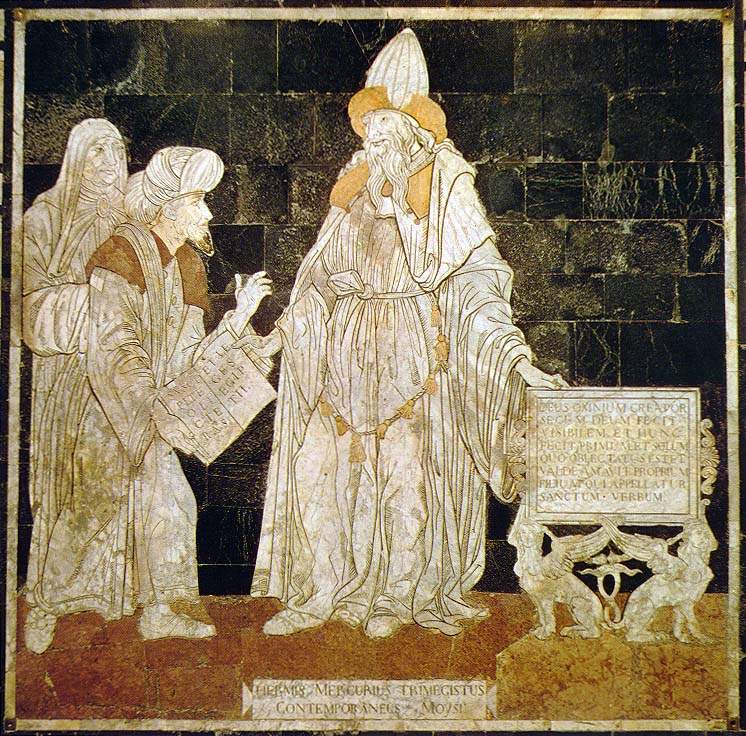

No comments:
Post a Comment